


Pakistan not among Asia’s fastest-growing economies in 2026
By Our Correspondent
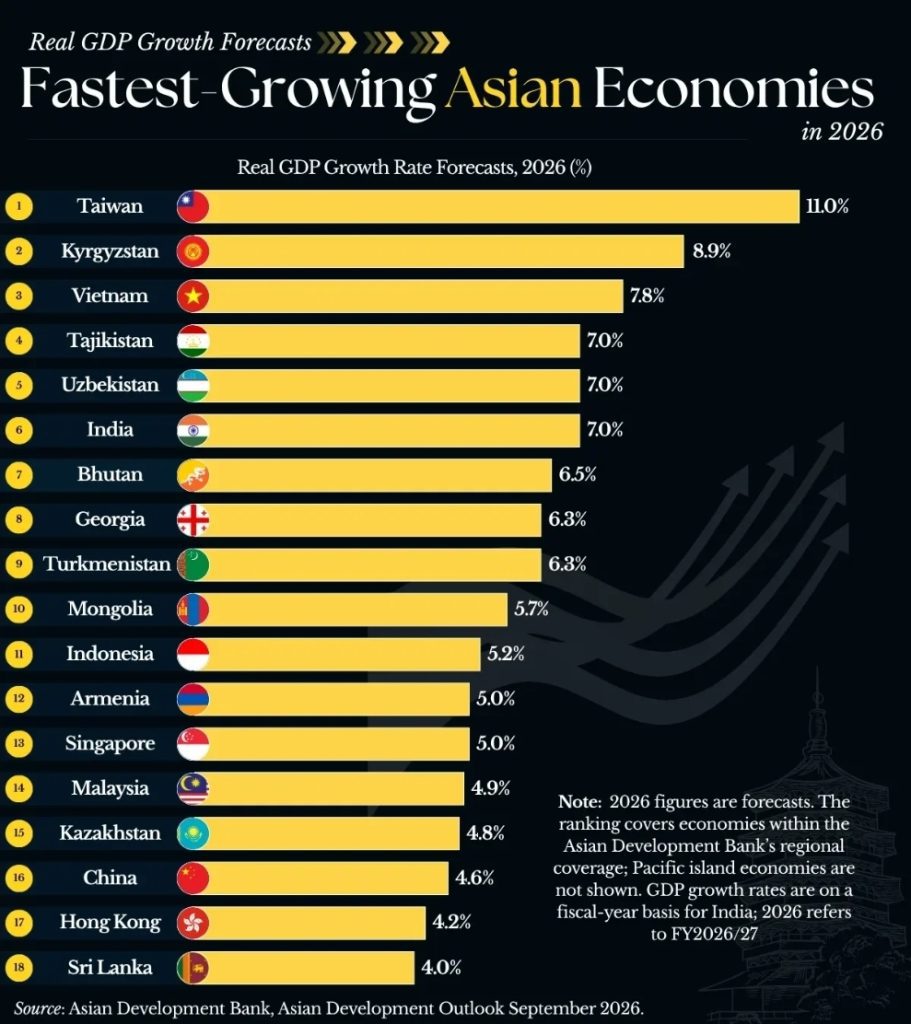
ISLAMABAD — Pakistan is absent from a ranking of 18 Asian economies projected to record the fastest real gross domestic product (GDP) growth in 2026, highlighting the country’s challenge of accelerating economic expansion amid stronger growth forecasts for several regional economies.
https://www.visualcapitalist.com/cp/ranked-the-fastest-growing-asian-economies-in-2026/
The ranking, published by Visual Capitalist and based on forecasts attributed to the Asian Development Bank’s (ADB) September 2026 Asian Development Outlook, places Taiwan at the top with projected growth of 11%, followed by Kyrgyzstan at 8.9% and Vietnam at 7.8%.
Tajikistan, Uzbekistan and India are each projected to grow by 7%, while Bhutan is forecast to expand by 6.5%. Georgia and Turkmenistan follow at 6.3% each.
Indonesia is projected to grow by 5.2%, while Singapore is forecast at 5%. Malaysia, Kazakhstan, China, Hong Kong and Sri Lanka also feature in the ranking, with projected growth rates ranging from 4% to 4.9%.
Pakistan does not appear among the 18 economies included in the infographic. However, the graphic represents a selected group of economies rather than a comprehensive ranking of every Asian country.
Pakistan’s economic growth outlook
The ADB forecasts Pakistan’s GDP growth at 3.7% in both FY2026 and FY2027, indicating that economic expansion is expected to remain moderate. The country’s economy grew by 3.7% in the fiscal year ended June 30, 2026, supported by improving credit conditions and a broad-based recovery. (Asian Development Bank)
The projections underline the importance of strengthening domestic production, encouraging private investment and expanding export capacity to support more sustained economic growth.
A faster-growing economy can generate employment, increase household incomes and expand business opportunities. However, maintaining growth over the longer term requires investment in productive sectors, improvements in infrastructure and policies that encourage businesses to expand.
For Pakistan, the challenge is to translate economic stabilisation into stronger industrial activity and a broader recovery that benefits businesses and households.
Investment and exports remain key
Improving export competitiveness will be important for Pakistan as it seeks to accelerate economic growth and strengthen its position in international markets.
High production costs, energy expenses, taxation and access to financing are important considerations for businesses deciding whether to expand operations or invest in new capacity.
A more predictable business environment, improved access to credit and investment in modern production technologies could help domestic industries increase productivity and compete more effectively.
Small and medium-sized enterprises also have an important role in economic development. Better financing opportunities and stronger links with larger manufacturers could enable smaller businesses to expand production, create jobs and contribute to exports.
Pakistan could also benefit from greater investment in value-added manufacturing, information technology, engineering goods and agricultural processing. Diversifying exports would help reduce dependence on a narrow range of products and markets.
Inflation presents another challenge
Economic growth must also be considered alongside inflation and the cost of living.
The ADB estimates that Pakistan’s inflation averaged 7.1% in FY2026 and forecasts it will rise to 8.3% in FY2027. Higher energy and import costs could place additional pressure on businesses and consumers. (Asian Development Bank)
Rising production and transportation expenses can affect industrial competitiveness, while higher household expenditure can limit purchasing power.
Maintaining price stability while encouraging investment and economic activity will therefore remain an important policy challenge.
Regional growth offers lessons
The growth forecasts show that Asian economies are benefiting from different sources of economic expansion.
Taiwan’s projected growth is closely associated with demand for semiconductors and technology exports linked to artificial intelligence. Vietnam’s performance reflects manufacturing, exports and domestic demand, while investment and services exports are among the factors supporting India’s growth outlook. (Visual Capitalist)
These economic models cannot be transferred directly to Pakistan, but they illustrate the importance of productivity, investment and integration into international markets.
For Pakistan, strengthening industrial capacity, improving workforce skills and encouraging innovation could help create a more competitive economy.
The road ahead
Pakistan’s absence from Visual Capitalist’s list of 18 selected Asian economies highlights the country’s challenge of accelerating growth, rather than establishing its position in a comprehensive ranking of every Asian economy.
The ADB’s forecasts indicate that Pakistan’s economy is continuing to expand, but stronger and more sustainable growth will be needed to create employment, improve living standards and support long-term development.
Expanding exports, attracting productive investment, improving business conditions and strengthening industrial competitiveness will be important to achieving that objective.
Source: Asian Development Bank, Asian Development Outlook, September 2026. The ranking of selected economies was published by Visual Capitalist on Oct. 7, 2026. (Visual Capitalist)