



By Our Correspondent
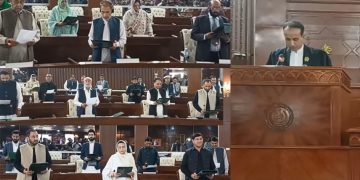
GILGIT — The newly elected members of the Gilgit-Baltistan Assembly took oath in Gilgit on Monday, marking the formal beginning of the legislative term following recent elections in the region.
The oath-taking ceremony was held during the inaugural session of the Assembly and was administered by outgoing Speaker Nazir Ahmed Advocate, who oversaw the proceedings in accordance with parliamentary tradition.
Following the oath of the members, the Assembly proceeded to elect its Speaker and Deputy Speaker. Pakistan Peoples Party’s (PPP) Imran Nadeem was elected unopposed as Speaker of the Gilgit-Baltistan Assembly, reflecting a consensus among parliamentary groups.
Soon after his election, outgoing Speaker Nazir Ahmed Advocate administered the oath of office to Imran Nadeem, formally transferring the responsibilities of the Speaker’s chair to the newly elected presiding officer.
In a similar development, Malik Kifayat-ur-Rehman of the Pakistan Muslim League-Nawaz (PML-N) was elected unopposed as Deputy Speaker of the Assembly. The position was filled without contest, indicating broad political agreement among the members of the House.
Speaker Imran Nadeem subsequently administered the oath to Malik Kifayat-ur-Rehman, completing the formation of the Assembly’s top parliamentary offices.
Outgoing Speaker Nazir Ahmed Advocate congratulated all newly elected members on assuming their responsibilities and expressed hope that the Assembly would function in accordance with democratic principles and public expectations.
He also acknowledged the importance of cooperation among political parties in ensuring smooth legislative functioning and effective governance in Gilgit-Baltistan.
The newly constituted Assembly is expected to take up key administrative and legislative matters in the coming sessions, including governance priorities, development projects, and regional policy issues.
Political observers note that the unopposed elections for both Speaker and Deputy Speaker suggest a degree of political consensus among major parties represented in the House, at least at the initial stage of the legislative term.
Gilgit-Baltistan’s Assembly plays a crucial role in local governance, particularly in legislation related to development, education, infrastructure, and administrative affairs in the region.
With the new leadership in place, attention is now expected to shift towards the formation of committees and the early legislative agenda of the House.
The smooth and unopposed election of key parliamentary positions indicates early-stage political cooperation, which may help ensure stability in the Assembly’s functioning.
The formation of leadership in the Assembly allows legislative work to formally begin, enabling decision-making on governance and development priorities in Gilgit-Baltistan.
Future sessions are expected to focus on committee formation, budgetary matters, and regional development policies, while political dynamics may evolve as the House begins full legislative activity.
Gilgit-Baltistan remains an important region in Pakistan’s governance structure, and the functioning of its Assembly plays a significant role in addressing local administrative and developmental needs within the broader national framework.


