



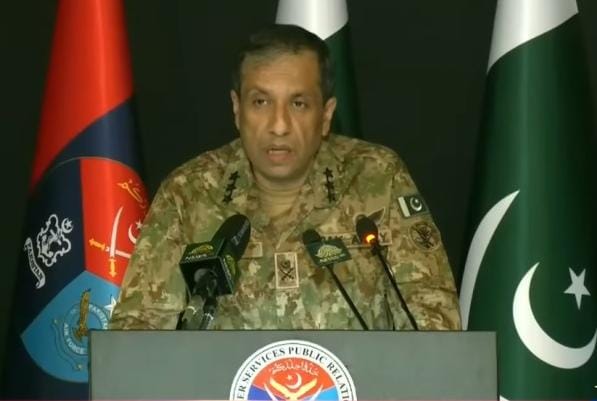
By Our Correspondent
RAWALPINDI: Director General of Inter-Services Public Relations (ISPR) Lieutenant General Ahmed Sharif Chaudhry on Friday rejected claims that the security environment in Balochistan was deteriorating, saying terrorists and their backers were attempting to create a misleading perception through coordinated violence and propaganda.
Addressing a comprehensive press conference on the country’s security situation, the military spokesperson said Pakistan’s security forces had carried out 40,348 intelligence-based operations (IBOs) so far this year, with more than 31,000 conducted in Balochistan alone.
He said security agencies had eliminated 2,084 confirmed terrorists during 2026, describing it as the highest average rate of militant neutralisation in the country’s history, with nearly 10 terrorists killed every day.
According to the DG ISPR, 3,145 terrorism-related incidents have been recorded nationwide this year, including 1,971 in Khyber Pakhtunkhwa, 1,148 in Balochistan, and 26 in other parts of Pakistan.
He said 819 Pakistanis had embraced martyrdom in terrorist attacks during the year, including 303 military personnel, 194 police and civil armed forces officials, and 322 civilians.
The military spokesperson also disclosed that 28 suicide attacks had taken place in 2026, alleging that most of them involved Afghan nationals or individuals linked to Afghanistan’s security apparatus.
Lt Gen Chaudhry maintained that Pakistan’s counterterrorism strategy had become increasingly proactive, with security forces now conducting nearly 200 intelligence-based operations every day.
Explaining the rise in terrorist incidents, he said militant organisations had intensified attacks after failing to achieve their broader objectives, while Pakistan had adopted a firm policy of rejecting negotiations or appeasement with armed groups.
“There is no space for compromise with terrorists. Those who challenge the writ of the state will either submit to the Constitution and the law or face decisive action,” he said.
Turning to Balochistan, the DG ISPR argued that the province’s challenges stemmed from entrenched feudal structures, vested political interests, foreign interference and organised propaganda rather than a collapse of security.
He alleged that certain influential groups sought to preserve the existing power structure while external actors exploited local grievances to undermine stability and obstruct development projects.
The military spokesperson also defended the state’s response to the issue of missing persons, saying the Commission of Inquiry on Enforced Disappearances had disposed of the vast majority of reported cases, with thousands of individuals returning home or being located through legal processes.
He further stated that terrorists were increasingly using social media videos of attacks to amplify fear and create the impression that the province was slipping out of government control.
Providing an overview of the security situation in Balochistan, Lt Gen Chaudhry said terrorists had killed 178 civilians, abducted 55 people, damaged roads and bridges at 24 locations, carried out 60 arson attacks, and committed 47 incidents of looting this year. Police and Levies personnel were also targeted in 105 separate attacks, he added.
Reaffirming Pakistan’s commitment to restoring lasting peace, the DG ISPR said security forces would continue intelligence-driven operations while strengthening law enforcement institutions and protecting development initiatives across Balochistan.


