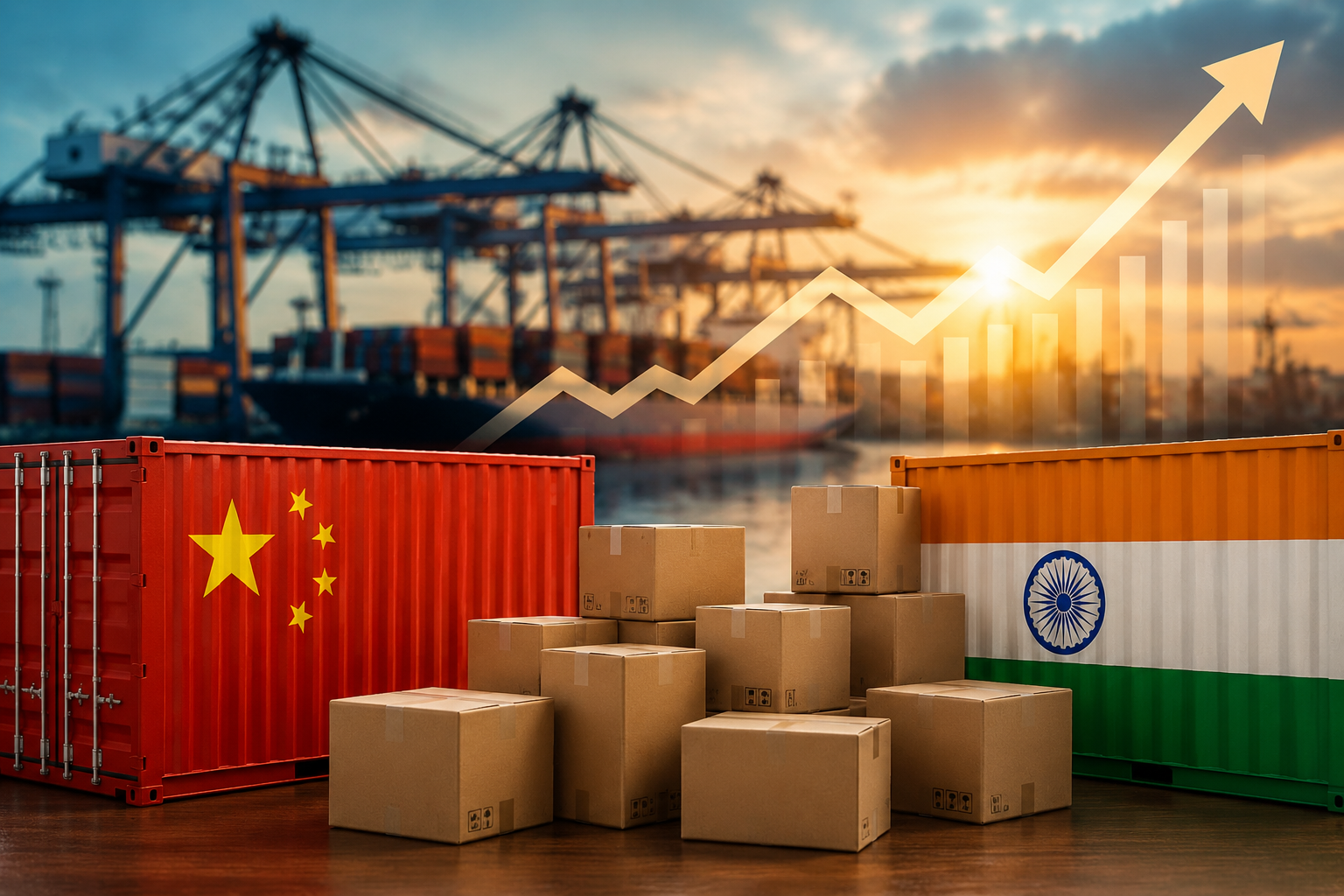
NEW DELHI (Web Desk) – India’s trade relationship with China has expanded sharply in the first half of 2026, with imports from its largest trading partner rising to nearly $80 billion, while Indian exports to China also recorded significant growth, according to trade data released by Chinese customs authorities.
China’s exports to India increased by 21.8% during January-June 2026 to reach $79.41 billion, compared with the same period last year, while India’s exports to China climbed by 37.2% to $12.31 billion, reflecting stronger bilateral trade activity between the two Asian economies.
The rise pushed total India-China trade during the first six months of 2026 to $91.72 billion, marking a growth of around 23.6% compared with the previous year. However, the increase in imports remained far higher than exports, resulting in a widening trade deficit for India.
India’s trade deficit with China stood at approximately $67.1 billion during the period, highlighting New Delhi’s continued concerns over its dependence on Chinese manufactured goods, machinery, electronics, and industrial inputs.
The surge in imports comes despite years of Indian efforts to reduce reliance on Chinese supplies through initiatives such as domestic manufacturing incentives and supply-chain diversification programmes. Analysts say China remains a key source of critical components required by India’s fast-growing manufacturing sectors, including electronics, telecommunications, pharmaceuticals, solar equipment and machinery.
Indian officials have repeatedly argued that improving market access for Indian products in China is essential to correcting the trade imbalance. New Delhi has sought greater opportunities for exports of pharmaceuticals, information technology-related services, agricultural products and other goods into the Chinese market.
The growth in Indian exports during the first half of 2026 was supported by higher shipments of selected commodities and industrial products, but experts caution that the overall structure of trade remains tilted heavily in China’s favour. Most Indian exports to China continue to be concentrated in sectors such as chemicals, minerals, agricultural commodities and intermediate goods, while imports include a wide range of finished products and high-value manufacturing equipment.
The latest figures come at a time when India and China have been attempting to stabilise economic ties after years of political and border-related tensions. Although strategic competition between the two countries remains intense, trade links have continued to expand due to the size of both economies and their deep integration in regional supply chains.
India’s broader trade figures also showed strong import growth during the April-June period of fiscal year 2026-27. Government data indicated that merchandise imports rose significantly during the quarter, reflecting increased domestic demand and higher purchases of industrial inputs.
Economic experts say the challenge for India is not only reducing the trade deficit but also increasing domestic production capacity in sectors where Chinese companies currently dominate. They argue that expanding manufacturing capabilities and moving towards higher-value exports would be crucial for improving India’s position in global trade.
Meanwhile, China continues to benefit from strong external demand for its manufactured goods. Recent Chinese trade data showed robust export performance in 2026, supported by technology products, artificial intelligence-related equipment and automobiles.
The latest India-China trade figures suggest that despite geopolitical differences, economic interdependence between the two neighbours remains strong. For India, the priority will be balancing access to affordable Chinese products with efforts to strengthen domestic industries and expand exports to achieve a more sustainable trade relationship.