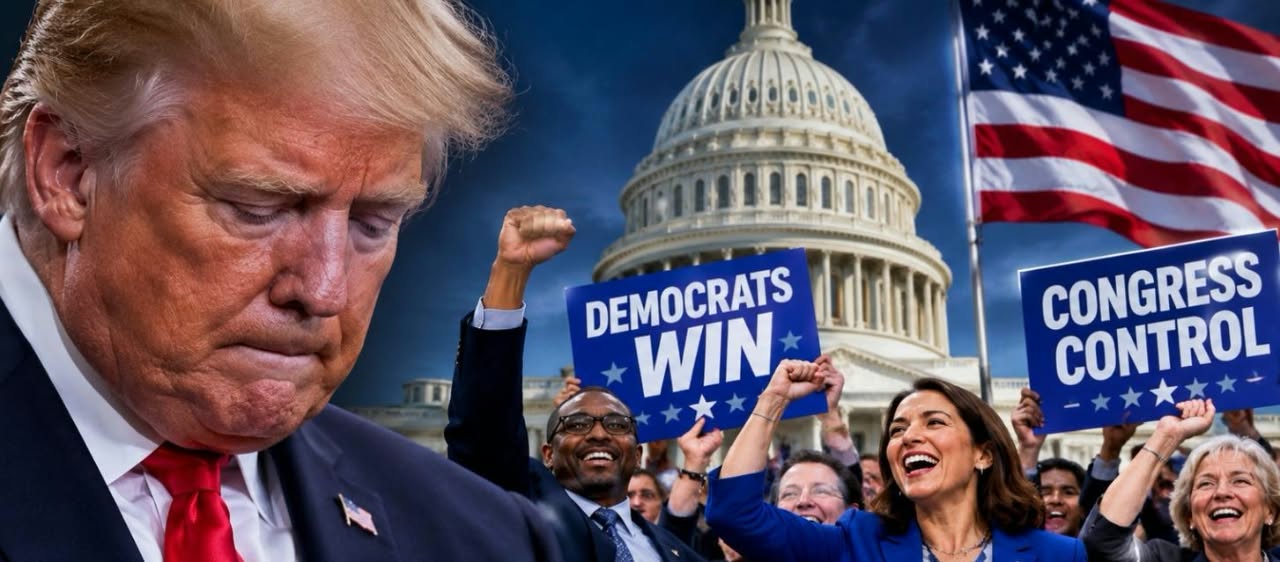
Democrats seize Congress in stunning rebuke to Trump as Republicans suffer historic defeat
25-word summary: Democrats captured both chambers of Congress, delivering a major setback to Trump amid voter anger over inflation, tariffs, the Iran war and his administration's policies.
WASHINGTON (Web Desk) — US Democrats have seized control of both chambers of Congress in a sweeping midterm election victory, dealing a major political blow to President Donald Trump and threatening to derail his legislative agenda during the final two years of his presidency.
The Democratic Party captured the House of Representatives and the Senate, overturning Republican majorities and delivering one of the most significant electoral setbacks of Trump’s second term. The results reflected growing voter dissatisfaction with the administration’s economic policies, rising living costs, trade tariffs and military involvement in the war against Iran.
The outcome represents a sharp reversal for Trump, who had urged Republican supporters to treat the midterm elections as a referendum on his presidency. Despite his efforts to mobilise the Republican base, candidates aligned with his political movement suffered defeats in several traditionally conservative states.
Democrats made significant gains in Texas, Kansas, Iowa, Ohio, South Carolina, North Carolina and Maine, breaking Republican strongholds and reshaping the political balance in Washington.
In Kansas, Democrat Adam Hamilton won a Senate seat, marking the first time in nearly a century that the state had elected a Democratic senator. In Texas, Democrat James Talarico secured a Senate victory, while Gina Hinojosa defeated Republican incumbent Greg Abbott in the gubernatorial race, ending decades of Republican dominance in the state’s governorship.
Democrats also secured a historic victory in Michigan, where Abdul El-Sayed defeated Republican Mike Rogers to become the first Muslim elected to the US Senate.
The results exposed the vulnerability of Trump’s political influence, particularly in states that had strongly supported him in the 2024 presidential election. Several districts that Republicans had expected to retain comfortably shifted towards Democratic candidates.
The economic situation emerged as a major factor behind the Republican losses. Voters expressed frustration over the high cost of living, while Trump’s tariff policies and the economic consequences of the Iran conflict added to public dissatisfaction.
The war against Iran, which has contributed to soaring fuel prices, became another significant political liability for the administration. Democrats highlighted the economic consequences of the conflict and questioned the government’s handling of international developments.
According to exit polling cited by US media, many voters wanted Congress to exercise stronger oversight of the presidency. The election results therefore reflected not only dissatisfaction with individual policies but also public demand for greater institutional checks and balances.
The Republican defeat also raises questions about Trump’s ability to maintain political control over his party. Although he remains a dominant figure in Republican politics, the scale of the losses could encourage internal disagreements and intensify discussions about the party’s future leadership ahead of the 2028 presidential election.
Trump, however, sought to distance himself from the electoral setback. In comments to US media, he congratulated Democrats, saying they had performed well, but rejected the suggestion that the results represented a personal defeat.
He also blamed Republican candidates for their poor performance and argued that the party would have secured a landslide victory had he personally been on the ballot.
Despite his remarks, the change in congressional control will significantly complicate his administration’s remaining legislative agenda.
Democrats are expected to use their new majority to launch investigations into the administration’s handling of the Iran war, immigration enforcement and allegations of corruption. They will also have the power to block presidential appointments and challenge Republican-backed legislation.
The change is particularly significant in the Senate, where Democratic control could prevent Trump from securing confirmation of senior government officials and judicial nominees without support from opposition lawmakers.
House Democratic leader Hakeem Jeffries has emerged as a central figure in the party’s victory and could become the first Black speaker of the House when the new Congress convenes in January.
The election has also strengthened Democratic ambitions to challenge Trump’s political legacy and establish a stronger position ahead of the next presidential contest.
However, winning control of Congress does not automatically guarantee that Democrats will be able to reverse the administration’s policies. Trump retains presidential veto powers, while disagreements between the White House and Congress could produce legislative deadlock.
The midterm results nevertheless mark a major turning point in Trump’s second presidency. After beginning his term with Republican control of Congress, the president now faces an opposition-controlled legislature, greater scrutiny of his administration and mounting political pressure.
For Trump, the election has transformed the political landscape of Washington, turning what was expected to be an opportunity to consolidate Republican power into a significant challenge to his leadership and policy agenda.