


By Commerce Reporter
LAHORE, December 31 – Secretary, Trade Development Authority of Pakistan (TDAP), Shahryar Taj, said that stable and clear policies along with active leadership from provincial governments are essential for increasing Pakistan’s exports and promoting industries. He mentioned that TDAP organizes multiple flagship events and international exhibitions across the country to create new opportunities for industrialists and exporters.
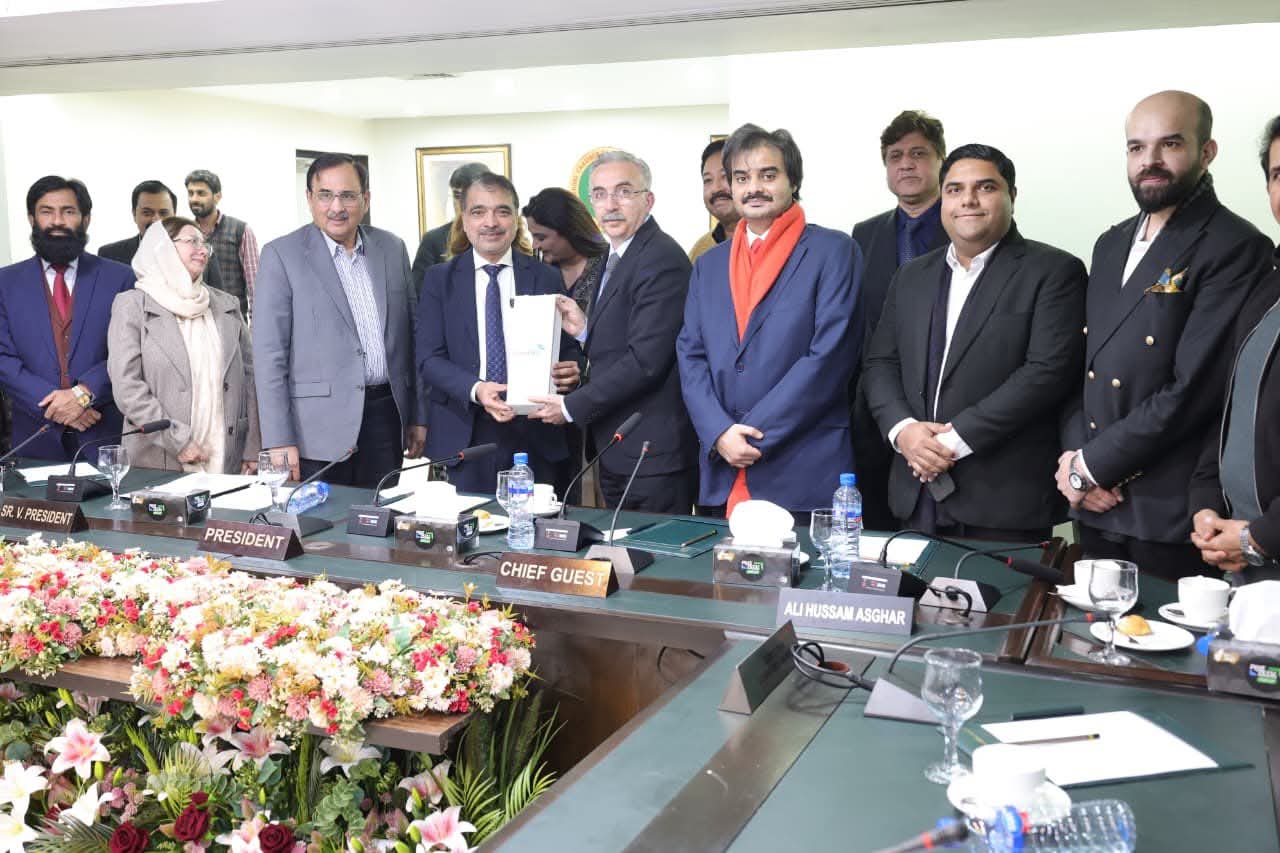
He was speaking at an event held at the Lahore Chamber of Commerce and Industry (LCCI). LCCI President Faheem ur Rehman Saigol delivered the welcome address. Senior Vice President Tanveer Ahmad Sheikh, Vice President SAARC Chamber Mian Anjum Nisar, TDAP Director General Rafia Syed, former LCCI President Muhammad Ali Mian, formwe senior Vice President Ali Hassam Asghar and executive committee members including Firdous Nisar, Syed Salman Ali, Amir Ali, Asif Malik, Rana Shoban Akhtar, and Abdul Majeed were also present.
Speaking at the occasion, LCCI President Faheem ur Rehman Saigol said that increasing exports and promoting the manufacturing sector is crucial to strengthen the country’s economy. He highlighted that in the first five months of the fiscal year, the current account deficit has reached around $15.5 billion, and if this trend continues, it could reach $36 billion by the end of the fiscal year, which is extremely concerning.
He emphasized that Pakistan can increase its exports through market and product diversification, value addition, and promoting startups. He added that providing facilities for SMEs, startups, and the IT sector is a necessity, and producing products according to international standards can boost global demand.
He noted that Pakistan’s food exports, cotton production, and quality have declined, with long-fiber cotton being exported while lower-quality cotton remains in the local market. He stressed that there is huge potential in textiles, livestock, food processing, and halal sectors, which can help increase exports.
Faheem ur Rehman Saigol further said that export growth is not possible without product and market diversification. Relying only on Europe and the U.S. is not enough; African and Central Asian markets should also be tapped.
He mentioned that Bangladesh has focused on value-added garments and increased its exports to $60 billion, while Pakistan remains at $31 billion.
He warned that a $15 billion trade deficit could put pressure on the currency, leading to devaluation and inflation. Therefore, a favorable environment for exports must be created collectively, and misuse of SROs and tax exemptions should be stopped so that local industries and exporters benefit.
He called for initiatives in startups, IT, and the blue economy to boost Pakistan’s exports. He appreciated Rafia Syed’s efforts, noting her close coordination with LCCI and quick response.
TDAP Secretary Shahryar Taj said that TDAP organizes annual flagship events in textiles, food & agriculture, health, engineering, and minerals. He shared results of the recent Food and Agriculture Exhibition in Karachi, which featured nine halls, 370 companies, 850 foreign buyers, and generated $730 million in business over three days.
He added that the target for horticulture and agriculture exports is $2 billion in the next three years, and a major event is being prepared in Lahore under the leadership of the Punjab government. He stressed that not only Punjab, but also Balochistan, Sindh, and Khyber Pakhtunkhwa should take a leading role.
He also mentioned plans for a “Made in Pakistan” exhibition and fashion show in Bangladesh, creating new opportunities for Pakistani companies, especially women entrepreneurs. Around 90% of the costs were covered by TDAP, and the remaining 10% by participating companies.
Shahryar Taj stated that global demand for Pakistani products remains strong, and focusing on quality, certification, and standards can further increase exports. He invited participants to cooperate with TDAP in all trade promotion initiatives and said that TDAP stands with LCCI in every effort to promote trade.