Iqbal’s spiritual philosophy offers a path to Muslim unity and revival
Allama Iqbal's philosophy of faith, knowledge and collective identity offers the Muslim Ummah a roadmap to overcome divisions and reclaim its global dignity.
The history of humanity is, in essence, a continuous journey in search of divine guidance. From the creation of mankind, when Allah Almighty bestowed His guidance upon Prophet Adam (peace be upon him), this sacred mission continued through a succession of prophets until it reached its ultimate perfection with the advent of Prophet Muhammad (peace and blessings be upon him), the Seal of the Prophets. With his departure from this world, the institution of prophethood came to its completion, but the light of divine guidance did not diminish.
It continued to illuminate human hearts through the teachings of the Holy Quran, the Sunnah and the lives of those chosen servants of Allah who devoted themselves to spiritual enlightenment, moral excellence and the awakening of humanity. Among such distinguished personalities, Allama Muhammad Iqbal occupies an exceptional place.
Iqbal was not merely a poet whose verses appealed to the imagination; he was a visionary who sought to restore the spiritual consciousness, intellectual confidence and collective dignity of the Muslim Ummah. His poetry was a call to awaken a nation that had gradually lost faith in its own potential and had become accustomed to political subjugation, intellectual stagnation and spiritual indifference. His message transcended geographical boundaries, reaching Muslims from the shores of the Nile to the valleys of Kashgar, reminding them that their strength lay not in territorial possessions or political arrangements alone, but in their common faith, historical identity and spiritual bond.
The idea of Pakistan was deeply rooted in Iqbal’s political and philosophical vision. His Allahabad Address of 1930 provided a significant intellectual foundation for the political aspirations of the Muslims of the subcontinent. He envisaged a political and social order in which Muslims could organise their collective existence in accordance with their religious, cultural and civilisational identity. Although he did not live to witness the emergence of Pakistan, his intellectual contribution helped shape the aspirations that ultimately culminated in the establishment of an independent homeland in 1947. In this sense, Pakistan represents not merely a geographical achievement but also an enduring expression of a vision that sought dignity, identity and freedom for the Muslims of the subcontinent.
Through his remarkable poetic collections, Iqbal attempted to revive the relationship between man and his Creator. His celebrated compositions, Shikwa and Jawab-e-Shikwa, hold particular significance in this regard. In Shikwa, he gives eloquent expression to the anguish of a Muslim community questioning its declining fortunes, while Jawab-e-Shikwa offers a profound spiritual response, reminding Muslims that the restoration of their former glory requires faith, unity, sacrifice, discipline and action. These works were not simply poetic exchanges; they were an intellectual and spiritual dialogue intended to awaken a dormant nation and make it conscious of its responsibilities.
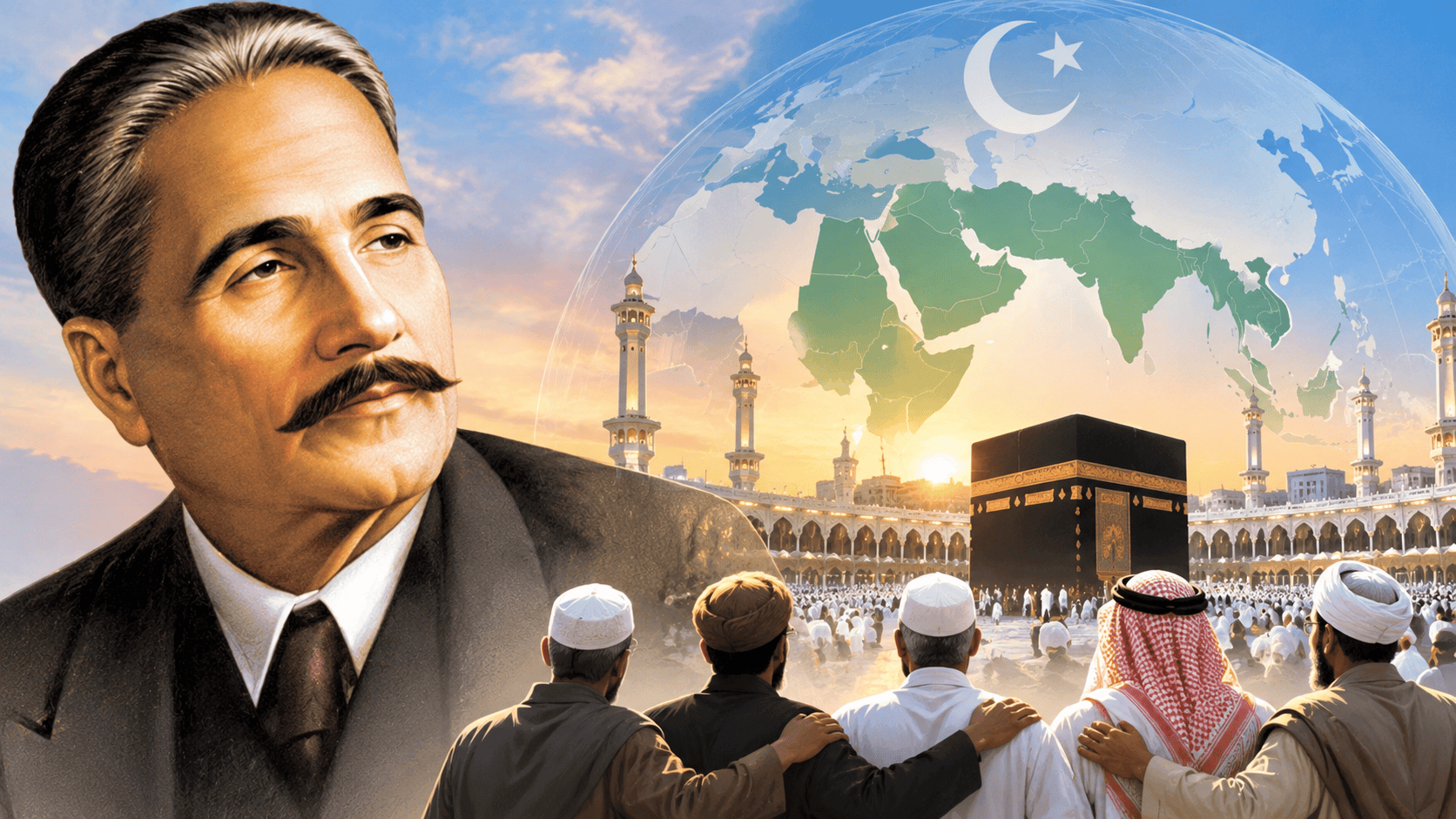
Perhaps one of Iqbal’s most enduring contributions was his insistence that the Muslim world must rise above geographical, linguistic, racial and political divisions. His memorable verse, “United by the guardianship of the Sacred Sanctuary, Muslims—from the shores of the Nile to the lands of Kashgar—are one,” conveys a timeless message of fraternity. The unity he advocated was neither an artificial political arrangement nor a demand for uniformity among Muslim societies. Rather, it was a call for shared purpose, mutual respect, collective responsibility and solidarity founded upon the common spiritual heritage of Islam.
Regrettably, the contemporary Muslim world presents a picture that would have deeply troubled Iqbal. Despite possessing enormous human resources, strategic locations, natural wealth and considerable economic potential, Muslim countries remain divided by political rivalries, regional conflicts and competing strategic interests. Tensions in the Gulf, instability in the Middle East and the continuing suffering of innocent people in different parts of the Muslim world demonstrate how far the Ummah remains from the collective strength that Iqbal envisioned. The tragedy is not merely that Muslim nations disagree; it is that their disagreements frequently prevent them from responding collectively to challenges that threaten their common interests and shared future.
In these circumstances, Pakistan carries a particular responsibility. Established through a movement inspired by the intellectual and political aspirations of Muslim identity, it must continue to serve as a voice for reconciliation, cooperation and solidarity within the Muslim world. Its diplomatic engagement, efforts to reduce regional tensions and initiatives for dialogue among Muslim countries should be viewed in the light of Iqbal’s philosophy. The Pakistani leadership’s efforts to promote understanding between Saudi Arabia and Iran, strengthen relations among Muslim nations and encourage peaceful solutions to regional disputes reflect an important dimension of this vision. Such endeavours require consistency, wisdom and collective support, for lasting peace cannot be achieved through declarations alone; it demands sincerity, confidence-building and a willingness to place the greater interests of the Ummah above narrow political considerations.
Iqbal’s message also places a responsibility upon the intellectuals, scholars, political leaders and younger generations of the Muslim world. Unity cannot be secured merely through emotional expressions or ceremonial gatherings. It must be cultivated through education, scientific advancement, economic cooperation, institutional strength, social justice and the promotion of tolerance. A community that neglects knowledge, abandons moral discipline and allows internal divisions to weaken its foundations cannot reclaim its rightful place in the world simply by recalling its glorious past.
The spiritual legacy of Allama Muhammad Iqbal therefore remains as relevant today as it was during his lifetime. His poetry continues to awaken consciences, his philosophy continues to challenge intellectual complacency, and his vision continues to inspire those who believe that the Muslim Ummah can overcome its divisions and reclaim its dignity. His enduring message is that nations are not transformed by wishes alone; they rise when faith becomes conviction, conviction inspires action, and action is guided by wisdom and collective purpose.
Iqbal’s greatness lies not only in what he wrote or what he envisioned for Pakistan, but also in the spiritual confidence he sought to restore among Muslims. His legacy is a continuing invitation to rediscover the essence of Islam, strengthen the bonds of brotherhood and serve humanity with courage, compassion and wisdom. As long as the Muslim world continues to seek spiritual awakening and collective uplift, the light of Iqbal’s thought will remain alive, reminding generations that the destiny of the Ummah lies in unity, knowledge, faith and purposeful action.