


By Asim Shahzad
LAHORE, Pakistan — HomeNet Pakistan has called for legal recognition, fair wages, social protection and improved working conditions for women home-based workers at a convention marking International Home-Based Workers Day 2026 and 25 years of the workers’ movement in Pakistan.
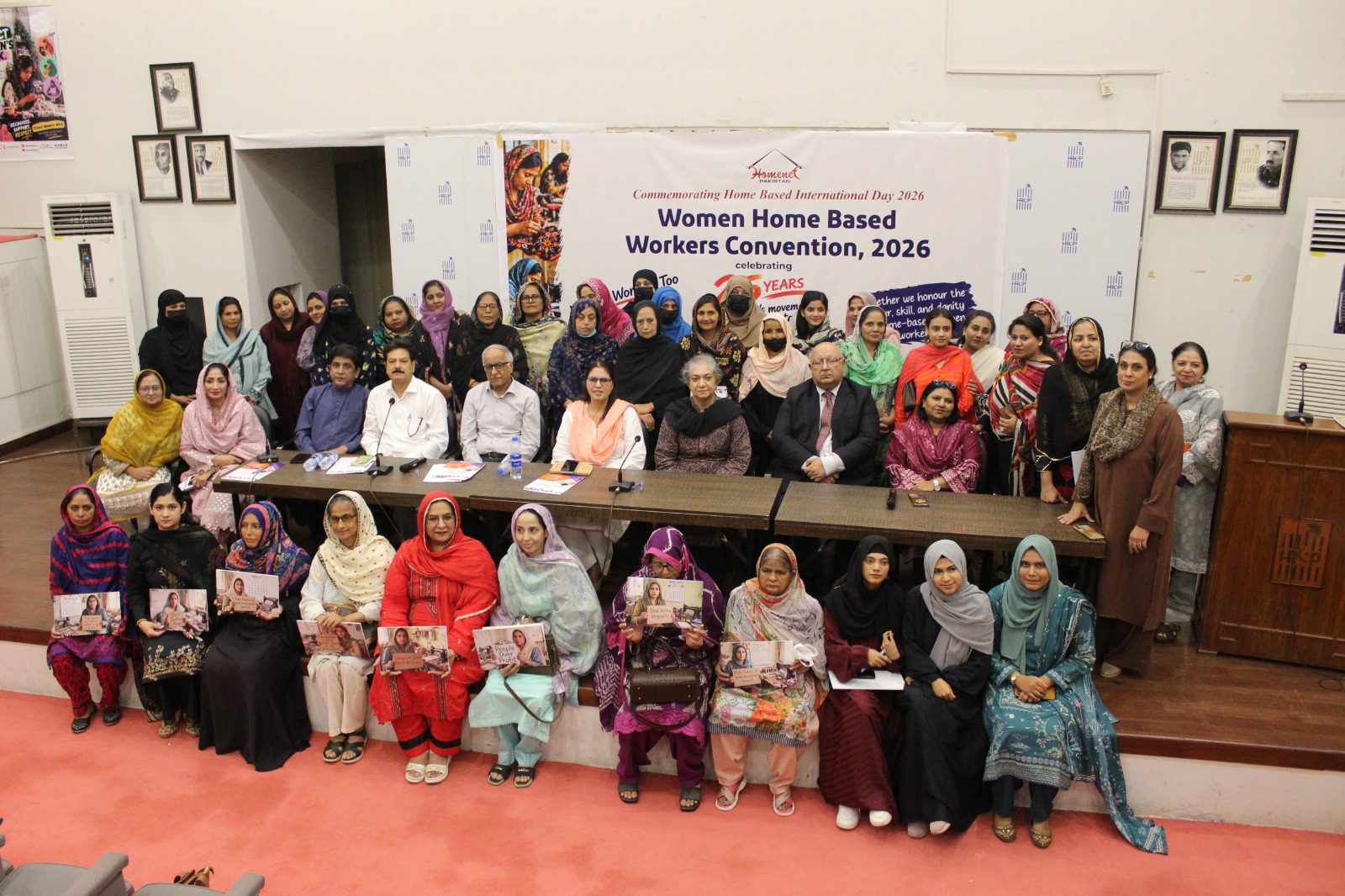
Held at the Human Rights Commission of Pakistan (HRCP) Auditorium in Lahore under the theme “We Are Workers Too,” the Women Home-Based Workers Convention Punjab brought together lawmakers, government officials, labour experts, employers’ representatives, human rights institutions, financial organisations, academics and civil society representatives to discuss challenges facing women home-based workers.
Participants stressed the need to implement existing provincial legislation, improve worker registration, ensure fair remuneration and expand access to healthcare, social security and other applicable benefits.
In her welcome address, Ume Laila Azhar, executive director of HomeNet Pakistan, said working from home should not exclude women from labour rights, decent wages or social protection.
She noted that all four provinces had enacted legislation concerning home-based workers, but emphasised the need for effective implementation, accessible registration systems, fair remuneration and stronger institutional accountability.
Azhar said women home-based workers contributed to global supply chains and deserved formal recognition and protection.
In her inaugural address, Jahan Ara Wattoo, vice chair of the Punjab Social Protection Authority (PSPA), highlighted the importance of inclusive social protection systems that reach vulnerable and marginalised workers, particularly women.
She called for improved access to government programmes, essential services and institutional support to strengthen women’s economic security and well-being.
Syeda Kalsum Haye, director general of Labour Punjab, emphasised recognising home-based workers as an integral part of the workforce and ensuring effective implementation of labour laws and policies.
She highlighted worker registration, fair wages, access to applicable social security benefits and stronger labour administration. She also encouraged workers to organise themselves and establish unions to strengthen collective representation and improve access to government schemes.
Haye stressed collaboration among government departments, employers and workers’ organisations to address implementation gaps and promote decent working conditions.
Call for international convention ratification
The convention also marked the 30th anniversary of the International Labour Organization’s Home Work Convention, 1996 (No. 177).
Participants signed a postcard calling on Pakistan to ratify the convention, which establishes international standards for protecting home-based workers.
MPAs Uzma Kardaar, Shagufta Faisal, Somia Atta and Farzana Abbas attended the event, highlighting the importance of political representation and legislative engagement in advancing women’s rights.
Irfan Mufti called for national, provincial and departmental action plans with measurable indicators, coordinated monitoring and transparent accountability.
Mohammad Waheed, representing the Punjab Commission on the Status of Women (PCSW), stressed the need for women’s representation in decision-making, clearly defined institutional responsibilities and practical implementation plans. He also highlighted the commission’s 1043 helpline for guidance on legal assistance and relevant services.
Muhammad Akram, representing the Employers’ Federation of Pakistan (EFP), called for fair remuneration, measures to address the gender pay gap and accessible district-level dispute resolution mechanisms to protect workers against exploitation.
He also appreciated Haye’s efforts to advance the Labour Code and strengthen labour rights.
Adeel Anwar of the Treaty Implementation Cell highlighted the importance of aligning policies with international human rights standards, while Muhammad Ali Mazari, regional director at the Ministry of Human Rights, emphasised coordinated efforts to promote recognition, protection and socioeconomic empowerment.
Ghulam Abbas Sipra, regional coordinator for Punjab at the National Commission for Human Rights (NCHR), stressed fundamental rights, dignity and access to justice.
Financial inclusion and skills development
Mohammad Tahir, senior chief manager for Financial Inclusion Support at the State Bank of Pakistan’s Banking Services Corporation, highlighted accessible banking, financial literacy and financial inclusion as important tools for helping women manage their earnings and participate in the formal economy.
Muhammad Imran of HBL Microfinance Bank emphasised the need for suitable financial services to support women’s businesses and economic empowerment.
Amir Aziz, director general of the Technical Education and Vocational Training Authority (TEVTA), highlighted vocational training and skills development.
Shahzad Bukhari, an entrepreneurship development expert, stressed business development, market access and digital skills, while Falahat Imran, former president of the Women’s Chamber of Commerce and Industry, called for greater support for women’s entrepreneurship and stronger market linkages.
Participants identified financial inclusion, vocational training, entrepreneurship and digital literacy as essential to improving women’s economic independence.
Labour experts Hanif Ramay and Dr Javed Gill called for stronger labour protections, fair wages, decent working conditions and effective implementation of existing laws.
Asif Nawaz, deputy director at the Punjab Employees Social Security Institution (PESSI), highlighted access to applicable healthcare and social security benefits for eligible workers while noting funding constraints.
Sajid Ali of AFWA stressed collective action, workers’ representation and advocacy for decent working conditions, while Dr Uzma Khan of Lahore College for Women University highlighted the importance of research, education and institutional collaboration.
Businesses urged to protect workers’ rights
Participants emphasised that businesses should respect human rights throughout their supply chains and provide accessible grievance mechanisms for workers facing exploitation or wage violations.
Discussions also covered the Sustainable Development Goals, particularly gender equality, decent work and climate action.
HomeNet Pakistan stressed the need for reliable data on home-based workers to ensure their contributions and challenges are reflected in official labour statistics and public policymaking.
Azhar summed up the issue by stating, “No Data = No Visibility; No Visibility = No Accountability.”
Provincial charter of demands presented
The convention concluded with the presentation of the Provincial Charter of Demands for Home-Based Workers by Fakhara Shakeel, Meimona, Azra, Sadaf and other representatives.
The charter called for:
-
Registration and legal recognition of home-based workers.
-
Fair wages and equal remuneration.
-
Access to applicable healthcare, Employees’ Old-Age Benefits Institution (EOBI) and social security benefits.
-
Accessible complaint and dispute resolution mechanisms.
-
Clearly defined departmental responsibilities and transparent monitoring.
-
Responsible business practices throughout supply chains.
-
Financial inclusion, vocational training, digital literacy and entrepreneurship opportunities.
-
Inclusion of home-based workers in official statistics and policymaking.
-
Gender equality and climate-resilient livelihood opportunities.