


Summary: Yemen’s Saudi-backed government has launched a major offensive against Houthi forces, with fighting intensifying around Bab al-Mandeb and Taiz amid growing regional and humanitarian concerns.
ADEN (Web Desk) – Yemen’s internationally recognised government has launched a major military offensive against Houthi forces, opening a new and potentially significant phase of the country’s long-running civil war as Saudi Arabia provides extensive air support.
Read also: Saudi Arabia condemns attacks on Jordan, calls for urgent regional de-escalation
The offensive, announced by the government on Sunday and expanded on Monday, aims to recapture territory held by the Iran-aligned Houthis, including areas around the strategically important Bab al-Mandeb Strait and the capital, Sanaa.
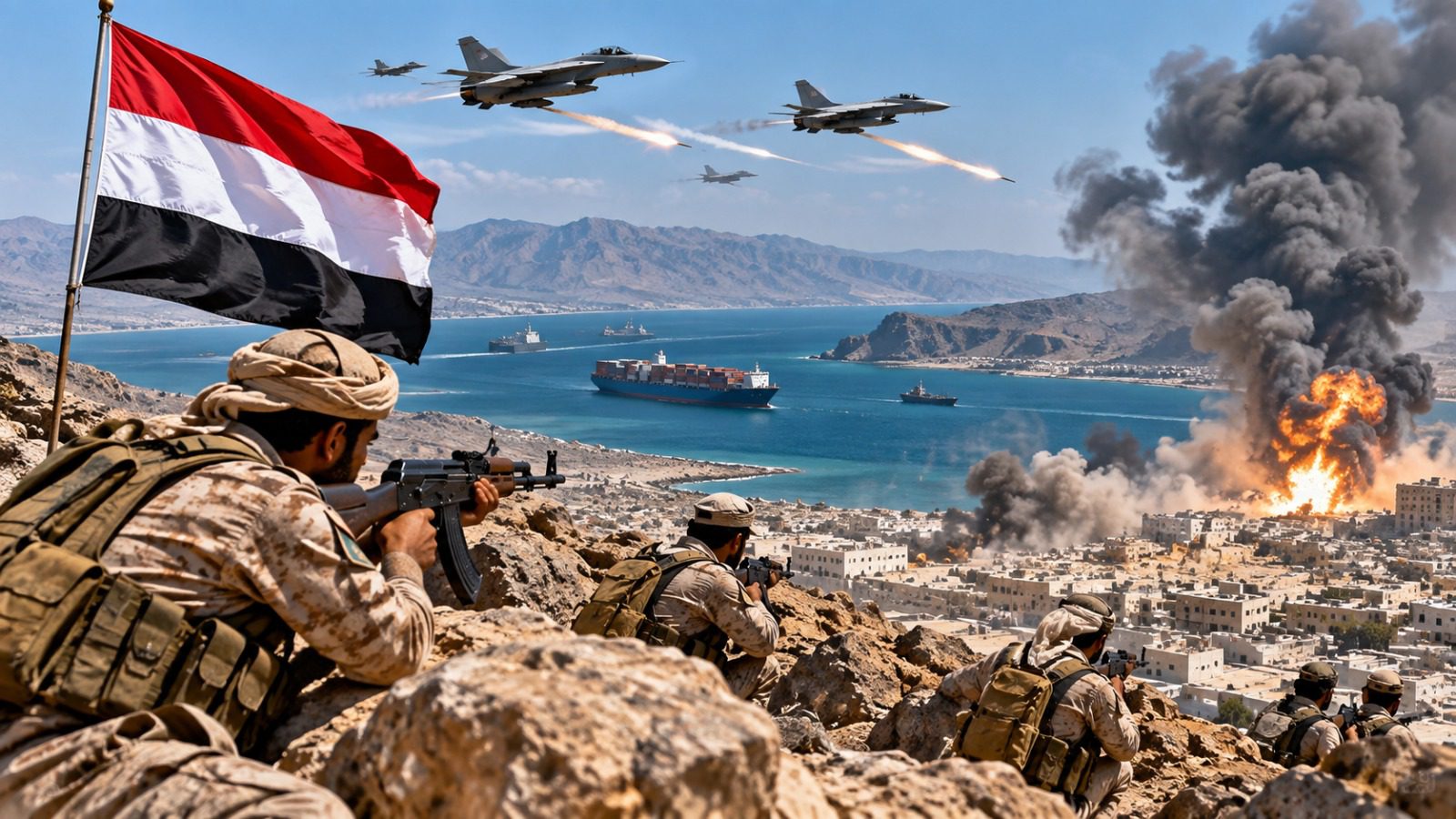
Yemeni government forces said they had advanced into the Dhubab district near the Bab al-Mandeb and captured key positions overlooking the strategic waterway. Government sources also claimed control of the Dhubab airstrip and said supply routes used by Houthi forces had been cut.
The battlefield claims could not be independently verified, and Houthi authorities have disputed reports of major government gains.
Saudi Arabia provides air support
Saudi Arabia has emerged as a key military supporter of the offensive. A Saudi-led coalition said it was providing air cover for Yemeni government forces operating on the ground.
Coalition spokesman Maj. Gen. Turki al-Malki said about 100 fighter jets were supporting the operation and that hundreds of Houthi targets had been struck. The scale of the reported air campaign underscores the importance Riyadh attaches to preventing Houthi control of territory along the Red Sea and the Bab al-Mandeb.
The Yemeni government has described the campaign as an effort to restore state institutions and reclaim territory controlled by the Houthis. President of Yemen’s Presidential Leadership Council Rashad al-Alimi has pledged to continue the military campaign.
The Houthis, formally known as Ansar Allah, have controlled Sanaa and large parts of northern and western Yemen since seizing the capital in 2014. Saudi Arabia intervened militarily in 2015 at the head of a coalition supporting Yemen’s internationally recognised government.
A UN-backed truce and subsequent de-escalation largely reduced the intensity of fighting from 2022, but the conflict has now returned to a much more dangerous phase. Defense News
Bab al-Mandeb becomes central battlefield
The Bab al-Mandeb Strait is one of the world’s most important maritime chokepoints. It connects the Red Sea with the Gulf of Aden and provides a major shipping route between Europe and Asia.
The latest fighting has therefore raised concerns well beyond Yemen. Any sustained disruption around Bab al-Mandeb could affect commercial shipping, energy supplies and global freight costs.
The strategic importance of the waterway has increased further because of wider instability in the Middle East and disruptions around the Strait of Hormuz. The renewed fighting in Yemen has consequently added another layer of uncertainty to already pressured international energy markets.
Houthis make gains around Taiz
While Saudi-backed government forces have launched their counteroffensive, Houthi forces have also made advances on another important front.
Military sources cited by Reuters said the Houthis had gained ground around Taiz and threatened routes linking the city with the southern coast. Taiz, Yemen’s third-largest city, has been a major frontline throughout the conflict.
The fighting around Taiz could potentially isolate government forces and further restrict access to civilians. Reports from the area have also highlighted shortages of fuel and other essential supplies. Reuters
The competing advances demonstrate the complexity of Yemen’s battlefield, where the internationally recognised government does not control a unified military force and several armed factions operate alongside government troops.
Humanitarian crisis deepens
The latest escalation is also worsening an already severe humanitarian crisis.
The UN migration agency said around 184,000 people had been displaced since fighting intensified again. The renewed violence has disrupted supply routes and increased pressure on communities already suffering from years of conflict and economic hardship.
Taiz is particularly vulnerable because of its strategic location and the concentration of civilians and government forces in and around the city. Reports of fuel shortages have added to concerns about access to basic necessities.
Humanitarian agencies face additional challenges as renewed fighting restricts movement and threatens vital roads and supply corridors.
Risk of wider regional escalation
The Yemen offensive is unfolding amid broader tensions involving Saudi Arabia, Iran and other regional powers. The Houthis have previously used missiles and drones against Saudi territory and have targeted shipping in and around the Red Sea.
The escalation therefore carries risks beyond Yemen’s borders. A prolonged battle around Bab al-Mandeb could affect international shipping at a time when other major Middle Eastern maritime routes are already facing disruption.
For now, the Saudi-backed Yemeni government says its campaign will continue until it can reclaim Houthi-held territory. The Houthis, meanwhile, retain significant military capabilities and continue to contest government advances.
The coming days will determine whether the offensive produces lasting territorial gains or develops into another prolonged phase of Yemen’s war.