



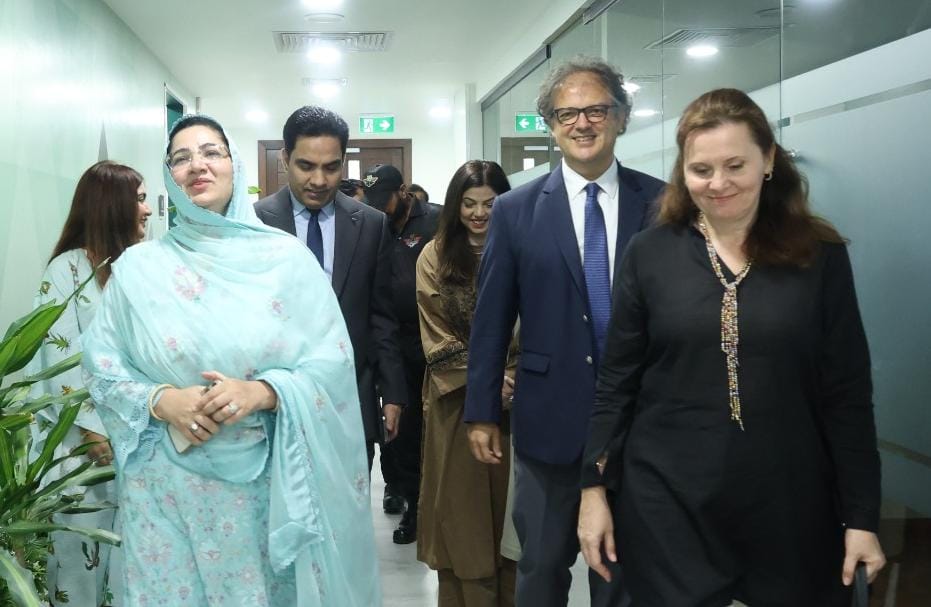
Pakistan and Türkiye explored cooperation on environmental protection and climate action as Punjab briefed Turkish officials on AI-based monitoring and anti-smog initiatives.
By Asim Shahzad
LAHORE: Pakistan and Türkiye have explored avenues for enhanced cooperation in environmental protection, climate action and sustainable development, with Turkish Consul General Mehmet Eymen Şimşek appreciating Punjab’s technology-driven initiatives to combat smog and air pollution.
The Turkish consul general, accompanied by his wife, Meltem Şimşek, met Environment Protection and Climate Change Department Secretary Silwat Saeed at the department’s Green Building in Lahore.
The meeting focused on strengthening institutional ties, sharing technical expertise and identifying opportunities for collaboration between Punjab and Turkish environmental institutions.
During a detailed briefing, Silwat Saeed outlined Chief Minister Maryam Nawaz Sharif’s vision for a cleaner, greener and climate-resilient Punjab. She highlighted government initiatives aimed at improving air quality, strengthening environmental governance and promoting sustainable development.
She briefed the Turkish delegation on the Punjab Climate Watch Hub, a technology-driven platform that combines environmental monitoring, air-quality forecasting and data-based decision-making. The department’s locally developed forecasting model uses ground-based monitoring and artificial intelligence to provide air-quality forecasts for Lahore, Faisalabad and other urban centres.
The delegation was also briefed about EcoBot, an AI-based citizen guidance initiative that provides air-quality information and practical advice during periods of increased pollution.
Highlighting the Green School Certification Programme, the secretary said the initiative had reached more than 26,000 schools across 41 districts, engaging approximately 7.6 million students and teachers.
The programme promotes environmental responsibility through waste management, water conservation, energy efficiency, plantation and air-quality education.
Silwat Saeed also explained the CM Green Credit Programme, which encourages citizens and communities to adopt environmentally responsible practices and contribute to sustainability through public participation.
A major part of the briefing focused on Punjab’s anti-smog strategy, covering industrial emissions, vehicular pollution, brick kilns, construction dust and agricultural residue burning.
The delegation was informed about thermal drone surveillance, enforcement operations, vehicular emissions scanning systems and remote-sensing devices installed at nine entry and exit points of Lahore to identify high-emitting vehicles.
The secretary said mandatory emission-control measures had been introduced for industries, while zigzag technology for brick kilns, anti-smog gun operations and expanded air-quality monitoring were also being used to tackle pollution.
She emphasised that the government was focusing on preventive measures throughout the year rather than limiting anti-smog efforts to the winter season.
Other initiatives discussed during the meeting included the Plastic-Free Punjab campaign, urban plantation, Miyawaki forests and partnerships with universities, research institutions and the private sector.
Project Director SPIU Tariq Mehmood Bhatti stressed the importance of technical coordination, effective project implementation and monitoring to translate environmental policies into measurable results.
He said international technical partnerships could strengthen institutional capacity and facilitate the adoption of innovative environmental solutions.
The Turkish delegation appreciated Punjab’s environmental policy direction, particularly its use of modern monitoring technologies, stronger enforcement mechanisms and public awareness initiatives.
Both sides discussed potential cooperation involving Turkish environmental institutions, technical experts, universities, businesses and research organisations.
Areas of mutual interest included the exchange of environmental best practices, climate technology, capacity-building, joint awareness campaigns, technical exchanges and stakeholder engagement.
The participants also explored opportunities for sharing Punjab’s environmental initiatives with Turkish counterparts while benefiting from Türkiye’s institutional and technical experience in environmental management and sustainability.
The meeting was attended by EP&CCD Director General Abdullah Nayyar Sheikh, Director General Amina Munir, Team Lead Advocacy and Communication Saima Murtaza, Mr Asim, Dr Wajid and EPCCD Ambassador Sam Ali Dada.
The engagement was described as a constructive step towards strengthening Punjab-Türkiye cooperation in environmental protection, climate resilience and sustainable development.
Both sides agreed to maintain institutional dialogue and explore practical avenues for cooperation, including knowledge-sharing, expert interactions and mutually agreed collaborative initiatives.