


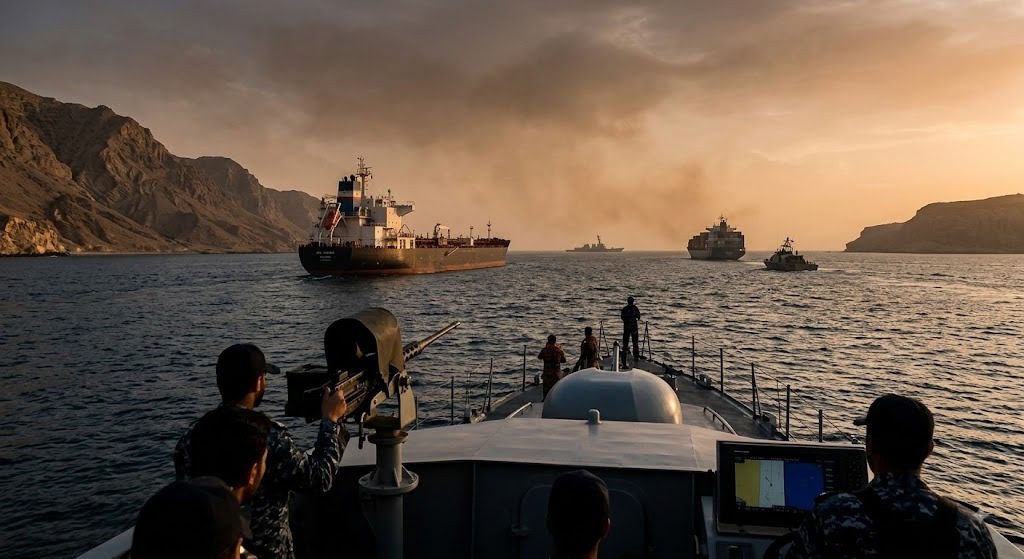
TEHRAN (Agencies) — Iran’s top military leadership has strongly rejected claims by US President Donald Trump asserting full American naval control over the strategic Strait of Hormuz.
The Khatam al-Anbiya Central Headquarters issued a formal communique on Thursday describing Washington’s statements as “baseless lies” and “falsehoods”.
#URGENT Iran’s Khatam al-Anbiya Headquarters dismisses US claims of full control over Hormuz as ‘baseless lies,’ says no vessel can transit without Tehran’s authorization
— Anadolu English (@anadoluagency) August 13, 2026
According to a report by the Turkish news agency Anadolu, the Iranian command stressed that the vital maritime choke point remains firmly under Tehran’s operational authority.
The statement emphasized that no commercial vessel or oil tanker can navigate the waterway safely without explicit authorization from Iranian authorities.
The Iranian military command characterized the US statements as evidence of helplessness and confusion within Washington’s military leadership.
“The false US claims regarding the normal passage of vessels through the Strait of Hormuz reflect nothing but falsehoods and baseless lies,” the statement carried by Iranian state broadcaster IRIB noted.
The reaction follows recent declarations made by US President Donald Trump on social media platform Truth Social, where he claimed the United States had established “total control” over the energy corridor.
Trump stated that the US naval deployment had formed a virtual “wall of steel” around the regional shipping lanes.
He further suggested that the United States intended to maintain its military presence and blockade over the passage indefinitely.
The Strait of Hormuz serves as the world’s most critical maritime transit point for petroleum, connecting Middle Eastern crude producers directly to global markets.
Roughly twenty percent of the world’s daily petroleum consumption and major volumes of liquefied natural gas normally pass through the narrow channel.
Tensions in the region have escalated significantly following widespread military friction, causing transit volumes across the passage to drop sharply over recent weeks.
Iranian defence officials reiterated that maritime transit inside the Persian Gulf remains strictly subject to regulatory enforcement established by Tehran.
The Persian Gulf Strait Authority previously stated on social media that official posts by US representatives regarding unrestricted movement do not alter operational realities along the coastal corridor.
Iranian military spokespersons affirmed that the passage will remain subject to restrictions until broader political and security conditions are formally resolved.
Addressing local media in Tehran, senior Iranian officials asserted that naval units and coastal defence networks continue active monitoring operations along the entire length of the waterway.
Military analysts note that conflicting official statements highlight an ongoing war of words between Washington and Tehran amidst heightened global economic anxiety over energy security.
Shipping firms and commercial operators have expressed growing concern regarding maritime safety and skyrocketing insurance costs for transit through the Persian Gulf.
What This Means for the Common Reader
Sustained Energy Market Volatility: Prolonged disputes and conflicting claims over the control of the Strait of Hormuz create uncertainty in global oil markets, driving up crude prices and fuel costs internationally.
Heightened Risk for Global Shipping: With both sides maintaining opposing operational claims, commercial shipping routes in the Persian Gulf face increased security risks, navigation delays, and surging maritime insurance premiums.
Escalating Geopolitical Standoff: The direct contradiction between US assertions of naval dominance and Iran’s enforcement of transit oversight signals ongoing military friction in a sensitive maritime corridor.


