


By The Tribune International Staff
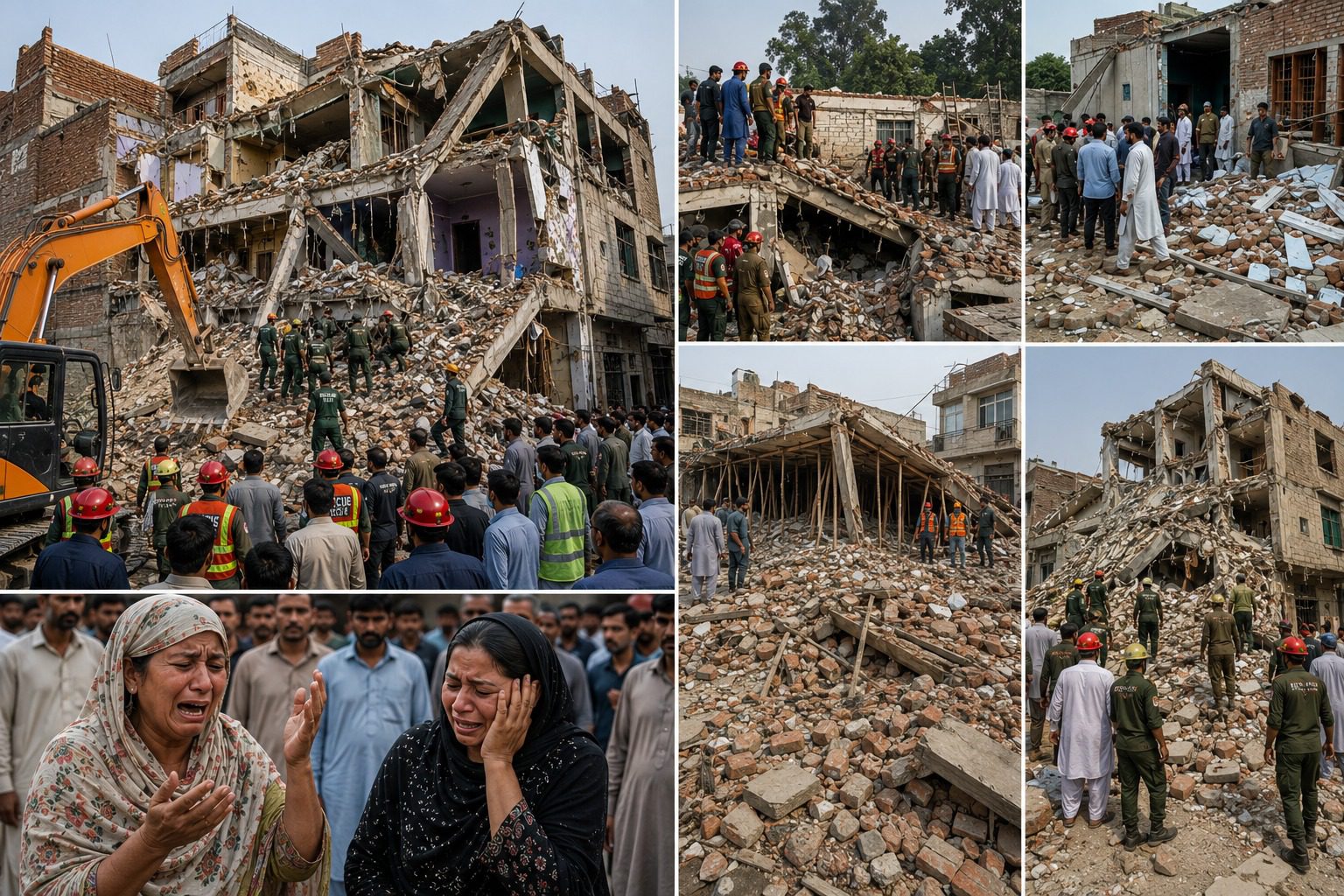
The house collapsing of a three-storey in Lahore’s Harbanspura, which killed 11 members of a family gathered for a birthday celebration, has once again exposed a troubling reality. In recent months, Pakistan has witnessed several deadly building and roof collapses. A tuition centre roof in Lahore claimed the lives of schoolchildren. A classroom roof collapsed in Dera Ghazi Khan, killing young students. Residential buildings in different cities have also given way, leaving behind grieving families and raising serious questions about public safety.
These incidents have sparked an important debate: Why are buildings collapsing so often in Pakistan?
Many people blame ageing structures. Others point to poor construction, illegal additions or weak government oversight. All of these factors play a role. Yet one important issue receives far less attention—the country’s worsening economic conditions.
Building collapses are rarely caused by a single problem. They are usually the result of several issues coming together. Poverty, inflation, ageing infrastructure, poor-quality construction and weak enforcement of building regulations are combining to create a growing safety crisis.
Houses are getting older, but repairs are becoming rarer
Across Pakistan, thousands of homes were built during the 1970s, 1980s and 1990s. Many of these buildings are now more than three decades old.
Like any other structure, buildings require regular maintenance. Roofs develop cracks, concrete weakens with time, steel reinforcement begins to rust and foundations may settle. Water seepage slowly damages structural components, particularly during the monsoon season.
In developed countries, property owners often carry out periodic inspections and repairs. In Pakistan, however, many families continue living in ageing homes without any structural assessment for decades.
Small defects that could have been repaired at relatively low cost are ignored until they become major structural risks.
The economy has changed people’s priorities
Pakistan has experienced years of high inflation and declining purchasing power. Food prices, electricity bills, gas tariffs, school fees and medical expenses have increased sharply, leaving little room in household budgets for home maintenance.
For many families, the choice is simple but painful: buy groceries, pay utility bills or repair a damaged roof.
Most naturally choose immediate survival.
According to international financial institutions, a significant proportion of Pakistan’s population now lives below or close to the poverty line. Even middle-income families have seen their savings eroded by inflation and rising living costs.
Structural repairs can cost hundreds of thousands of rupees. Rebuilding a damaged roof or reinforcing an old building may cost even more. For households already struggling with daily expenses, such work becomes impossible.
As repairs are postponed year after year, buildings continue to deteriorate.
Illegal additions increase the danger
Pakistan’s growing population has placed tremendous pressure on housing.
Instead of purchasing new homes, many families expand existing ones. Extra floors are added to accommodate married children or to generate rental income.
The problem is that these additions are not always carried out under the supervision of qualified structural engineers.
A house originally designed to support one or two storeys may eventually carry three or four floors. Heavy rooftop water tanks, solar panels, storage rooms and additional concrete further increase the load.
Without proper engineering calculations, columns and foundations may no longer be able to support the building safely.
Many building collapses occur not because a house was badly built originally, but because it was altered over time without considering its structural capacity.
Weak enforcement allows unsafe construction
Pakistan has building regulations and municipal authorities responsible for approving construction plans.
However, enforcement remains inconsistent.
Illegal constructions, unauthorised modifications and violations of approved building plans are common in many cities.
Some homeowners proceed without obtaining proper approvals, while others hire unqualified contractors to reduce construction costs.
Routine inspections are often limited, allowing structural weaknesses to go unnoticed.
By the time cracks appear or walls begin to lean, significant damage may already have occurred.
Poor-quality materials and workmanship
Another factor contributing to structural failures is the quality of construction.
Not every building collapse involves an old structure. Some relatively new buildings also develop serious defects.
Experts have long warned that the use of substandard materials, inadequate steel reinforcement and poor workmanship can weaken a building long before visible signs appear.
Cost-cutting during construction may save money initially, but it can compromise safety for decades.
Buildings constructed without proper engineering supervision are especially vulnerable during heavy rainfall or earthquakes.
Monsoon rains expose hidden weaknesses
Pakistan’s annual monsoon season places additional pressure on ageing buildings.
Rainwater entering through damaged roofs or cracked walls gradually corrodes steel reinforcement embedded inside concrete.
Moisture weakens walls, damages foundations and accelerates structural deterioration.
Heavy rainfall alone rarely causes a properly designed building to collapse.
However, when a structure has already been weakened by poor maintenance or construction defects, prolonged rain can become the final trigger.
This explains why many building collapses occur during or shortly after periods of intense rainfall.
A growing urban challenge
Rapid urbanisation has transformed Pakistan’s major cities over the past few decades.
Lahore, Karachi, Rawalpindi, Faisalabad and Multan have experienced significant population growth, increasing demand for housing.
Land has become more expensive, encouraging people to build upwards rather than outwards.
In densely populated neighbourhoods, buildings are often constructed very close together, leaving little room for proper foundations or future maintenance.
Some older neighbourhoods contain houses that have been repeatedly modified over several generations without any comprehensive structural assessment.
As cities continue expanding, the challenge of ensuring building safety becomes even greater.
Building safety receives little public attention
Unlike road accidents or floods, building safety rarely becomes part of national policy discussions until tragedy strikes.
There is currently no widespread system requiring routine structural inspections of ageing residential buildings.
Many homeowners are also unaware of warning signs such as widening cracks, uneven floors, sagging roofs, exposed steel reinforcement or persistent water seepage.
Ignoring these signs can allow relatively minor problems to develop into life-threatening hazards.
Public awareness campaigns could help homeowners recognise structural risks before they become disasters.
Preventing future tragedies
Experts say reducing building collapses requires action from both government and citizens.
Authorities should strengthen enforcement of building codes and ensure that illegal construction is dealt with promptly.
Older buildings—particularly schools, tuition centres, apartment blocks and other public buildings—should undergo periodic structural inspections.
Local governments should maintain updated records of ageing structures considered unsafe.
At the same time, affordable financing programmes or low-interest loans could help low-income homeowners carry out essential repairs.
Banks and housing finance institutions could also develop products specifically designed for structural rehabilitation rather than only new construction.
Professional engineering bodies have an important role to play by promoting awareness about safe construction practices and encouraging homeowners to seek qualified technical advice before making structural changes.
The cost of inaction
Every collapsed building represents more than damaged concrete.
It represents children who never return to school, parents who lose their families, communities left traumatised and emergency responders searching through rubble in the hope of finding survivors.
The Harbanspura tragedy serves as a painful reminder that many buildings across Pakistan may be ageing silently while economic hardship delays essential repairs.
The challenge facing Pakistan is therefore not simply one of construction quality. It is also about affordability, planning, governance and public awareness.
Unless these issues are addressed together, the country risks witnessing more heartbreaking tragedies in the years ahead.
Safe housing is not merely an engineering concern—it is a public safety issue, an economic issue and, above all, a human issue. Every family deserves to live in a home that offers protection rather than becoming a source of danger. The true measure of development is not only how many buildings are constructed, but how safely people can live within them.


