


By M Qadeer
LAHORE: The Punjab government has finalised the broad contours of its Punjab budget for the fiscal year 2026–27, with the total outlay projected at Rs5.13 trillion, according to official sources.
The proposed financial plan reflects the province’s focus on maintaining fiscal discipline while balancing recurring expenditures and development priorities.
How much will Punjab receive from the NFC award in FY 2026-27?
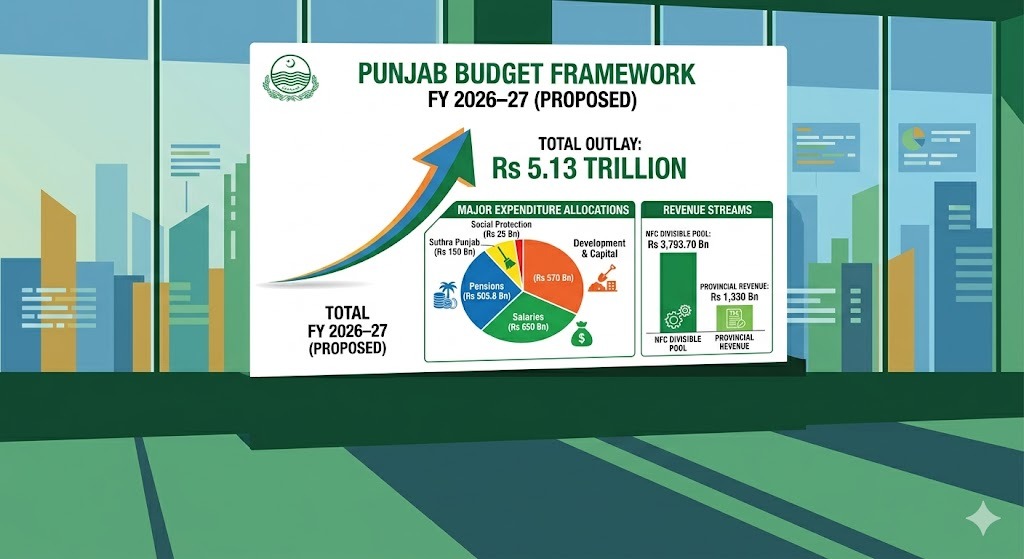
When looking closely at the divisible federal tax share for Punjab in upcoming fiscal year estimates, the province is set to receive a massive chunk of its funding from central resources. Under the National Finance Commission (NFC) award, Punjab is expected to receive approximately Rs3,793.70 billion from divisible federal taxes.
Additionally, the Punjab provincial tax and non-tax revenue targets for 2026 budget planning have been locked in at around Rs1,330 billion from the province’s own local sources. Together, these inflows form the backbone of the province’s projected fiscal capacity for the upcoming financial year.
How much did Punjab allocate for government salaries and pensions?
A major question for public sector workers is the Punjab government employee salary increase details budget 2026-27 framework. While officials have indicated that exact salary and wage increases will be determined in line with the federal government’s upcoming budgetary decisions, the baseline allocations are massive.
The total pension allocation in Punjab budget fiscal year 2026-27 is set at Rs505.8 billion, running alongside a hefty Rs650 billion strictly set aside for government employee salaries.
Punjab Finance Commission transfers and development spending breakdown
Outside of administrative costs, civic infrastructure is receiving a major push. The provincial government has proposed Rs800 billion for Punjab Finance Commission transfers to empower local governance.
Furthermore, citizens tracking localized urban updates will note the Suthra Punjab cleanliness program budget allocation and details, which features a dedicated Rs150 billion earmarked for sanitation. For infrastructure tied to global partners, the allocation for externally assisted development projects in Punjab budget 2026-27 is proposed at Rs54 billion, while Rs570 billion is expected to be spent on broader general development and capital expenditures.
How Punjab budget 2026-27 aligns with IMF economic targets
The overall Punjab budget total outlay and fiscal space projections show total provincial expenditures calculated at Rs3,569.6 billion. This leaves an estimated Rs1,562.2 billion in fiscal and development space for expansionary and strategic programmes.
When evaluating Punjab government operational expenditures vs development spending patterns (with operational costs estimated at Rs580.2 billion), analysts note that the tight balancing act is explicitly designed to keep the province in line with macroeconomic stability goals and external IMF-related financing commitments.
Social protection initiatives and civic infrastructure development targets
Beyond administrative salaries, the financial plan prioritizes grassroots public relief and structural modernization. A dedicated allocation of Rs25 billion has been locked in for targeted social protection initiatives, aiming to safeguard vulnerable segments of the population against ongoing inflationary pressures. This safety net runs parallel to a robust focus on regional development.
Furthermore, the province has laid out clear guidelines for its upcoming development portfolio, proposing Rs54 billion specifically for externally assisted development projects. These foreign-funded initiatives are designed to upgrade regional supply chains and energy efficiency. To ensure these programs succeed, the government has carved out an impressive Rs1,562.2 billion in fiscal and development space. This strategic buffer ensures that high-priority public works, municipal improvements, and economic expansion programs remain fully funded throughout the upcoming fiscal year without compromising the province’s broader macroeconomic stability targets.
This comprehensive focus on infrastructure is expected to modernize regional connectivity, making it further easier for local small and big businesses aluke to expand across domestic and international trade routes while establishing long-term economic resilience.


