


ISLAMABAD (The Tribune Intl ) – According to a newly released report by the Pakistan Institute of Development Economics (PIDE), Pakistan’s savings rate has experienced a drastic decline, reaching its lowest level in nearly three decades.
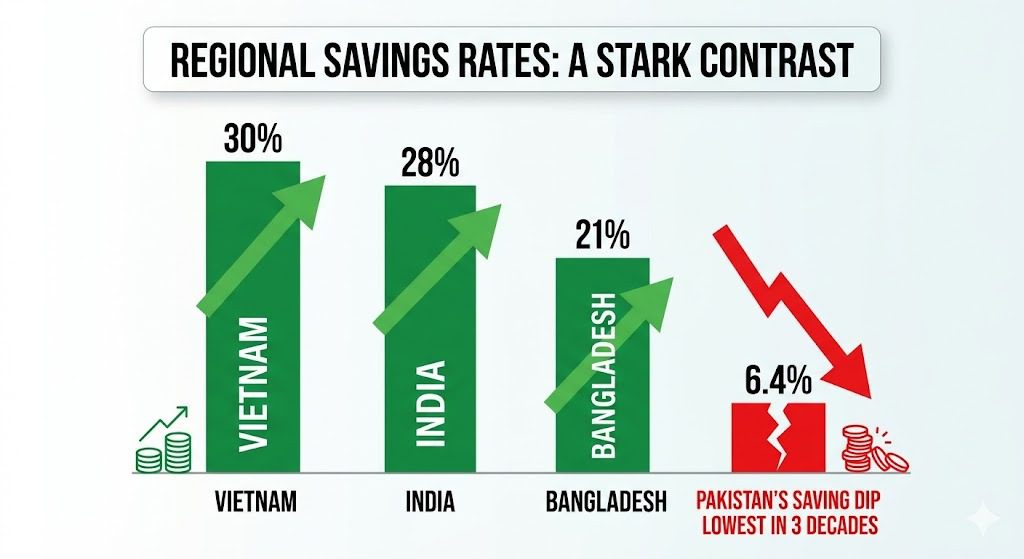
The report indicates that the current savings rate stands at a mere 6.4%, with households only saving Rs6 out of every Rs100 earned. This stands in stark contrast to the significantly higher savings rates in regional economies, including Bangladesh at 21%, India at around 28%, and Vietnam at a robust 30%.
The PIDE report highlights the potential negative consequences of this persistent low savings trend. It warns that a lack of adequate domestic savings could stifle investment, which is crucial for economic expansion and capital formation. The report suggests that this could lead to an investment crisis, forcing Pakistan to become increasingly dependent on external borrowing and repeatedly turn to international lenders for financial support. This, in turn, could exacerbate the country’s debt burden and hinder its long-term economic stability.
The PIDE report attributes the decline in savings to several factors, including high inflation and low returns on bank deposits. These factors have pushed people away from formal financial institutions, leading many to prefer alternative investment options such as gold, real estate, and cash holdings.
The report also highlights the concern that heavy government borrowing is “crowding out” private sector investment, further limiting the availability of capital for businesses to expand and innovate.
To address this critical issue, PIDE has urged the government to prioritize the promotion of domestic savings in the upcoming 2026-27 federal budget. The institute proposes a nationwide savings campaign and recommends the implementation of various measures to encourage individuals and businesses to save more. These recommendations include:
Tax incentives for long-term savings schemes: Offering tax benefits can encourage people to commit to long-term saving plans.
Stronger protection for small savers: Protecting small savers from financial risks can increase public trust in savings products.
Improved digital access to national savings products: Simplifying the process of accessing and managing savings accounts through digital platforms can encourage wider participation.
Creation of an annual savings mobilisation dashboard: This dashboard would track the progress of savings mobilization efforts and identify areas for improvement.
The report also recommends targeted savings incentives for specific demographic groups, such as women, pensioners, and workers in the informal sector. Additionally, it calls for measures to make savings safer, more profitable, and easier to access for all segments of society.
In its concluding remarks, the PIDE report emphasizes the importance of stronger domestic savings for long-term economic resilience. It states, “Running the future on other people’s money is no longer sustainable.” This statement underscores the critical need for Pakistan to reduce its reliance on external borrowing and foster a culture of saving and investment that can drive sustainable economic growth.


