


By Muhammad Mohsin Iqbal
In an age that prides itself on enlightened conscience and codified international law, it remains a sobering paradox that territories may be held in prolonged occupation despite the universal principles that forbid acquisition by force. Many states in history have erred in moments of conquest, yet in our own era two cases continue to cast a long and troubling shadow over global diplomacy; Kashmir under Indian control and Palestine under Israeli occupation. For more than seven decades, these lands have endured cycles of resistance and repression, while the guardians of world order oscillate between protest and paralysis.
Read also: Power struggle in Afghanistan and India’s expanding role
That both India and Israel enjoy overt and covert patronage from powerful quarters has only deepened the complexity of these disputes.
The moral contradiction is particularly striking in the case of India. During the 1930s and 1940s, under British colonial rule, India identified deeply with the Palestinian cause. Mohandas Karamchand Gandhi wrote in 1938, “Palestine belongs to the Arabs in the same sense that England belongs to the English, or France to the French,” while also expressing sympathy for Jewish suffering in Europe. Independent India voted against the 1947 United Nations Partition Plan and later opposed Israel’s admission to the world body. Even after recognising Israel in 1950, Prime Minister Jawaharlal Nehru refrained from establishing full diplomatic relations, wary of alienating Arab partners and mindful of anti-colonial solidarity.
Yet strategic necessity gradually softened ideological rigidity. During the 1962 war with China and the 1965 conflict with Pakistan, Israel quietly supplied India with arms. The pattern became more structured in the 1970s. As tensions between India and Pakistan spiked in 1971, D.N. Chatterjee, India’s ambassador to France, urged New Delhi to seek Israeli assistance. Prime Minister Indira Gandhi accepted the proposal. Through India’s external intelligence agency, the Research and Analysis Wing (RAW), arms were procured via Liechtenstein. Israeli Prime Minister Golda Meir reportedly sought diplomatic recognition in return, but India demurred, preferring to maintain public distance even as covert cooperation deepened. This duality—public solidarity with Palestine and discreet security ties with Israel—became a defining feature of India’s West Asia policy for decades.
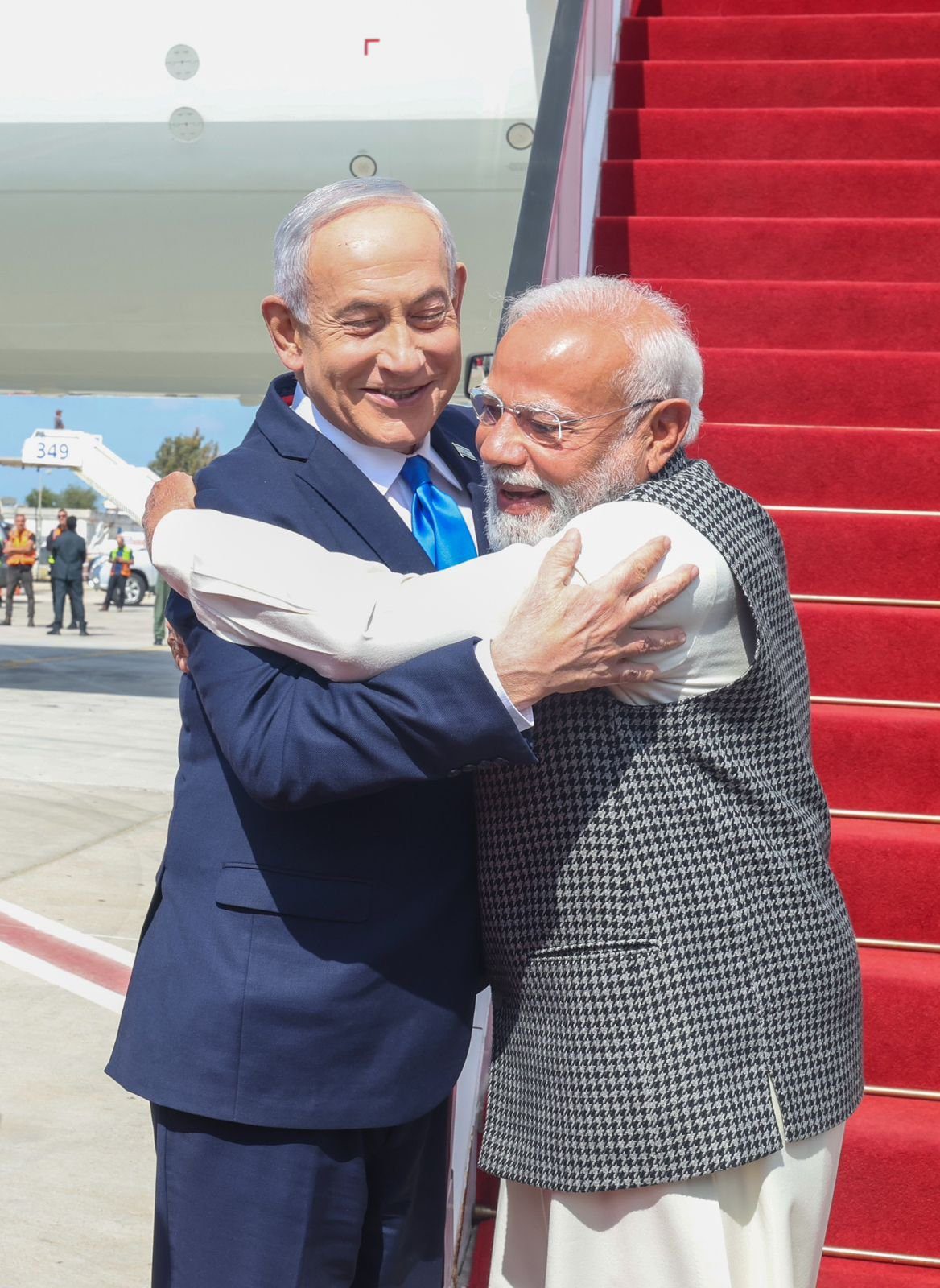
Diplomatic relations were finally normalised in 1992, and since then defence and technological cooperation has flourished. Under Prime Minister Narendra Modi, the relationship has moved from discreet engagement to open camaraderie. His 2017 visit to Israel—the first ever by an Indian premier—symbolised the shedding of long-held inhibitions. His recent visit now added significance, coming amid the continuing devastation in Gaza and heightened regional tensions. Israeli Prime Minister Benjamin Netanyahu has spoken of a “tremendous alliance” between the two nations, underscoring cooperation in defence, technology, innovation, and trade.
Trade volumes have multiplied dramatically since 1992, and Israel has emerged as a major supplier of advanced weaponry to India. Joint ventures, military exercises, and intelligence exchanges illustrate a relationship no longer veiled in ambiguity. Yet India officially maintains support for a two-state solution and continues diplomatic engagement with the Palestinian leadership. Its voting pattern at the United Nations, however, reflects increasing caution; abstentions on resolutions critical of Israel have drawn scrutiny at home and abroad.
The strategic calculus becomes more intricate when placed against the backdrop of rising tensions between the United States and Iran. Israel remains firmly aligned with Washington, and the possibility of a broader confrontation in the region cannot be discounted. Political analysts are examining whether, through Israel, India has conveyed assurances of support to the United States in the event of war. In return, Israel may be expected to facilitate an improvement in US–India relations. The facilitation India has recently provided to the United States and Israel in matters relating to Iran is not unnoticed. Such positioning inevitably generates unease among Gulf states that host millions of Indian workers and have long invested in close ties with New Delhi. For them, any overt alignment against Iran would represent a delicate and potentially destabilising shift.
Equally significant are the security implications for South Asia. It is widely speculated that during high-level exchanges, discussions extend beyond bilateral cooperation to shared threat perceptions. According to some assessments, Israel and India view Pakistan through a similar strategic lens. There is concern in Islamabad that efforts may be coordinated to counter Pakistan diplomatically and strategically, including by leveraging developments in Afghanistan. Information circulate that financial or military assistance could be extended to actors hostile to Pakistan’s interests. While such claims remain within the realm of strategic conjecture, Pakistan is keeping a close watch, and its Senate has voiced formal concern over the evolving India–Israel proximity.
This convergence, therefore, cannot be seen merely as a bilateral arrangement. It intersects with broader regional rivalries, superpower calculations, and unresolved territorial disputes. The Middle East remains unsettled: Gaza lies scarred despite ceasefire efforts; international courts and humanitarian agencies have documented grave suffering; and settlement expansion in the West Bank continues to provoke global criticism. In South Asia, Kashmir remains a flashpoint whose embers have repeatedly ignited armed confrontation.
Nations pursue their interests with layered calculations, and India aspires to great-power status, seeking technological advancement, diversified energy sources, and expanded diplomatic leverage. Israel values India’s demographic weight, economic potential, and strategic location. Yet moral and legal questions persist. When occupation endures and civilian suffering recurs, strategic pragmatism alone cannot provide lasting legitimacy.
South Asia and the Middle East are passing through a critical hour. The convergence of enduring disputes, emergent alliances, and superpower tensions forms a combustible mixture. Should conflict widen—whether between the United States and Iran, within the Palestinian territories, Pak Afghan border or along the Line of Control in Kashmir—the repercussions will not remain confined.
In the final analysis, the deepening India–Israel alliance symbolises the triumph of realpolitik over early post-colonial idealism. It reflects a world in which historical solidarities yield to contemporary calculations. Yet history also teaches that unresolved grievances seldom fade through neglect. If justice remains deferred in Kashmir and Palestine, no alignment, however formidable, can secure durable peace.