
• Latest
  • All
  • Pakistan
Pakistan’s food security crisis: Beyond shadow of doubts — Who cares?

Pakistan’s food security crisis: Beyond shadow of doubts — Who cares?

February 11, 2026 - Updated on February 12, 2026
Iran-India tensions escalate after vessel attack in Strait of Hormuz

Iran-India tensions escalate after vessel attack in Strait of Hormuz

April 18, 2026
ADVERTISEMENT
Iran shuts Strait of Hormuz again amid US blockade tensions

Iran shuts Strait of Hormuz again amid US blockade tensions

April 18, 2026
Customs claims progress as LCCI warns of rising costs and system flaws

Customs claims progress as LCCI warns of rising costs and system flaws

April 18, 2026
‘Let businesses breathe’: LCCI urges end to load-shedding, PERA crackdown businesses

‘Let businesses breathe’: LCCI urges end to load-shedding, PERA crackdown businesses

April 18, 2026
New policy aims to unlock women’s economic power, SMEDA tells journalists

New policy aims to unlock women’s economic power, SMEDA tells journalists

April 18, 2026
Youth mental health takes centre stage at anti-drug campaign seminar

Youth mental health takes centre stage at anti-drug campaign seminar

April 18, 2026
US, Iran advance talks in Islamabad as expert teams exchange draft texts

Iran refutes US claim over nuclear material transfer

April 18, 2026
Hormuz Strait reopened for trade after ceasefire, says Iran’s Foreign Minister Abbas Araqchi

Hormuz Strait reopened for trade after ceasefire, says Iran’s Foreign Minister Abbas Araqchi

April 17, 2026 - Updated on April 18, 2026
Historic visit to Tehran reflects strategic signaling and echoes past diplomacy

Historic visit to Tehran reflects strategic signaling and echoes past diplomacy

April 17, 2026
Pope Leo XIV calls for peace, condemns ‘tyrants’

Pope Leo XIV calls for peace, condemns ‘tyrants’

April 16, 2026 - Updated on April 18, 2026
Gas pipeline explosion kills eight in Haripur industrial estate

Gas pipeline explosion kills eight in Haripur industrial estate

April 16, 2026 - Updated on April 18, 2026
Cargo, courier businesses urge Punjab government to review early closure decision

Cargo, courier businesses urge Punjab government to review early closure decision

April 16, 2026
ADVERTISEMENT
Your text
Plugin Install : Cart Detail need WooCommerce plugin to be installed.
Sunday, April 19, 2026
The Tribune
  • Login
  • Home
  • Top News
  • World
    • Interview
  • Pakistan
    • Politics
    • Crime
  • Iran-US-Israel war
  • Epaper
  • Opinion
  • Sports
    • Cricket
  • Business
    • Business
    • Science
      • Weird
        • News Analysis
      • FBR & Customs
  • Entertainment
  • History in focus
    • Tech
    • Event News
    • Event Reporting
    • NGOs
  • Health
  • Fake News
No Result
View All Result
  • Home
  • Top News
  • World
    • Interview
  • Pakistan
    • Politics
    • Crime
  • Iran-US-Israel war
  • Epaper
  • Opinion
  • Sports
    • Cricket
  • Business
    • Business
    • Science
      • Weird
        • News Analysis
      • FBR & Customs
  • Entertainment
  • History in focus
    • Tech
    • Event News
    • Event Reporting
    • NGOs
  • Health
  • Fake News
No Result
View All Result
The Tribune
No Result
View All Result
  • Home
  • Top News
  • World
  • Pakistan
  • Iran-US-Israel war
  • Epaper
  • Opinion
  • Sports
  • Business
  • Entertainment
  • History in focus

Pakistan’s food security crisis: Beyond shadow of doubts — Who cares?

The Tribune International by The Tribune International
2 months ago
in Opinion
0 0
A A
0
0
SHARES
0
VIEWS
Share on FacebookShare on Twitter

Dr Alamdar Hussain Malik

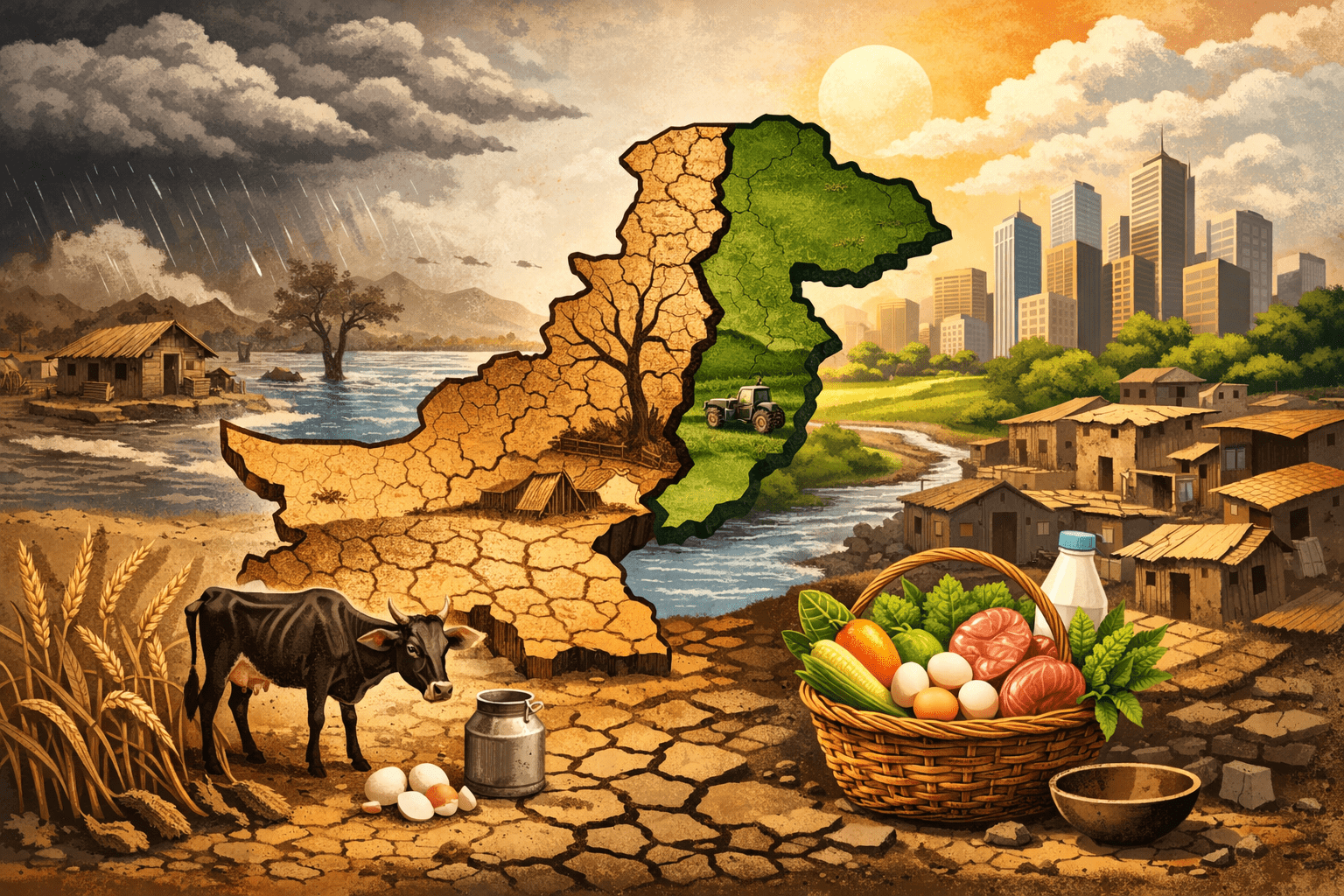
Pakistan today is not merely facing inflation, nor only an agricultural slowdown. It is confronting a food security crisis — silent, expanding, and dangerously misunderstood. The tragedy is not that the crisis exists; the tragedy is that it is still debated as if it were a theory. Food insecurity in Pakistan is no longer a prediction. It is a reality.

Read also: Flour prices soar, basic food staples continue slipping out of reach

ADVERTISEMENT

Millions of citizens already live on the edge of hunger. In several districts of Sindh, Balochistan and parts of Khyber Pakhtunkhwa, families have reduced meals not by choice but by compulsion. Children are not simply underfed; they are undernourished. Malnutrition, stunting and anemia have quietly become public health emergencies. Yet at the national level, the discussion remains limited to wheat procurement and flour prices, as if food security were only a question of grain availability.

This misunderstanding lies at the heart of the crisis. Food security is not merely the presence of wheat in a warehouse. It is the ability of a household to obtain safe and nutritious food regularly. A country may produce grain and still face hunger if people cannot afford it. Pakistan produces wheat almost every year, and sometimes even surplus, yet millions remain food insecure because access has failed. When food inflation rises faster than income, availability loses meaning. Flour may be present in the market, but if a laborer cannot purchase it, it is practically absent.

The situation becomes more dangerous when nutrition is examined. Food security is not only calorie security. A stomach filled with carbohydrates but lacking protein, minerals and vitamins creates a population that survives but does not develop. Pakistan is increasingly facing protein deficiency. Milk, meat and eggs — the real sources of growth, immunity and cognitive development — are becoming expensive for ordinary households. Consequently, children grow up stunted, maternal health declines, and disease resistance weakens. The crisis therefore is not visible starvation; it is hidden malnutrition.

Climate change has intensified this vulnerability. Agriculture in Pakistan has entered an era of uncertainty. Floods, heat waves, irregular rains and droughts now determine production more than planning. Crops are damaged not occasionally but repeatedly. Farmers who once relied on predictable seasons now gamble with nature. A single flood can destroy standing crops, fodder reserves and livestock simultaneously, removing both food and income. When rural livelihoods collapse, urban food prices rise, and the entire food chain becomes unstable.

Ironically, the most important sector for nutrition — livestock — receives the least attention in policy. Pakistan’s agriculture is actually livestock-dominated. Milk, meat and related products contribute more to agricultural value than crops, yet planning still revolves almost entirely around wheat. Food security cannot exist without protein security. When fodder shortages occur, animal productivity declines, milk output drops, and prices increase. The impact reaches households immediately because milk is often the first and sometimes the only animal protein accessible to children. Pakistan produces roughly 70 million tons of milk annually, yet only about 4 percent enters the formal commercial processing sector. The overwhelming majority is handled through an unregulated informal supply chain, resulting in quality losses, low farmer income, and poor nutrition for consumers. Ignoring livestock and the dairy value chain is therefore not an agricultural oversight; it is a direct threat to public health.

Farmers themselves are losing confidence. Rising fertilizer prices, costly seed, uncertain support prices, water shortages and delayed policy decisions have made farming economically risky. Agriculture is no longer seen as a stable livelihood. When farmers shift away from crops or reduce herd sizes to avoid losses, national food supply weakens. Food security begins with farmer security; without protecting producers, consumers cannot be protected.

Pakistan’s food insecurity cannot be separated from the steady decline of its cash-crop and staple-crop production. Major crops — cotton, wheat, rice and sugarcane — have repeatedly missed production targets in recent years. Cotton production has collapsed from nearly 14 million bales a decade ago to almost half that level, while wheat and rice yields have fluctuated sharply due to heat waves, water shortages and policy uncertainty. Sugarcane production is equally unstable, affected by floods and inadequate irrigation. Minor crops — pulses, oilseeds, vegetables and fodder — have also stagnated or declined, forcing imports of edible oil and pulses and reducing dietary diversity. This pattern shows that Pakistan is not merely facing food insecurity but agricultural instability, where both staple crops and cash crops are increasingly unreliable under climate pressure, economic uncertainty and inconsistent policy support.

Adding to the paradox is Pakistan’s cyclical trade of wheat and sugar. In surplus years, the country exports these commodities to earn foreign exchange and support farmers. Yet in poor seasons, the same commodities must be imported to meet domestic demand, leading to higher costs and market dependence. This cycle is caused by climate variability, inconsistent policies, and weak storage and transport infrastructure, demonstrating the fragility of Pakistan’s agricultural system.

Despite the worsening food situation, the state machinery continues to treat agriculture more as a seasonal political slogan than a permanent national priority. Governments announce packages — fertilizer subsidies, wheat support prices, electricity relief, loan rescheduling, and crop procurement drives — yet none address the structural collapse of the food production system. Policy remains reactive: when wheat prices rise, imports begin; when sugar prices spike, exports are banned. Lower electricity bills may reduce farmer expenses, but they do not solve declining soil fertility, seed quality deterioration, water scarcity, or research failure. Fiscal pressures and international financial commitments dominate decision-making, leaving food security largely secondary.

A comparison with India highlights the difference policy can make. India treats agriculture as a strategic security sector, offering predictable support: minimum support prices, direct cash transfers, fertilizer and irrigation subsidies, crop insurance, and strategic procurement of wheat and rice. Pakistan, in contrast, provides mostly temporary and inconsistent relief. Wheat support prices are uncertain, procurement operations are limited, crop insurance coverage is negligible, and direct income support to farmers is absent. The outcome is predictable: India maintains food reserves and exports rice and wheat, while Pakistan repeatedly imports, despite comparable agro-ecological potential.

In 2023, the food crisis moved beyond academic debate. Around 10.5 million people faced acute food insecurity, rising to nearly 11.8 million during the winter lean season. Reports of stampedes at subsidized flour distribution points, protests over soaring wheat prices in regions like Gilgit-Baltistan, and social unrest highlighted the human cost of policy inaction.

By 2030, experts warn, up to half of Pakistan’s population could face significant food insecurity if climate impacts, weak resilience, and policy inertia are not urgently addressed, potentially pushing millions more into hunger.

The way forward is clear but requires urgent, integrated action. Agriculture must be treated as national security. Long-term policies should focus on increasing productivity, crop diversity, and livestock development while promoting high-value minor crops. Farmers need predictable support: minimum support prices, direct income transfers, subsidized inputs, crop insurance, and guaranteed procurement. Food systems must be modernized with storage, processing, cold chains, veterinary services, and value addition. Water management and climate resilience are essential, alongside nutrition-focused policies that integrate milk, meat, eggs, pulses, and vegetables. Governance reforms are necessary to create accountability and coordination across federal and provincial levels, ensuring food security is proactive, not reactive. Pakistan has the resources, the population, and the agro-ecological potential to feed itself; the challenge is converting that potential into sustained, equitable, and resilient food security.

Beyond the shadow of doubts, the crisis is present.  The only uncertainty that remains is attention. The fields are warning, the farmers are warning, and the children are warning. The unanswered question is simple: who cares?



Tags: agricultureClimate ChangeEggsFarmer SupportFood AccessFood SecurityLivestockMilknutritionPakistanPolicy ReformPublic HealthSustainable Farmingvegetableswheat crisis
ShareShareTweetShareSendSendShare

Get real time update about this post categories directly on your device, subscribe now.

Unsubscribe
ADVERTISEMENT

Related Posts

Historic visit to Tehran reflects strategic signaling and echoes past diplomacy
Opinion

Historic visit to Tehran reflects strategic signaling and echoes past diplomacy

April 17, 2026
Electricity crisis threatens Pakistan’s economy, industry and livelihoods
Opinion

Electricity crisis threatens Pakistan’s economy, industry and livelihoods

April 15, 2026
Faith, strategy and Pakistan’s evolving military role in the Muslim world
Opinion

Faith, strategy and Pakistan’s evolving military role in the Muslim world

April 15, 2026
Islamabad emerges as global diplomatic hub in high-stakes US–Iran Talks
Opinion

A step towards peace: Iran–US talks in Islamabad

April 13, 2026
Islamabad emerges as global diplomatic hub in high-stakes US–Iran Talks
Opinion

Islamabad emerges as global diplomatic hub in high-stakes US–Iran Talks

April 11, 2026
Architects of a shared destiny: The enduring Pakistan–UAE strategic partnership
Opinion

Architects of a shared destiny: The enduring Pakistan–UAE strategic partnership

April 10, 2026
  • Trending
  • Comments
  • Latest
Pioneers Businessmen Group hosts grand iftar dinner in honour of Chairman Ali Hussam Asghar

Pioneers Businessmen Group hosts grand iftar dinner in honour of Chairman Ali Hussam Asghar

March 17, 2026 - Updated on March 21, 2026
Upgradation work at Badshahi Mosque to be completed after Eid: Dr Ehsan Bhutta

Upgradation work at Badshahi Mosque to be completed after Eid: Dr Ehsan Bhutta

March 18, 2026 - Updated on March 19, 2026
Business leaders attend Iftar dinner held in honour of Ali Hussam Asghar in Lahore

Business leaders attend Iftar dinner held in honour of Ali Hussam Asghar in Lahore

March 16, 2026 - Updated on March 18, 2026
Eid ul Fitr amid global conflict: A call for unity and humanitarian leadership in the Muslim World

Eid ul Fitr amid global conflict: A call for unity and humanitarian leadership in the Muslim World

March 18, 2026
Unrest in Iran kills at least 2,000 activists say

Unrest in Iran kills at least 2,000 activists say

4
High-alert security arrangements ensured across city during Eid-ul-Adha

CCPO Kamyana reviews police performance, orders crackdown on gambling and better security for Chinese nationals

2
CM Maryam launches PERA to curb hoarding, land grabbing across Punjab

CM Maryam launches PERA to curb hoarding, land grabbing across Punjab

2
CM Maryam Nawaz Sharif to start latest SRT Train in Lahore

CM Maryam Nawaz Sharif to start latest SRT Train in Lahore

2
Iran-India tensions escalate after vessel attack in Strait of Hormuz

Iran-India tensions escalate after vessel attack in Strait of Hormuz

April 18, 2026
Iran shuts Strait of Hormuz again amid US blockade tensions

Iran shuts Strait of Hormuz again amid US blockade tensions

April 18, 2026
Customs claims progress as LCCI warns of rising costs and system flaws

Customs claims progress as LCCI warns of rising costs and system flaws

April 18, 2026
‘Let businesses breathe’: LCCI urges end to load-shedding, PERA crackdown businesses

‘Let businesses breathe’: LCCI urges end to load-shedding, PERA crackdown businesses

April 18, 2026
April 2026
MTWTFSS
 12345
6789101112
13141516171819
20212223242526
27282930 
« Mar    
ADVERTISEMENT

Browse by Category

  • Apps
  • Business
  • Business
  • Cricket
  • Crime
  • Entertainment
  • Epaper
  • Event News
  • Event Reporting
  • Fake News
  • Fashion
  • FBR & Customs
  • Food
  • Gadget
  • Gaming
  • Health
  • History in focus
  • Interview
  • Iran-US-Israel war
  • Mobile
  • Movie
  • Music
  • News Analysis
  • NGOs
  • Opinion
  • Pakistan
  • Politics
  • Politics
  • Review
  • Science
  • Science
  • Sports
  • Startup
  • Tech
  • Top News
  • Travel
  • Weird
  • World
  • #21289 (no title)
  • About Us
  • Blog
  • Cart
  • Checkout
  • Contact Us
  • Disclaimer
  • My account
  • Privacy Policy
  • Shop
  • Terms and Conditions
  • 📰 Advertise With Us

© 2026 The Tribune International. All rights reserved. | Powered by JNews
Disclaimer: The Tribune International is an independent platform and is not affiliated with any other organisation.
Reach us: Thetribuneintl@gmail.com

Welcome Back!

Sign In with Facebook
Sign In with Google
Sign In with Linked In
OR

Login to your account below

Forgotten Password?

Retrieve your password

Please enter your username or email address to reset your password.

Log In
Translate »

Add New Playlist

No Result
View All Result
  • Home
  • Top News
  • World
    • Interview
  • Pakistan
    • Politics
    • Crime
  • Iran-US-Israel war
  • Epaper
  • Opinion
  • Sports
    • Cricket
  • Business
    • Business
    • Science
      • Weird
      • FBR & Customs
  • Entertainment
  • History in focus
    • Tech
    • Event News
    • Event Reporting
    • NGOs

© 2026 The Tribune International. All rights reserved. | Powered by JNews
Disclaimer: The Tribune International is an independent platform and is not affiliated with any other organisation.
Reach us: Thetribuneintl@gmail.com