


By Asim Shahzad
LAHORE: The popular debate over the creation of new provinces cant undermine the constitutional necessity of the establishment of effective and democratic local governance in the provinces. Marginalised sections including women, minorities and youth are major stake holders in local governance and the absence of elected local governance affect them the most. Without their effective participation there is no concept of democracy at grass roots level. The future of democracy in Pakistan lies in strong system of local governance. The govt of Punjab should perform its constitutional responsibility and hold LG polls without further delay in the province.”
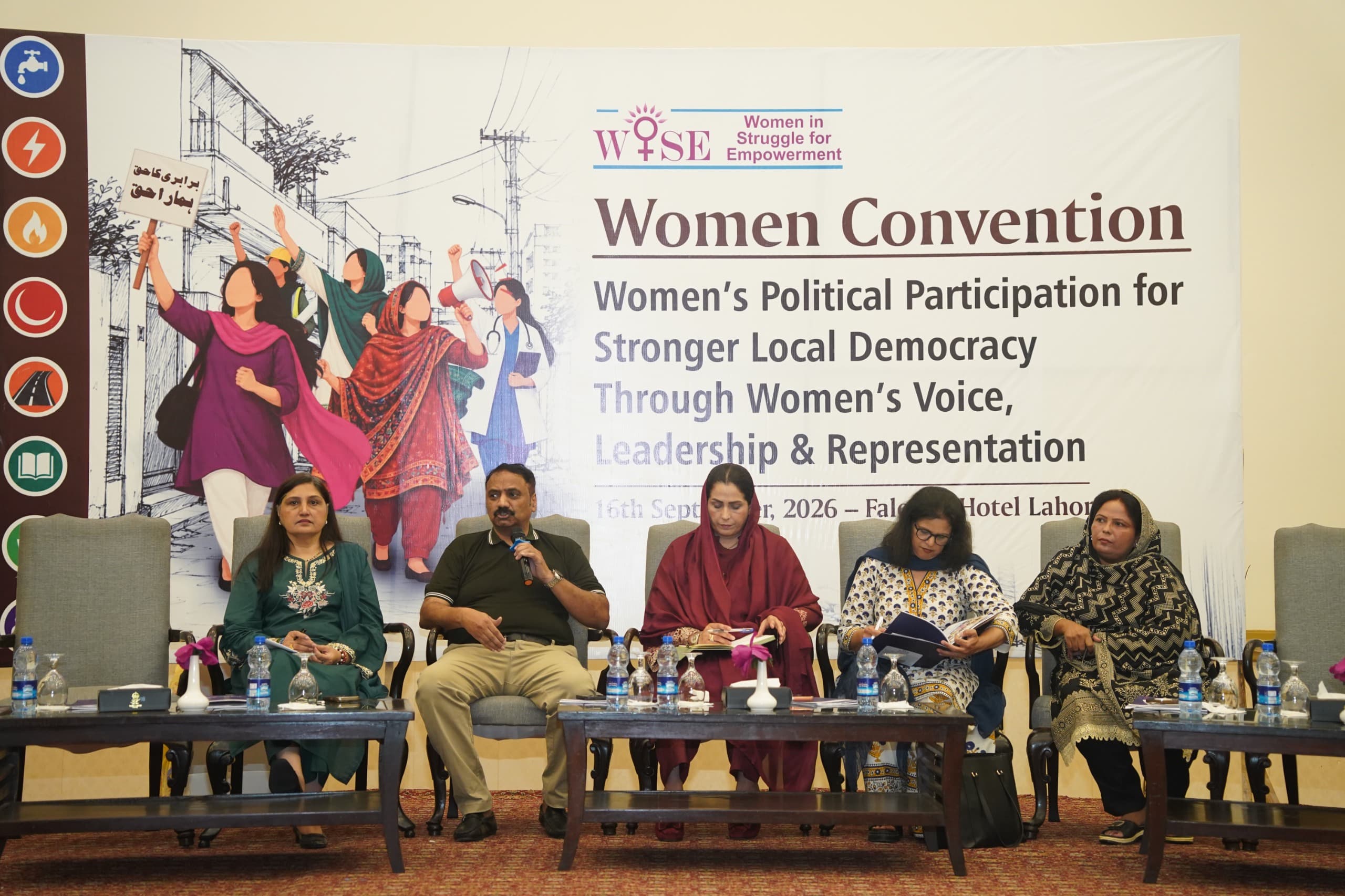
These views were expressed by the speakers at the Women Convention “Women Political Partici[pation for Stronger Local Democracy through Women Voice, Leadership & Representation”, organized by Women in Struggle for Empowerment (WISE) in connection with International Democracy Day, here today (Wednesday) at Falettis Hotel, Lahore. Over 130 participants from different districts including; Lahore, Kasur, Sheikhupura, Nankana Sahib, Gujranwala, Pakpattan, Multan, Khanewal, and Rajanpur, involving women activists, civil society members, lawayers, acedemics, ex-councilors and members of different LG networks joined the event.
Speaking on the occasion, Executive Director WISE, Bushra Khaliq said the local govts are functioning in three provinces; Sindh, KPK and Baluchistan and they are about to complete their respective tenures, however, people of Punjab are still deprived of their constitutional right to have an elected local government. Which means 56% of Pakistan population are still denied effective and democratic local governance. Women, minorities and youth are major stake holders in local governance and the absence of elected local governance affect them the most. Without their effective participation there is no concept of democracy at grass roots level, she opined adding that future of democracy in Pakistan lies in strong system of local governance. The govt of Punjab should perform its constitutional responsibility and hold LG polls without further delay in the province, she demanded.
Salman Abid, senior journalist and LG expert said political parties and even state has never been sincere to establish a sustainable local govt. system in the country. There is no accountability of the Punjab govt. for persistently using delaying tactics to avoid LG system in province, he lamented, adding that constitutional protection of the local govt. in provinces is a must. Article 140/A is not enough to help sustain and continuity of local govt. as third tier of the governance. For the continuity of LG system, there should be consensus among provinces on a common framework of action, guaranteed by the federal govt.
Zahid Islam, Executive Director Sangat said democracy is receeding globally, urgent need is to make efforts to safe the democractic systems and values across the world. He emphasized on the citizens participation in the affairs of local governance. Pakistan and particularly Punjab needs a strong local govt. system because of a dangerous phenomenon of rapid urbanization coupled with highest population growth rate (2.8%) in South Asia. Under these circumstances, it is impossible for the provincial govt to address these vital issues without an effective local govt. system. The majority of everyday issues a common man faces are related to local govts, there it is imperative to hold LG elections in Punjab at earliest, he added.
Tanveer Jahan, Executive Director, Democractic Commission for Human Development said the Local government is considered a nursery of new politicians; therefore, governments should give women and youth more opportunities to join politics rather than excluding them. At least 33% representation for women should be ensured on all teirs of LG system. Similarly, the peasants, laborers and workers, which comprise big chunk of marginalized population – has been ignored in the new LG law. Their reasonable representation should also be ensured through reserve seats on all tiers. She said The real powers in the PLGA 2025 are vested with the provincial govt. and civil bureaucracy, which negates the true spirit of Article 140-A/. The need is to devolve the administrative and fiscal powers down to the level of Union councils in line with the constitutional provisions.
Huda Ali Gohar, Deputy Director, Election Commission of Pakistan said there is paramount need to develop consensus among political parties about the continuity of local govts and delimitation on permanent basis. Since 2017, the ECP had to conduct three exercises of delimitations on account of three different laws introduced by successive govts in Punjab, he repented. There is strong impression that provincial govt is administratively overburdened due to the absence of local govts in Punjab. Devolution of fiscal, administrative and political powers is very important, she said.
Ms. Qudsia Batool , Member Punjab Assembly, PML (N) speaking on this occasion, said her party is committed to democracy and Local governance. The Punjab Local govt Act 2026 has already been passed and preperations are now underway to hold LG elctions in the province. The party leadership has confirmed that local body elections across Punjab will be conducted in phases, she added. Meanwhile, the party’s office-bearers are already undertaking preparations for the LG elections and public outreach across the province.
Speaking on the occasion, women ex-councilors from different districts, expressing reservations over the new LG laws said women political participation is taken for granted by the political parties. Therefore, they have to struggle unitedly beyond party line to reclaim their political space in the democratic intuitions. They said, the reserve seats of women in the latest LG law have been decreased from two to one, which is sheer political injustice to women. Moreover, the mode of election on reserve seats; including women and minorities is declared as indirect. True democracy demands direct mode of election for reserve seats, enabling the candidates to have direct contact with their voters. The peasants, laborers and workers comprise big chunk of population. This marginalized section of society has been ignored in the new LG laws. Their reasonable representation should be ensured through reserve seats on all tiers.