


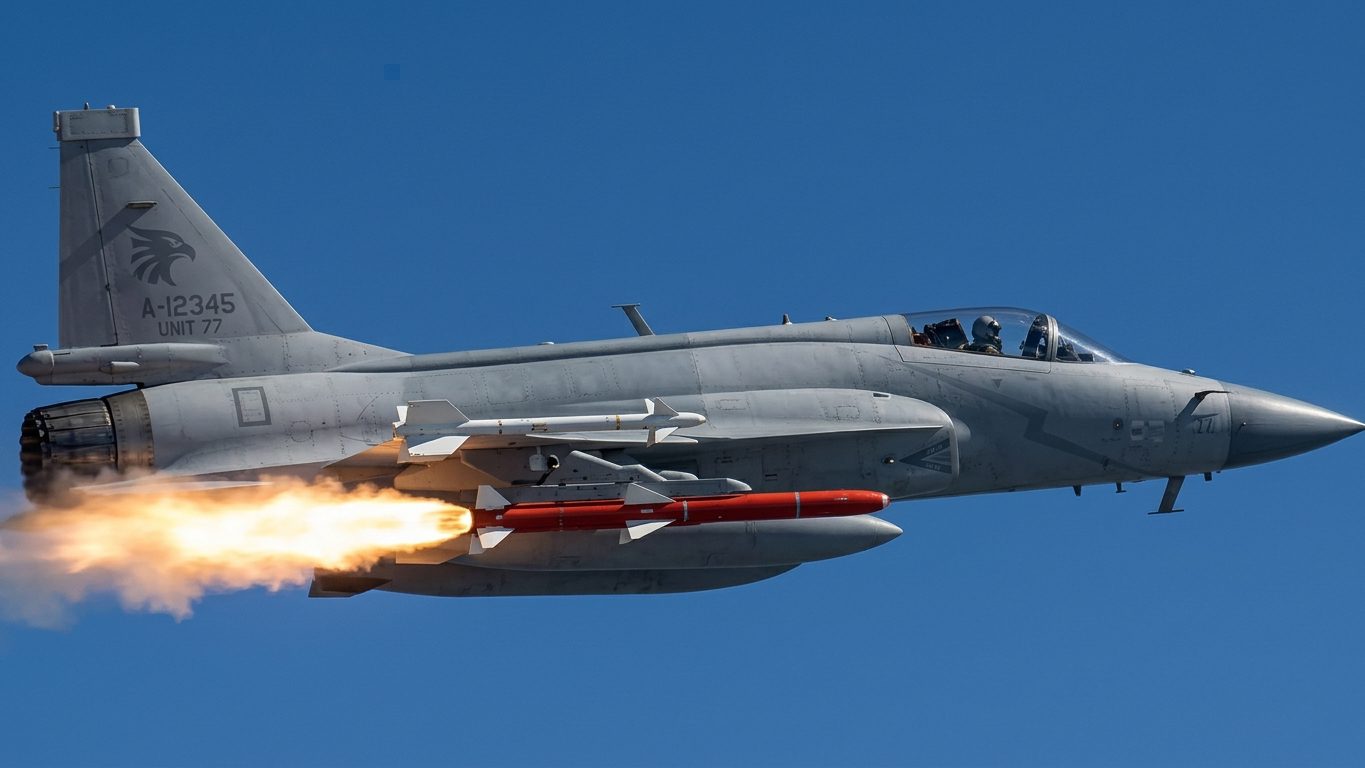
ISLAMABAD (Web Desk) – Pakistan has successfully conducted the flight test of its first indigenously developed Fa’az air-to-air missile, marking a significant advancement in the country’s defence technology and strengthening efforts to expand domestic aerospace manufacturing capabilities.
The successful test was announced by the Inter-Services Public Relations (ISPR) on Tuesday, November 3, which described the development as an important achievement in Pakistan’s efforts to achieve greater self-reliance in advanced military technology.
The missile has been equipped with a modern terminal guidance system designed to track and engage aerial targets during the final phase of its flight. According to the military, this capability will improve the operational flexibility of the Pakistan Air Force (PAF) and enhance its ability to respond to aerial threats.
The achievement highlights the growing role of domestic scientists, engineers and defence researchers in developing sophisticated weapon systems for the country’s armed forces.
Advanced guidance technology enhances missile capabilities
One of the most significant features of the Fa’az missile is its terminal guidance system, which allows the weapon to adjust its flight path towards an aerial target during the final stage of an engagement.
In air-to-air combat, accurate target tracking is essential because aircraft and other aerial platforms can change direction and altitude rapidly.
A reliable terminal guidance system can help improve interception accuracy and increase the effectiveness of a missile against moving aerial targets.
The ISPR said the new weapon system offers longer-range engagement capabilities, although it did not disclose its maximum operational range, speed, dimensions or other detailed technical specifications.
The military also did not announce when the missile would enter operational service or identify the aircraft used during the successful flight test.
The availability of such technical details will remain important for understanding the missile’s full operational capabilities and its intended role within the Pakistan Air Force.
Boost for Pakistan Air Force modernisation
The successful Fa’az test is expected to support Pakistan’s broader efforts to modernise its air force and strengthen its domestic defence production capabilities.
The Pakistan Air Force operates several advanced fighter aircraft, including the JF-17 Thunder, which was jointly developed by Pakistan and China.
The JF-17 has become an important component of the country’s military aviation capabilities and represents a major example of international cooperation in aircraft development.
However, the ISPR did not confirm whether the Fa’az missile was tested using the JF-17 or another aircraft.
Developing indigenous air-to-air weapons could provide Pakistan with additional opportunities to integrate locally developed technologies into its existing and future aircraft programmes.
It could also reduce dependence on foreign suppliers in selected areas of defence equipment and support the growth of domestic engineering expertise.
Scientists and engineers receive appreciation
The successful flight test was witnessed by senior military officers, scientists and engineers who contributed to the development of the missile.
President Asif Ali Zardari, Prime Minister Shehbaz Sharif, Chief of Army Staff and Chief of Defence Forces Field Marshal Syed Asim Munir, and the services chiefs congratulated the teams involved in the project.
The country’s political and military leadership praised the dedication, professional expertise and technical contributions of the scientists and engineers.
Their development efforts were recognised as an important contribution towards strengthening Pakistan’s indigenous defence industry and advancing technological self-reliance.
Follows recent missile development achievements
The Fa’az test comes after several other missile-related developments announced by Pakistan’s military during recent weeks.
On October 6, the ISPR announced the successful test of the extended-range Fatah-4 ground-launched cruise missile.
Another major development followed on October 13, when the military announced the successful test of the Fatah-2 Extended Range hypersonic ballistic missile.
These developments reflect continuing research and development activities across different areas of Pakistan’s missile and defence technology programmes.
While the Fatah systems represent ground-based missile capabilities, the Fa’az development adds an air-to-air weapon system to the country’s recent series of announced technological achievements.
Indigenous defence production remains a strategic priority
The successful test represents an important step in Pakistan’s efforts to strengthen domestic research, engineering and manufacturing capabilities.
Indigenous development can provide greater control over technological improvements, maintenance arrangements and future modifications of military equipment.
It can also create opportunities for local defence organisations to develop specialised expertise and contribute to the wider aerospace industry.
However, the missile’s actual operational performance, production timeline and eventual deployment will depend on further testing, evaluation and decisions by the relevant military authorities.
With the successful flight test of the Fa’az missile, Pakistan has demonstrated another milestone in its efforts to develop advanced domestic defence systems.
The achievement is expected to contribute to the country’s ongoing aerospace development programme and support the modernisation objectives of the Pakistan Air Force.