


By Muhammad Mohsin Iqbal
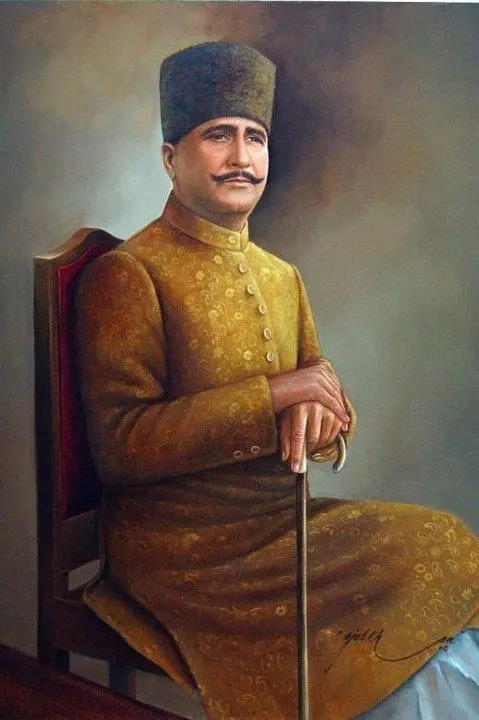
When Allah Almighty ordains the rise of a nation, He sends among them chosen souls who serve as the torchbearers of His divine will. Such individuals are endowed with wisdom, courage, and spiritual insight to guide humanity out of darkness into light. Among the blessed personalities who kindled the flame of awakening in the hearts of the Muslims of the Sub Continent, Allama Muhammad Iqbal stands foremost.
Read also: Pulse of regional diplomacy beats in Islamabad
He was not merely a poet who stirred emotions, but a thinker who sculpted destinies. His poetry was not confined to rhyme and rhythm—it was a call to action, a message of divine inspiration, and a roadmap for the spiritual and political emancipation of the Muslim Ummah.
Allama Iqbal was a poet, philosopher, reformer, and visionary whose intellect transcended his age. His verses echoed not only in mosques and classrooms but in the very soul of a nation yet unborn. With remarkable foresight, he envisioned a separate homeland where Muslims could live with dignity, freedom, and moral integrity—where faith and modernity would blend to form a just, dynamic society. It was Iqbal who recognized the extraordinary leadership potential of Muhammad Ali Jinnah, preparing and persuading him to take up the daunting responsibility of leading the Muslims of India toward their promised destiny. The dream he conceived in 1930 took form seventeen years later, when Pakistan emerged on the world map on August 14, 1947.
Now, as Pakistan crosses the milestone of seventy-five years, the question arises; have we lived up to the expectations of that noble dreamer? Have the ideals he so passionately preached been translated into reality? Have we become the nation of self-respecting, disciplined, and morally upright individuals that Iqbal desired?
Sadly, the answers are disheartening. Iqbal envisioned a Pakistan where knowledge would be a means to serve humanity, not a ladder to corruption and self-interest. Yet today, the education system stands divided and weakened—producing degrees without direction, intellect without ethics, and ambition without compassion. The youth, whom Iqbal addressed as the “Shaheen,” meant to soar above worldly desires and serve as pioneers of change, are often seen disillusioned, trapped in materialism, and deprived of purpose. Their wings are heavy with societal burdens—unemployment, inequality, and moral confusion.
Politically, the decline is equally lamentable. Iqbal dreamed of a state where leadership would be synonymous with service, humility, and justice. But our political culture has often revolved around self-interest, power struggles, and empty rhetoric. The true spirit of democracy—rooted in accountability and sincerity—has been overshadowed by greed and division. The ruling elite, instead of following Iqbal’s vision of “Khudi” (selfhood) and selflessness, have succumbed to the allure of privilege and expediency.
Allama Iqbal’s vision also encompassed social justice and compassion for humanity. He warned against class divisions, exploitation, and moral decay. Yet our society remains plagued by inequality. The poor struggle for survival while the affluent flaunt excess. We have built grand mosques but failed to build a sense of brotherhood. We preach morality but practice hypocrisy. Corruption, which Iqbal regarded as a moral disease, continues to erode our national character. The very ideals of honesty and service that he celebrated in his poetry are often neglected in public life.
Religious scholars, too, have not entirely fulfilled their duty. Instead of guiding society toward unity and tolerance, many have allowed sectarian differences to widen. Iqbal’s Islam was dynamic, progressive, and rooted in the spirit of Ijtihad—the constant striving for new understanding in the light of the Qur’an and Sunnah. He urged Muslims to move beyond rigid traditions and embrace intellectual revival. However, instead of being centers of enlightenment, many religious institutions have become symbols of stagnation and discord.
Even in the economic sphere, we have not realized Iqbal’s dream of self-reliance. He warned against servitude to foreign powers and dependence on external aid. Yet, decades later, our policies often reflect a reliance that undermines sovereignty. Iqbal’s vision was not of a Pakistan that begged for loans but of one that stood tall through hard work, integrity, and faith.
Despite this bleak reflection, Iqbal’s message is not one of despair. It is a message of revival—a call to rediscover our lost potential. His poetry reminds us that nations rise not through wealth or weapons but through character, unity, and conviction. “Khudi ko kar buland itna,” he wrote, “ke har taqdeer se pehle, Khuda bande se khud pooche, bata teri raza kya hai.” His message was clear; individual moral strength leads to collective national greatness.
To move forward, we must return to the foundations laid by Iqbal. First, education must be reformed—not merely to impart information but to nurture faith, ethics, and critical thinking. The youth should be equipped with skills and a sense of moral responsibility to serve their nation. Secondly, leadership at all levels must internalize Iqbal’s ideal of mard-e-momin—a person of faith, integrity, and courage—who rules not by fear or deceit but by example.
Thirdly, economic policies must prioritize self-sufficiency. We must promote industrial growth, innovation, and fair opportunities for all citizens. The state must ensure that no child sleeps hungry and no young graduate remains hopeless. Fourthly, our religious discourse must move toward unity, compassion, and tolerance. The message of Islam, as Iqbal emphasized, is one of balance—between reason and revelation, faith and action.
Above all, we must cultivate the spirit of self-accountability. If every Pakistani, regardless of position or status, commits to honesty and justice, the nation will inevitably rise. Iqbal’s Pakistan was to be a moral state—a reflection of Islamic principles where compassion reigns over cruelty, merit over mediocrity, and service over self-interest.
Seventy-five years may have dimmed the dream, but it has not died. The soul of Iqbal still calls upon us from the depths of his verse—to rise, to rebuild, and to rediscover the greatness within. Pakistan can still become the realization of his dream if we, as a nation, awaken from complacency and embrace his vision in spirit and in action. For the destiny of this land, as Iqbal believed, lies not in the stars but in the strength of its people.