


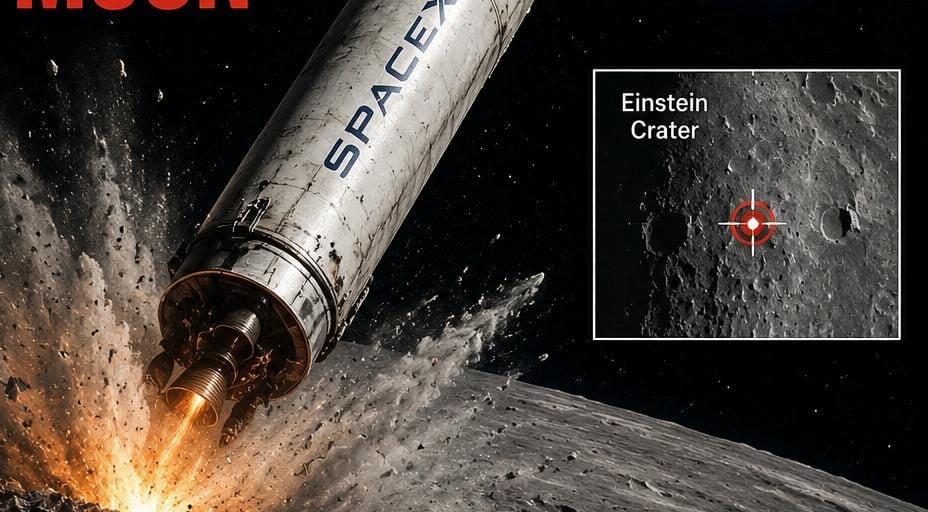
LONDON (Dunya News) – A discarded upper stage of a SpaceX Falcon 9 rocket is believed to have crashed into the Moon at a speed of around 8,700 kilometres per hour, potentially creating a new crater on the lunar surface.
The impact was expected to occur at around 5:35am BST on Wednesday, with astronomers around the world monitoring the predicted location in an effort to capture the rare event and study its scientific effects.
The object involved is the upper stage of a SpaceX Falcon 9 rocket launched in January 2025. The rocket carried payloads including Japan-based ispace’s Resilience lunar lander as well as Firefly Aerospace’s Blue Ghost mission.
The approximately 14-metre-long upper stage, weighing around 4,000 kilograms, eventually entered an orbit that placed it on an unintended collision course with the Moon.
Astronomers had predicted that the spacecraft would strike near Einstein crater, close to the edge of the lunar surface visible from Earth.
Scientists monitor impact
Researchers and observatories were expected to examine the area before and after the collision in an attempt to determine whether the impact created a detectable crater and ejecta plume.
NASA estimates that the collision could have produced a crater approximately 18 metres wide and 4 metres deep.
Lunar orbiters operated by the United States and South Korea are also expected to provide observations of the impact site, potentially offering scientists a closer look at the consequences of the collision.
Hannah Sargeant of the University of Leicester said the incident raised concerns about the growing amount of human-made material being sent into space and eventually reaching other celestial bodies.
She argued that spacecraft operators should consider the consequences of leaving discarded hardware on trajectories that could lead to unintended impacts.
Debate over lunar debris
The incident has also revived debate over whether spacecraft and rocket stages should be deliberately disposed of in ways that minimise contamination or unintended impacts on the Moon.
Sargeant noted that space agencies such as NASA and the European Space Agency generally consider spacecraft end-of-life plans when designing missions. However, commercial companies are not necessarily subject to the same requirements, she said, while efforts are being made to introduce stronger rules.
The Falcon 9 upper stage ended up on a lunar collision trajectory after the rocket’s launch profile left it without sufficient control to return safely to Earth.
Despite concerns about the accident, scientists said the impact could provide valuable information.
Roberto Bugiolacchi of the Macau University of Science and Technology said an impact with known parameters such as mass, velocity, angle and trajectory could offer useful data about how planetary surfaces evolve.
The Moon has already been subjected to countless natural impacts as well as decades of spacecraft activity from several countries.
David Rothery of the Open University said the Moon contains an estimated 100 million natural impact craters of a similar size, meaning the new crater would have little geological significance on a global scale.
However, he described the accidental collision as reckless and said a deliberately planned impact could be scientifically valuable if it were designed to study the Moon’s surface or interior.
The incident highlights a growing challenge as commercial and government missions send increasing numbers of spacecraft and rocket stages towards the Moon and other celestial bodies.


