By Maheen Sultan
KARACHI: Pakistan’s banking sector has channelled an overwhelming share of its investment portfolio into government securities, highlighting the growing reliance of the state on commercial banks and raising concerns about the availability of credit for businesses, industry and other productive sectors.
Read also: Governor SBP calls on banks to harness technology to significantly increase financial deepening
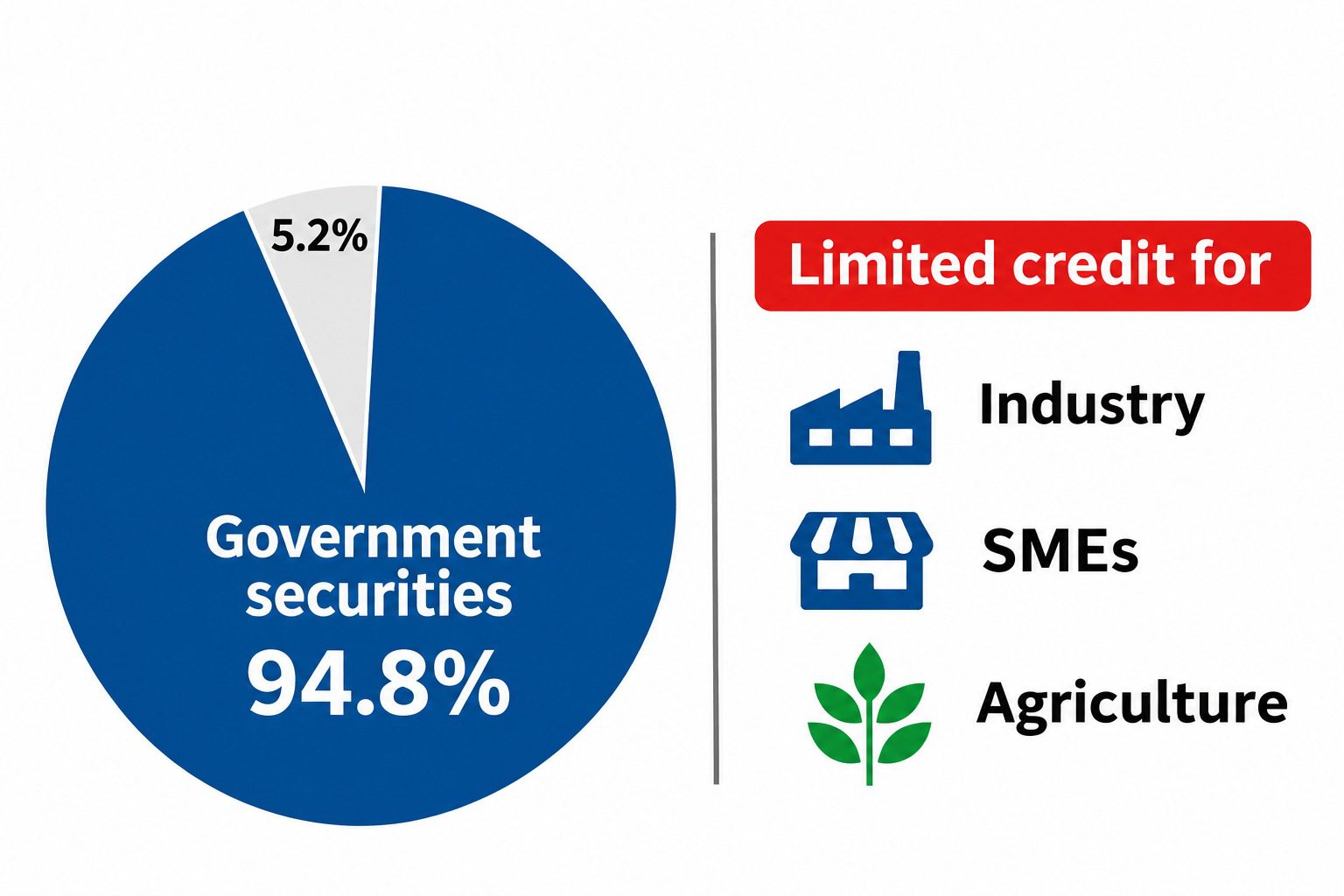
According to the State Bank of Pakistan’s (SBP) Financial Stability Review 2025, government securities accounted for 94.8% of the banking sector’s total investment portfolio during calendar year 2025. The value of these securities increased by Rs9.2 trillion, or 32.9%, during the year, reflecting the government’s continued reliance on banks to finance its budgetary requirements.
The concentration of investments in government papers has intensified debate over whether the banking system is adequately supporting private-sector activity, particularly at a time when businesses require financing to expand production, upgrade technology, create employment and improve export competitiveness.
The SBP report also showed that investments accounted for 61.8% of the banking sector’s total assets in December 2025, while advances represented 23.5%. The figures illustrate the significant weight of investments in banks’ balance sheets, although the 94.8% figure relates specifically to the composition of the investment portfolio and not to total deposits or assets.
More recent banking data for September 2026 show that total deposits increased 16% year-on-year to Rs40.83 trillion, while advances rose 14.3% to Rs15.38 trillion. Total investments stood at Rs40.14 trillion, taking the advances-to-deposits ratio (ADR) to 37.7% and the investment-to-deposits ratio to 98.3%.
These figures indicate that investments remain substantially higher than advances relative to the deposit base. However, the September 2026 investment total includes different categories of investments and should not be treated as entirely comprising government securities.
The International Monetary Fund (IMF) has previously warned about the risks associated with the close relationship between the government, commercial banks and the central bank. In its October 2024 report on Pakistan’s sovereign-bank nexus, the Fund said banks’ exposure to the government was three times their exposure to the private sector at the end of 2023.
The IMF cautioned that when banks primarily finance government borrowing, their ability to channel available funds towards the wider economy can be weakened. It said reduced private-sector lending and higher borrowing costs could dampen investment and economic growth over the medium and long term.
The SBP has also acknowledged the problem of incentives within the banking system. Its half-year report for 2024-25 observed that the presence of a dominant government borrower skews banks’ incentives. With profits growing through government borrowing, banks have less motivation to extend financing beyond established private-sector customers, particularly small and medium-sized enterprises (SMEs).
The central bank further noted that bank lending was concentrated mainly in working-capital facilities rather than fixed investment. This limits businesses’ ability to expand production capacity, acquire modern machinery and adopt new technologies — factors essential for improving productivity and industrial competitiveness.
SMEs, agricultural businesses, start-ups and emerging enterprises are particularly vulnerable to limited access to financing. Many smaller businesses lack the collateral, formal documentation and established banking relationships required by conventional lending assessments, despite having viable commercial opportunities.
The issue extends beyond manufacturing. Businesses in education, healthcare, technology and digital media also require access to financing to develop infrastructure, improve services and create employment. A credit system heavily tilted towards established borrowers and government securities can make it harder for new enterprises to secure the capital needed to grow.
Banks, however, operate within commercial and regulatory considerations. Government securities offer liquidity and relatively low credit risk, while lending to smaller businesses involves higher assessment, monitoring and recovery costs. Government borrowing also finances public expenditure and is not inherently unproductive.
The challenge, therefore, is not to eliminate banks’ investment in government securities but to achieve a more balanced allocation of financial resources. Better credit assessment based on business cash flows, stronger credit information systems, risk-sharing arrangements and effective SME financing programmes could help expand lending to productive sectors.
The IMF and SBP assessments point to a structural concern: when government borrowing becomes the most attractive destination for bank funds, the financial system’s role in supporting private investment can weaken. Reducing the government’s dependence on domestic bank borrowing, alongside credible fiscal consolidation and broader financing sources, would help create greater room for businesses.
For Pakistan, the question is not simply how much money banks mobilise in deposits or earn through investments, but how effectively the financial system converts available capital into industrial capacity, innovation, employment and sustainable economic growth.