


By Asim Shahzad
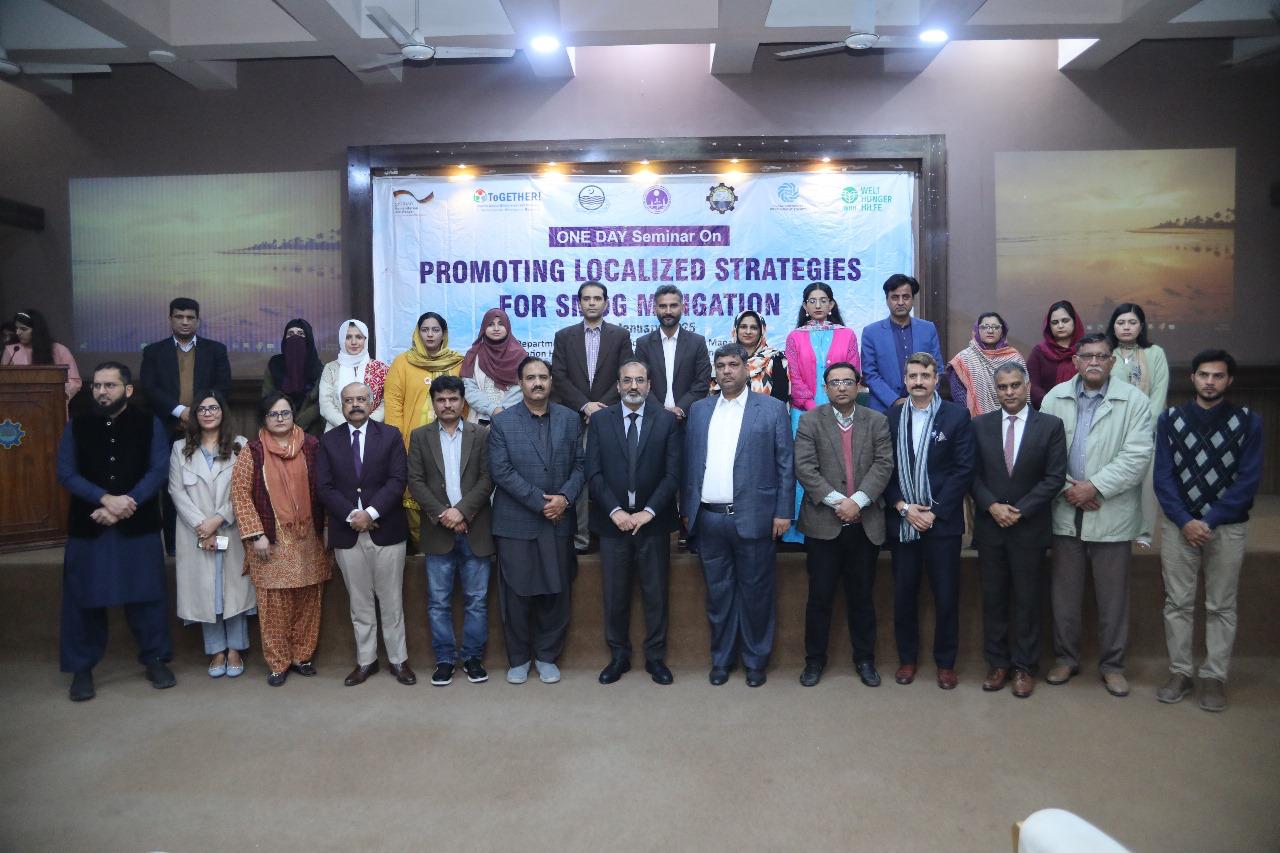
LAHORE: A Seminar on promoting Localized strategies for smog mitigation.
Rural Community Development Society (RCDS), in partnership with Welthungerhilfe, organized a seminar on promoting localized strategies for smog mitigation.
The seminar was held at the Department of Transportation Engineering & Management, University of Engineering & Technology (UET) Lahore.
Read more: 4th International Conference on Emerging Trends in Physics kick started
The seminar was attended by more than 250 participants, including students, faculty members, civil society representatives, members of provincial assembly Punjab, journalists, and government officials.
The main objective of the seminar was to enhance students’ understanding of the causes, consequences, and adverse effects of smog on health, the environment, and quality of life so that they can contribute to smog mitigation.
The experts from academia, researchers, Urban Unit, Environment Protection and Climate Change Department, PDMA, and City Traffic Police officials were invited to share their insights and strategies on smog mitigation in the seminar.
Qaisar Iqbal, Managing Director of RCDS, shared the objectives of the seminar and briefed the audience about RCDS, Welthungerhilfe, and shared a detail of the project.
He said that smog is rapidly increasing in the Punjab, because we are polluting our environment and cutting trees. He added that through localized strategies RCDS and Welthungerhilfe are playing their role to smog mitigation.
While addressing the seminar, experts shared the latest research and findings with local perspectives on climate change. The research highlighted that how climate change is contributing to the smog and air pollution.
Transportation and waste management are contributing to release corban dioxide that is leading to the climate change. The methodology on reducing the corban dioxide was also shared
Speakers discussed on how climate change is impacting on the culture, highlighting that disasters such as heat waves, floods and droughts are occurring in the Pakistan. They added that climate change is affecting the indigenous groups, agriculture and livestock. The speakers mentioned that smog is leaving severe impacts on our life style, adding that climate change is a big threat to our tradition and archaeological sites such as Mohenjo-daro, Harappa etc. Speakers went on to say that climate change is a human rights issue.
Dr Imran Sattar from Health Department addressed the seminar and shared the history of smog and composition of smog. He said smog is severely affecting on the human health, and it is damaging agriculture. He, furthermore, shared the preventive measures of smog, emphasized that during smog, we need to limit our outdoor activities.
Ms. Rahila Khadim Hussain, a Member of Provincial Assembly Punjab, and Member of Women Protection Caucus, shared Punjab Government’s efforts on smog mitigation and policy on the environment protection. She emphasized that all citizens of the country have together to protect our environment, adding that we are equally responsible to clean our country, and we can make smog free country with joint efforts.
Speakers shared key contributors of smog, as they informed audience that transportation and industries are major contributors to smog. They shared Actionable strategies to reduce smog. The role of academia and devising potential strategies on climate action and adaptation to reducing smog was shared with audience.
Prof. Dr. Shahid Munir, Vice Chancellor of the University of Engineering and Technology (UET), addressed a seminar, appreciating the efforts of RCDS and Welthungerhilfe for collaborating with academia on the issue of climate change.