


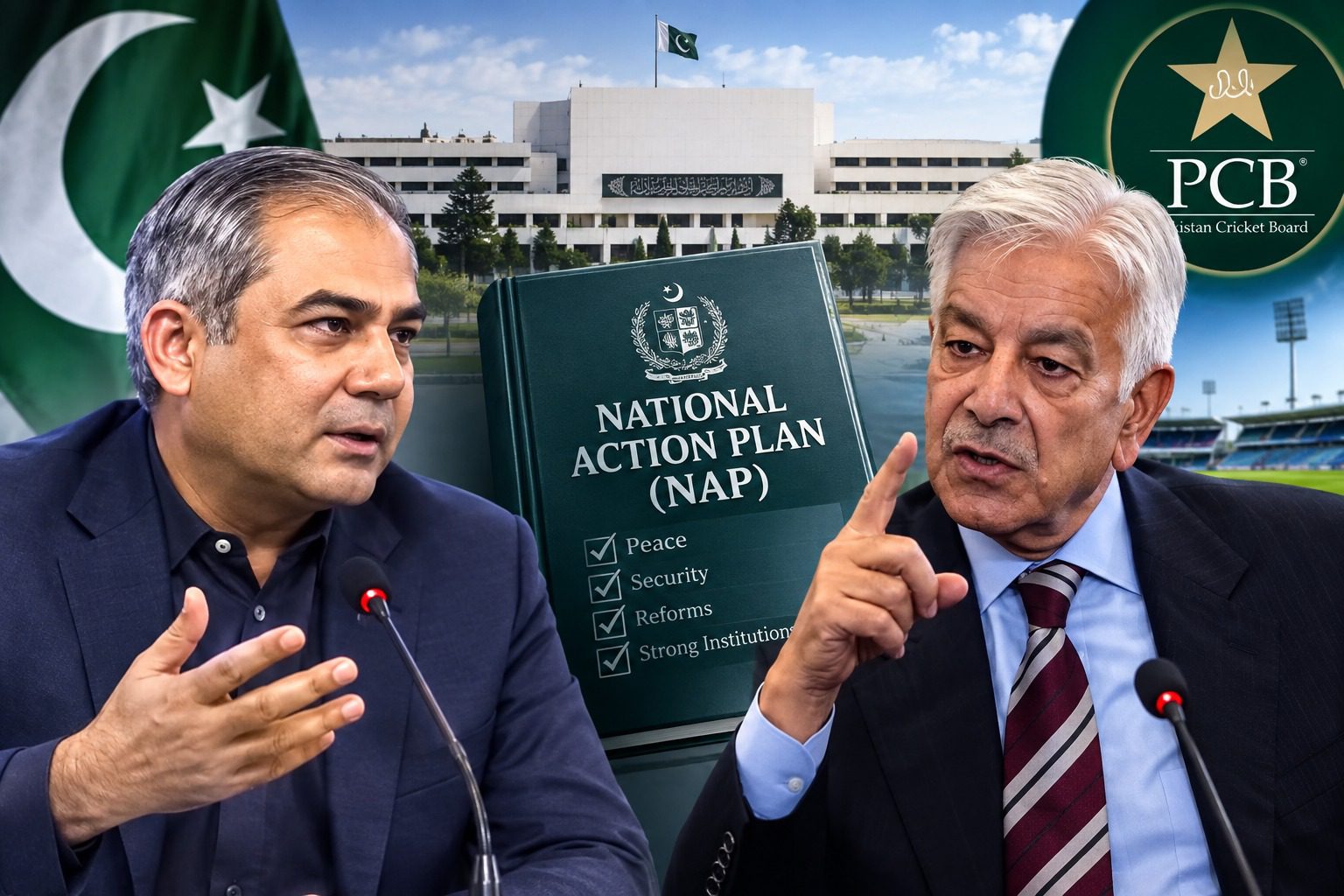
ISLAMABAD (Web Desk) – Defence Minister Khawaja Asif has challenged Interior Minister Mohsin Naqvi to begin the governance overhaul he has called for by focusing on the implementation of the National Action Plan (NAP) and reforming his own ministry.
Asif was responding to Naqvi’s recent remarks that Pakistan’s governance system had deteriorated and required fundamental changes, including the creation of additional administrative units to improve public services, accountability and access to justice.
Naqvi, who also serves as chairman of the Pakistan Cricket Board (PCB), had made the comments while addressing the Pakistan Economic Summit. He argued that the country needed stronger institutions and new leadership capable of responding to the aspirations of its young population.
A day later, Inter-Services Public Relations (ISPR) Director General Lt Gen Ahmed Sharif Chaudhry also called for consideration of changes to the country’s administrative structure. He said effective governance was closely linked to national security and stability.
In a post on X, Asif said he broadly agreed with Naqvi’s assessment of the system, describing the interior minister as a “powerhouse”. However, he argued that meaningful institutional change should be pursued through constitutional forums rather than public gatherings.
The defence minister said Parliament or the federal cabinet should provide the platform for discussing fundamental reforms, arguing that this would allow changes to be introduced through a constitutional process.
Asif also questioned Naqvi’s participation in parliamentary and cabinet proceedings, saying that major proposals for changing the system would carry greater weight if presented through the relevant constitutional institutions.
Asif points to National Action Plan
Referring to the DG ISPR’s recent remarks about the NAP, Asif said the plan provides a practical starting point for the reforms proposed by Naqvi.
He argued that while the armed forces were fulfilling their responsibilities under the plan at considerable human cost, several other components remained to be implemented by civilian authorities.
Asif therefore urged Naqvi to begin the reform process by ensuring implementation of the NAP through the Interior Ministry.
“Begin the change in the system with the implementation of NAP; begin the change in the system with your ministry,” Asif said in his post.
PCB also comes under criticism
In another post, Asif turned his attention to the Pakistan Cricket Board, which is headed by Naqvi.
He said systems should continuously evolve and suggested that Naqvi could demonstrate his reform agenda by introducing major changes within the PCB.
Asif argued that Naqvi had considerable authority over the cricket board and faced fewer institutional obstacles there. He also said cricket fans were dissatisfied with the PCB’s performance.
Debate over new provinces
Naqvi’s proposal for restructuring the administrative system and creating additional provinces has triggered a political debate.
The PPP has referred the issue to its highest decision-making forum, while Sindh Chief Minister Murad Ali Shah has rejected the proposal. Lawyers in Lahore have also questioned its constitutional basis, while Sindhi nationalist groups have called for Naqvi to resign.
The Muttahida Qaumi Movement-Pakistan (MQM-P), a coalition partner of the PML-N-led federal government, has repeatedly advocated making Karachi a separate province.
The PPP, which governs Sindh and is also part of the federal coalition, has strongly opposed the proposal.
The growing debate has placed governance reform, administrative restructuring and the creation of new provinces at the centre of a wider political discussion about Pakistan’s institutional future.


