


By Dr Alamdar Hussain Malik
Eid-ul-Azha is not merely a religious festival but a profound lesson of selflessness, sacrifice, love, brotherhood, and humanity. These were the days when homes were filled with joy, children insisted on new clothes, streets echoed with the sounds of animals, and every face carried a strange glow. But today the common man in Pakistan approaches Eid-ul-Azha not with happiness, but with fear, helplessness, and anxiety.
If in a state even the days of Eid are filled with tears instead of joy, if festivals themselves become mirrors of deprivation, then it is no longer just an economic crisis but a national wound. It is in this painful reality that we witness the last smile of common man: Eid-ul-Adha lost in shadow of inflation and hunger—a smile that once symbolized hope but now struggles to survive under crushing economic pressure. It is that moment when promises of prosperity fade into silence, leaving only one unanswered question: what kind of happiness is this that never reaches the door of the common man?
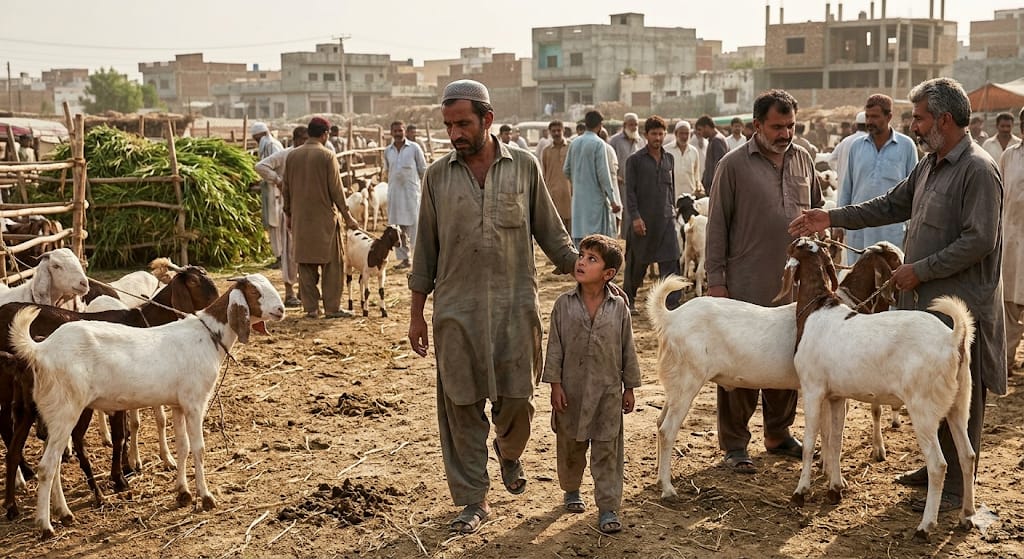
The father who once considered buying an animal for sacrifice as a matter of pride and joy for his children now silently returns from the market after seeing the prices of animals. His pockets are empty, his eyes are lowered in shame, and his heart is wounded by the questions of his children. He wonders what answer he will give when they ask:
“Father! Why will we not be able to sacrifice this time?”
The common man of Pakistan today is crushed between inflation, unemployment, heavy electricity bills, gas shortages, and the skyrocketing prices of flour, sugar, ghee, pulses, and meat. Salaries remain the same, but expenses have multiplied several times. A laborer who works all day under the sun earns only enough to afford two meals a day. In such conditions, buying an animal for sacrifice is becoming nothing more than a dream.
Pakistan’s current economic situation is extremely complex and under severe pressure.
The country faces high inflation, limited economic growth, and rising unemployment. According to various economic reports, inflation in recent years has at times reached around 25 to 30 percent, severely reducing the purchasing power of ordinary citizens. Unemployment has become a major issue, especially among the youth, while millions rely on uncertain incomes in the informal sector.
Alongside this, Pakistan’s total debt has reached several trillion rupees, with a large portion of the budget consumed by debt servicing and interest payments, leaving little space for meaningful public relief.
The common man in Pakistan is not only suffering emotionally but also statistically under severe economic stress. Inflation has repeatedly pushed the middle class into financial instability, shrinking their ability to sustain basic living standards.
Although some official statistics show a slight decline in inflation in recent months, the reality remains that essential commodities such as meat, sugar, flour, electricity, gas, and daily necessities are still beyond the reach of the average citizen. Rising utility bills have destroyed household budgets, forcing families to choose between survival and basic dignity.
According to international financial institutions and economic analysts, poverty in Pakistan continues to rise, with millions of families now living close to or below the poverty line.
Unemployment, uncertainty, and declining purchasing power have created a deep psychological burden on society.
On the occasion of Eid-ul-Azha, the prices of sacrificial animals have also moved far beyond the reach of the common man. The price of a single goat, sheep, or cow now reaches hundreds of thousands of rupees, while the monthly income of a daily wage worker is not even enough to meet basic household expenses. This is why millions of families, despite a strong desire to fulfill the Sunnah of sacrifice, remain helpless due to financial constraints.
What kind of Eid is this where on one side a few classes enjoy lavish feasts, while on the other side millions struggle for basic necessities? What kind of system is this where the sacrifice of the poor is no longer limited to animals, but their dignity, joy, dreams, and peace have also been sacrificed?
The common man is not only a victim of inflation but has become a prisoner of deprivation. He sees that Eid remains a celebration for the elite, with expensive animals being purchased in grand farmhouses, displayed on social media, while the poor avert their eyes from their children. This difference is not merely economic; it is also the killing of human emotion.
Pakistan’s laborers, shopkeepers, rickshaw drivers, pensioners, and daily wage earners are all under severe mental stress. Their worries are no longer limited to sacrifice alone, but include rent, education fees, medicines, and daily survival costs that have crushed them from within. Eid, once a sacred festival of joy, has now turned into a test of endurance.
Pakistan’s current economic condition has led ordinary citizens to believe that the entire nation is trapped under overwhelming financial pressure. Strict conditions imposed by international financial institutions, especially the International Monetary Fund, rising taxes, expensive utilities, and removal of subsidies have turned daily life into continuous hardship. It now feels as if not only animals but the entire nation is being sacrificed. Every father is sacrificing his desires, every mother her needs, and every child their innocent joy.
Eid-ul-Azha reminds us of the great sacrifice of Prophet Ibrahim (AS), but perhaps in today’s Pakistan, the greatest sacrifice is being made by the common man. He is sacrificing his dreams, his desires, his happiness, and even his dignity.
If in a state even the days of Eid bring tears instead of joy, if children’s eyes show deprivation instead of sparkle, if mothers’ prayers are mixed with silent sighs, then this is not merely an economic issue but a sign of national decline.
The most painful scene is when a father returns empty-handed from the market and his innocent child runs to the door asking:
“Father! When will our goat come?” And the father has no answer except silence. He lowers his gaze, because he sees in his child’s eyes dreams that he cannot fulfill.
The most heartbreaking moment is when a mother comforts her children while silently breaking inside, and a father stays awake all night calculating whether to run the household or fulfill his children’s wishes.
This poverty does not only exhaust the body but wounds the soul as well. It steals peace, removes inner satisfaction, and dims the light of hope. It creates a void that money cannot fill and time cannot heal. Poverty keeps a person alive but takes away the feeling of living.
This reality is no longer just an economic condition—it has become a collective psychological wound that may affect generations.
In such a scenario, the last smile of common man: Eid-ul-Adha lost in shadow of inflation and hunger becomes not just a phrase, but a lived reality for millions of families across the country.
It is necessary that the government, state institutions, and the privileged class do not merely perform the ritual of sacrifice this Eid, but truly feel the pain of the common man. Because sacrifice is not only about slaughtering animals; bringing a smile to a helpless person’s face is also an act of worship.
If we fail to understand this, then Eids will remain only calendar dates, not festivals of joy. For the hungry, distressed, and deprived, even the crescent of Eid rises with sadness—a crescent that does not bring light, but leaves behind a question: for whom is happiness in this country?