


By Commerce Reporter
LAHORE: The Government of Punjab has introduced a series of sweeping legislative amendments in its latest Finance Bill 2026-27 , aiming to modernize the provincial tax infrastructure, boost revenue mobilization, and crack down on security loopholes.
Administered largely by the Excise, Taxation & Narcotics Control (ET&NC) Department, the new bill strikes a calculated balance between hitting high earners with structural tax hikes and offering major administrative reliefs to struggling agricultural and commercial sectors.
What is Increasing?
1. Token Tax Hiked for High-Capacity Cars
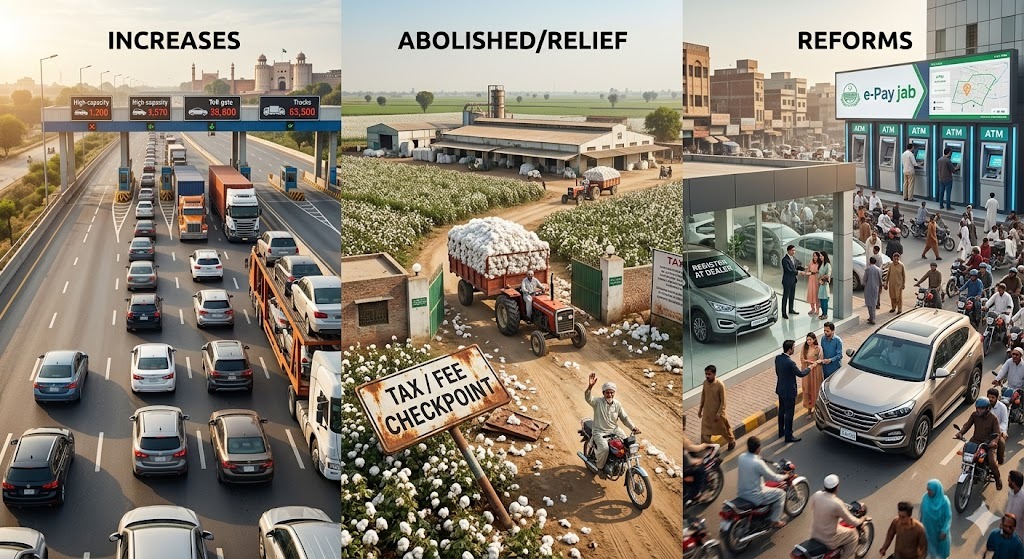
To better align provincial revenues with actual asset values, token tax rates for all passenger cars with engine capacities above 1000cc have been increased. Owners of high-value and luxury vehicles will now face higher annual costs to keep their vehicles on the road.
2. Commercial Vehicle Tax Revised After Two Decades
In a major structural shift, tax rates on commercial vehicles—including trucks, delivery vans, and logistics transport—have been officially revised. This marks the first major update to commercial transport levies in more than 20 years, brought forward by the government to reflect modern economic realities and inflation.
What is Being Abolished or Lowered? (Taxpayer Relief)
1. Cotton Fee Banned in South Punjab
In a massive win for the agricultural sector, the government is completely abolishing the seasonal cotton fee originally imposed under the Punjab Finance Act, 1973.
Historically levied on raw cotton arriving at ginning factories, the tax has been scrapped to provide urgent economic relief. A sharp decline in local cotton production had previously forced numerous ginning factories across South Punjab to shut down permanently.
2. Surcharge Penalties Diluted
Property owners facing late payment surcharges on their property tax will find significant relief under the new bill. Surcharges will now be calculated and levied on a quarterly basis instead of the current monthly system, heavily reducing the compounding penalty burden on late taxpayers.
Major Administrative & Digital Reforms
1. Mandatory e-Pay for Property Tax
Property tax, which operates as a major provincial levy on urban immovable properties under the Punjab Urban Immovable Property Tax Act, 1958, is shedding its paper trail. Moving forward, payment via the digital e-Pay system has been made strictly mandatory, eliminating manual payment modes to improve transparency, block revenue leakage, and offer better convenience to property owners.
2. Spot Registration by Car Dealers
In a critical move to improve provincial law and order, the government has amended the Punjab Motor Vehicle Transaction Licensee Act, 2015.
Motor vehicle dealers are now officially designated as legal agents of the ET&NC Department. They will be legally empowered—and required—to register motor vehicles right at the point of sale. This move intends to expedite the registration pipeline and entirely eliminate the illegal practice of driving unregistered vehicles (“plying without registration”) off the showroom floor.
The Bottom Line: Provincial officials state that these changes are designed to expand Punjab’s structural revenue base, ensure equity across different income brackets, simplify compliance mechanisms, and maximize transparency through digital-first enforcement.