


LONDON (Web Desk) – International oil prices declined significantly on Monday after US President Donald Trump announced that Washington was moving towards renewed talks with Iran, prompting investors to reassess the risk of further disruption to crude supplies from the Middle East.
The market reaction reflected growing expectations that diplomatic engagement between Washington and Tehran could help reduce the possibility of a wider military confrontation in the region.
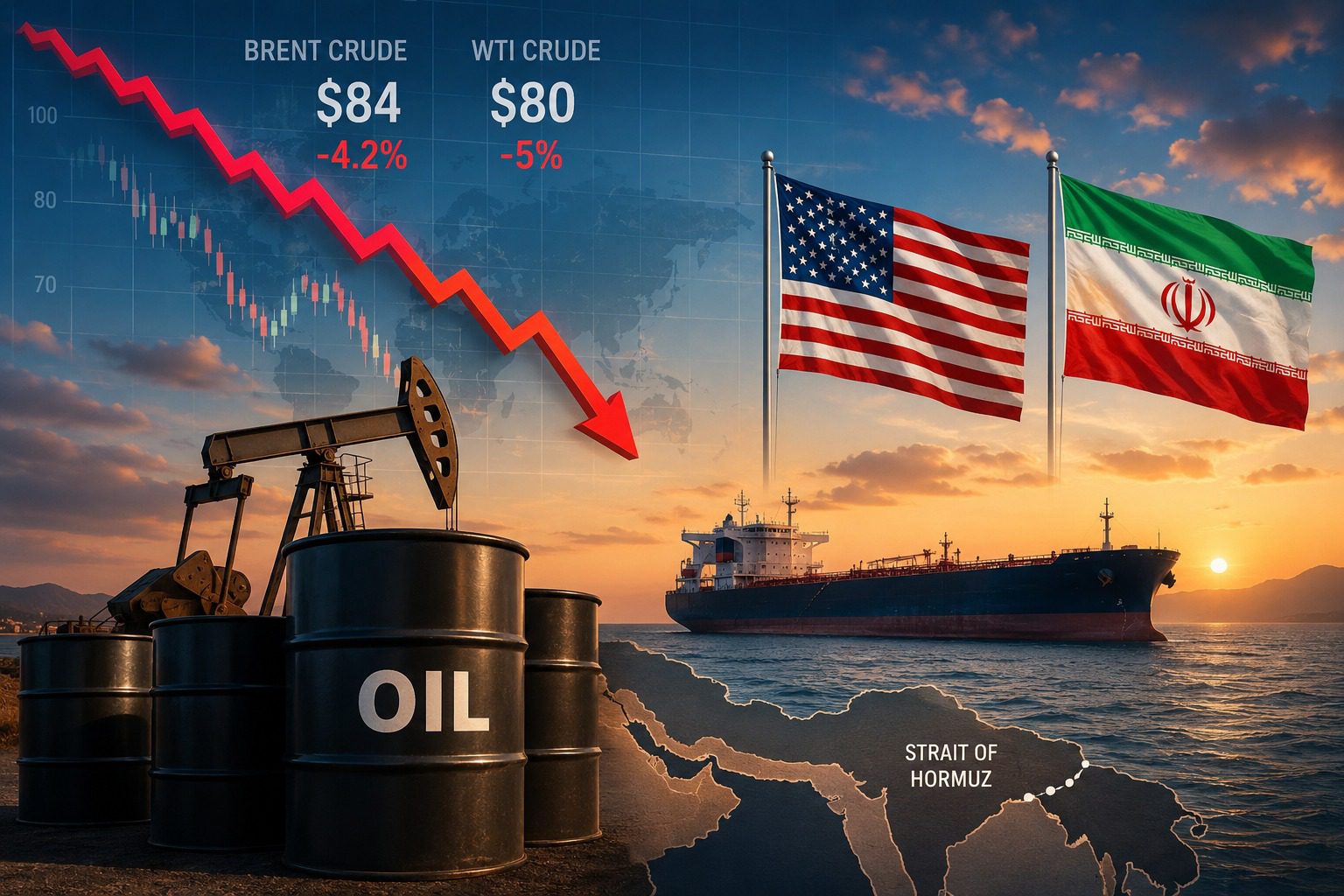
Brent crude, the international benchmark, fell by about 4.2 per cent to nearly $84 per barrel, while US West Texas Intermediate (WTI) crude declined by around 5pc to approximately $80 per barrel.
The sharp movement came as traders responded to signs that the geopolitical risk premium built into oil prices could begin to ease if the United States and Iran make progress towards a diplomatic understanding.
Investors focus on supply risks
Oil markets have remained highly sensitive to developments involving Iran because of the country’s position near the Strait of Hormuz, a crucial maritime passage for global energy shipments.
Trump’s announcement encouraged investors to reduce some of the premium attached to crude prices because a reduction in military tensions could allow energy transportation through the region to gradually return towards normal levels.
However, the situation remains uncertain.
Although diplomatic contacts are being discussed, shipping activity through the Strait of Hormuz has not yet fully recovered. Iran has not announced an unrestricted reopening of the waterway, leaving international energy traders cautious about the outlook for supplies.
Iranian authorities have indicated that discussions with Oman are continuing over arrangements for a temporary secure maritime corridor. If such an arrangement is successfully established, it could permit vessels to move through the strategically important waterway on a limited basis.
A broader restoration of maritime traffic would be closely watched by oil-consuming countries because even a partial improvement in shipping conditions could ease concerns about shortages and transportation costs.
Hormuz remains central to oil markets
The Strait of Hormuz is among the world’s most important energy routes, with substantial volumes of crude oil and petroleum products normally passing through it every day.
Current flows are reported to be well below levels seen before the conflict. Around 5 million barrels per day are currently moving through a southern route near Oman, compared with an estimated 20 million barrels per day before the disruption.
The difference has heightened concerns over global energy supplies and encouraged traders to closely monitor developments involving Iran, the United States and regional shipping routes.
Any further deterioration in security around the waterway could quickly reverse Monday’s decline in oil prices.
Conversely, a sustained diplomatic breakthrough could encourage additional selling in crude markets as traders price out the possibility of a prolonged supply disruption.
Saudi Arabia adjusts export routes
Saudi Arabia has also taken steps to redirect some of its crude exports towards western markets.
Part of the country’s shipments has been moved through the Red Sea, using the Bab el-Mandeb route as an alternative maritime corridor.
The alternative route, however, is not without security concerns. Shipping in the area has previously faced attacks linked to the conflict in Yemen, including incidents involving Houthi forces.
Consequently, energy traders continue to attach a degree of risk to regional transportation despite the latest decline in crude prices.
What could happen next?
The future direction of oil prices will largely depend on whether the latest diplomatic signals develop into substantive negotiations.
If Washington and Tehran succeed in reducing tensions and maritime traffic through the Strait of Hormuz is restored, the pressure on global energy supplies could ease considerably.
Such a development could remove part of the geopolitical premium from crude prices and potentially push benchmarks closer to levels recorded before the escalation.
However, markets remain vulnerable to sudden reversals. A breakdown in negotiations, renewed military confrontation or another major disruption to shipping could quickly send crude prices higher again.
For now, investors appear to be focusing on the possibility of de-escalation. Monday’s sharp decline in Brent and WTI prices suggests that traders are increasingly willing to price in the prospect of improved regional stability.
Nevertheless, the Strait of Hormuz, Bab el-Mandeb and the wider Middle East security environment will remain key factors for the global oil market in the coming days.


