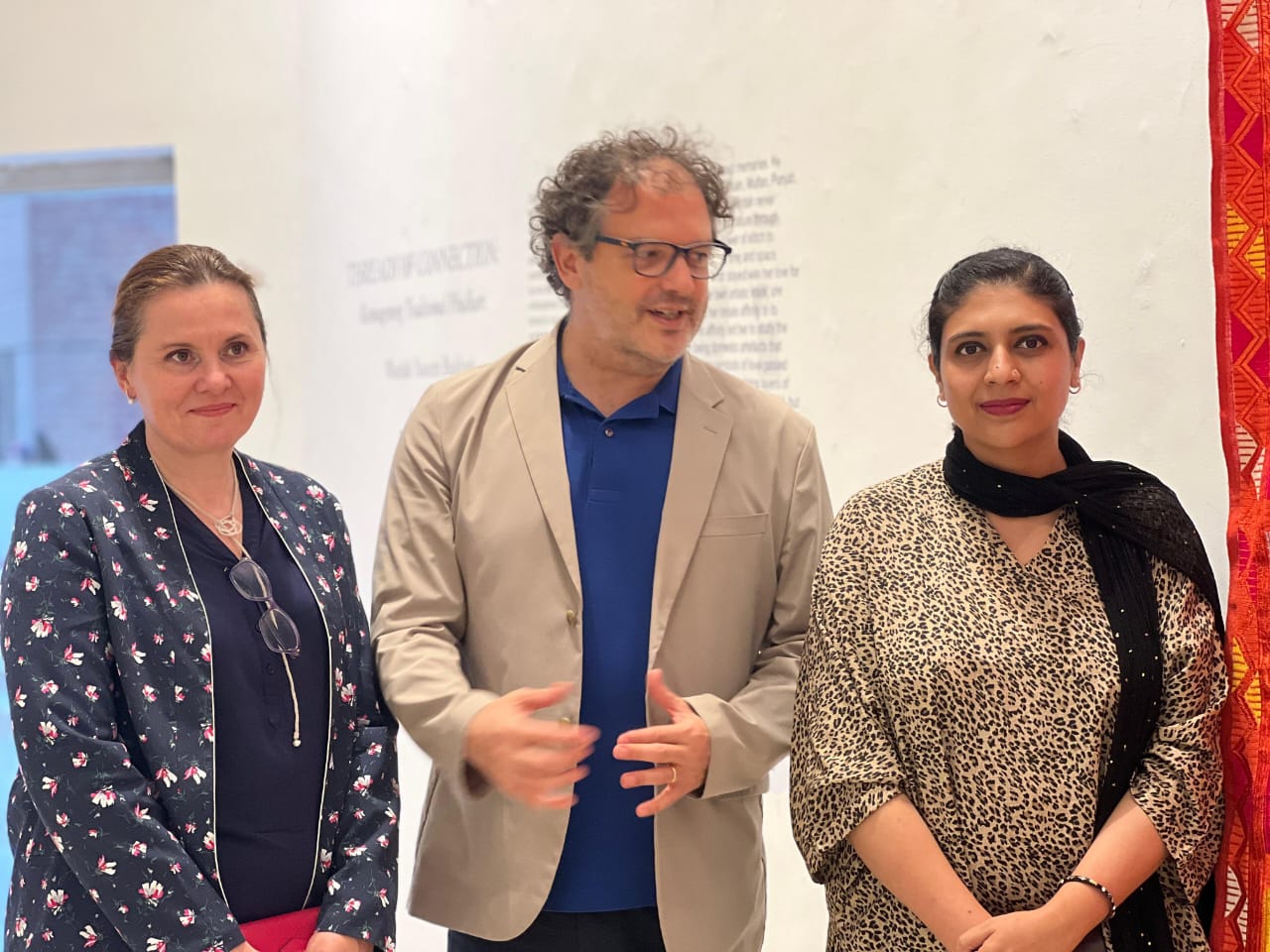



LAHORE, October 17, 2025: The Lahore Arts Council Alhamra presented Threads of Connections: Reimagining the Traditional Phulkari, a solo exhibition by Wardah Naeem Bukhari, curated by Aasim Akhtar, at the Ustad Allah Bux Gallery, Alhamra, the Mall. H.E. Mehmet Eymen Şimşek, Consul General of the Republic of Türkiye, was the Chief Guest of the exhibition. The exhibition invited viewers into a luminous conversation between past and present, where each embroidered stitch served as both testimony and transcendence.
Wardah’s practice traced the intimate lineage of cloth and memory; she drew upon the needlework of her mother as a formative archive, and from those earliest, meditative stitches, she fashioned a contemporary visual language. The works on display transformed Phulkari’s domestic lexicon into a conceptual cartography of identity, layering running stitches, time-honored motifs, and grid-based rigor with daring contemporary interventions.
Across the hangings and panels, the textile became narrative, memory threaded beside abstraction, folklore braided with personal testimony. Wardah’s compositions distilled the communal grammar of Punjab’s embroidery into works that read simultaneously as heirloom and manifesto; they preserved the artisanal rigor of tradition while proposing new modes of expression that speak to the present moment.
Curator Aasim Akhtar’s arrangement emphasized dialogue: historical fragments were positioned next to experimental gestures, and viewers were encouraged to follow the tension between repetition and rupture. In that interplay, the gallery space became a seam where lineage and invention were stitched into an ongoing practice of cultural continuity.
Executive Director Alhamra Mahboob Alam said, “Alhamra was honoured to host an exhibition that made heritage palpably contemporary. Wardah’s work reminded us that creativity is a living archive; through her art, tradition spoke with fresh urgency.”
Artist Wardah Naeem Bukhari expressed, “Phulkari is the voice of women’s hands across generations; in this body of work, I sought to let those hands speak in new tones. Every stitch carried a memory, and every reworking rewrote a story.”
The exhibition attracted scholars, practitioners, and a wide public who came to witness how a regional craft was reframed as a critical and poetic practice. Critics and visitors alike noted the exhibition’s capacity to make textiles act as language, precise, eloquent, and resonant.
Threads of Connections positioned Phulkari not simply as an ornament but as a repository of thought, a practice of belonging, and a vehicle for contemporary inquiry. In doing so, it affirmed Alhamra’s continuing mission to present work that both reveres tradition and interrogates its future.