


By Commerce Reporter
LAHORE: — Chief Collector Customs (Exports) Mohsin Rafiq said that customs authorities are committed to providing maximum facilitation to exporters and positive changes are being considered to improve the Export Facilitation Scheme (EFS).
He said practical measures would be taken to ensure expeditious clearance of export consignments, timely payment of duty drawback claims, and removal of all irritants and bottlenecks in the Export Facilitation Scheme to provide greater ease to the export sector.
He said a committee has been constituted to review the EFS and prepare its future roadmap. The committee will formulate recommendations after consultation with all stakeholders.
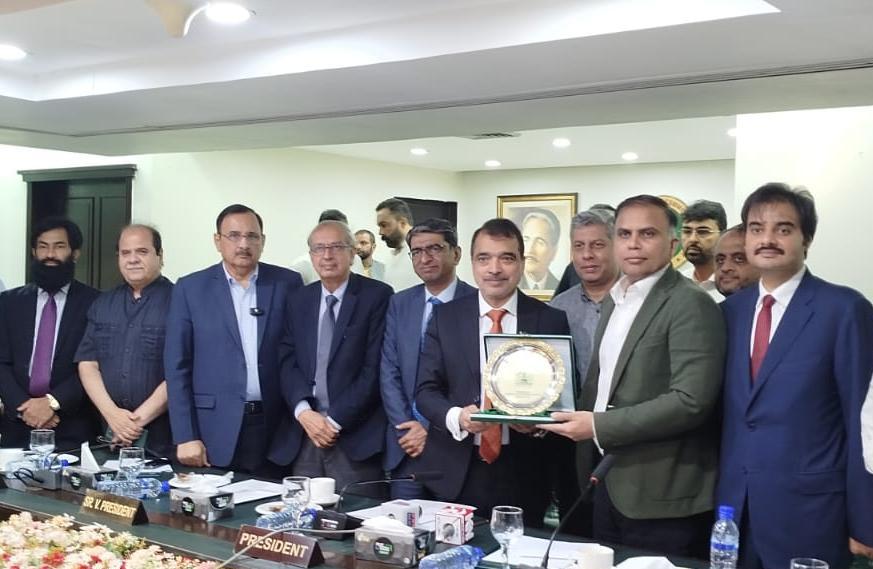
He was speaking at a meeting held at the Lahore Chamber of Commerce and Industry, where LCCI President Faheem Ur Rehman Saigol welcomed him.
Also present on the occasion were Collector Customs Appraisement Lahore Salman Afzal, Senior Vice President Tanveer Ahmed Sheikh, Vice President Khurram Lodhi, former FPCCI and LCCI President Mian Anjum Nisar, former President Muhammad Ali Mian, former Senior Vice President Ali Hussam Asghar, former Vice President Haris Ateeq, and Executive Committee members Firdous Nisar, Ehtesham-ul-Haq, Asif Malik, Karamat Ali Awan, Syed Salman Ali, Zain Elahi, Shouban Akhtar, Ahad Amin Malik, Nadeem Ansari, Amir Ali, Rana Nisar, Syed Hassan Raza and Mohsin Bashir.
Addressing the gathering, LCCI President Faheem Ur Rehman Saigol said that Pakistan is striving for economic stability and higher exports, and the Export Facilitation Scheme can play a key role in achieving these objectives.
He appreciated the government’s decision to extend the utilization period for imported raw materials under EFS from nine months to eighteen months, but said the business community is still facing several issues.
He pointed out that in the textile sector, varying interpretations and appraisements of identical products under different HS codes at different ports are causing unnecessary difficulties, delays and demurrage costs for industrialists. He stressed the need to ensure uniform interpretation and appraisement of HS codes for specific sectors.
The LCCI President further said that approval of Letters of Credit and processing by IOCO takes up to two months.
He noted that the procedures for determining production capacity and adding new HS codes are complicated and unclear. He proposed that the entire system should be based on a single-window operation so that industrialists do not have to deal with multiple departments and approval processes.
Faheem Ur Rehman Saigol said that the large number of documents required under the EFS creates difficulties, particularly for the SME sector.
He proposed integrating the scheme with SMEDA’s SME-RP portal so that small and medium enterprises can complete all procedures through a single platform.
He also called for the establishment of clear timelines for approvals and clearances and suggested that applicants should be provided with an online facility to monitor the status of their applications. He emphasized the need for awareness programs, workshops and training sessions for new exporters and SMEs.
He further said that under risk management principles, exporters with a good track record and consistent export performance should be given fast-track clearance and reduced documentation requirements to lower their business costs and improve their competitiveness in international markets.
Later, Chief Collector Customs (Exports) Mohsin Rafiq said that his visit to the Lahore Chamber was specifically focused on the Export Facilitation Scheme and aimed at obtaining detailed feedback and recommendations from the business community.
He said customs authorities want to make the EFS more efficient, transparent and business-friendly, and that the role of the Lahore Chamber of Commerce and Industry is of great importance in this regard.
He assured the participants that the proposals and suggestions of the business community would be given serious consideration and that, through consultation with stakeholders, recommendations would be formulated that would not only make the EFS more effective but would also contribute to increasing Pakistan’s exports and promoting industrial growth.


