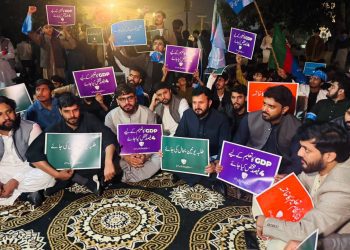
JIUQUAN, China (Web Desk) – Forty-year-old Muhammad Zeeshan Ali made history on Wednesday by becoming the first Pakistani astronaut to enter Earth’s orbit, after China’s Shenzhou-24 spacecraft successfully reached its preset orbit following liftoff from the Jiuquan Satellite Launch Centre.
The spacecraft, propelled by a Long March-2F carrier rocket, blasted off from the launch site in northwestern China’s Gobi Desert at 8:18 a.m. Beijing time (5:18 a.m. Pakistan Standard Time). Shortly after launch, Chinese space officials confirmed that the vessel had smoothly entered its designated orbit and that the three-member crew was in good condition.
Ali, a former Pakistan Air Force fighter pilot, is serving as a payload specialist alongside Chinese mission commander Tang Hongbo and flight engineer Wu Yi. In addition to becoming the first Pakistani national in orbit, Ali holds the distinction of being the first foreign astronaut to join a crewed mission to China’s Tiangong space station.
During his stay of approximately five to ten days aboard Tiangong, Ali will install and initiate four scientific experiments covering biotechnology, materials science, and photosynthetic microorganisms. While the full experimental cycles will span six to twelve months, Ali’s primary task is to ensure the equipment survived launch vibrations and operates safely in microgravity. He is scheduled to return to Earth aboard the outgoing crew’s Shenzhou-23 spacecraft.
Speaking to reporters prior to the launch, Ali emphasized the collective significance of the mission. “I want to assure you that I am not flying for myself. I carry the name of Pakistan on my shoulder, the hopes of 250 million Pakistanis,” he said, addressing the media in Urdu, Mandarin, and English. He also encouraged Pakistani youth to pursue science, telling children watching from home to look up at the sky and remember he was carrying their dreams.
The milestone stems from a landmark bilateral space cooperation agreement signed in Islamabad in February 2025 between the Pakistan Space and Upper Atmosphere Research Commission (SUPARCO) and the China Manned Space Agency (CMSA). Following three rigorous rounds of screening, Ali and backup candidate Khurram Dawood underwent seven months of intensive training in China—mastering centrifuge tests, emergency simulations, and the Mandarin language.
Pakistani leadership hailed the launch as a defining moment for the nation’s scientific ambitions and bilateral ties. President Asif Ali Zardari called the mission a landmark achievement that would inspire younger generations toward innovation and discovery. Prime Minister Shehbaz Sharif noted that Pakistan-China friendship was “surpassing the heights of the Himalayas in its journey to outer space,” while Planning Minister Ahsan Iqbal, who attended the launch in Jiuquan, remarked that bilateral cooperation had expanded from highways to skyways as the two nations celebrate 75 years of diplomatic relations.
Although Pakistani adventurer Namira Salim previously reached suborbital space aboard a commercial Virgin Galactic flight in October 2023, Ali is the first Pakistani to achieve full orbital flight. Building on this momentum, SUPARCO and Chinese space authorities are already collaborating on deeper space initiatives, including plans to deploy a Pakistani-built lunar rover aboard China’s Chang’e-8 mission around 2028.