


By Maheen Sultan
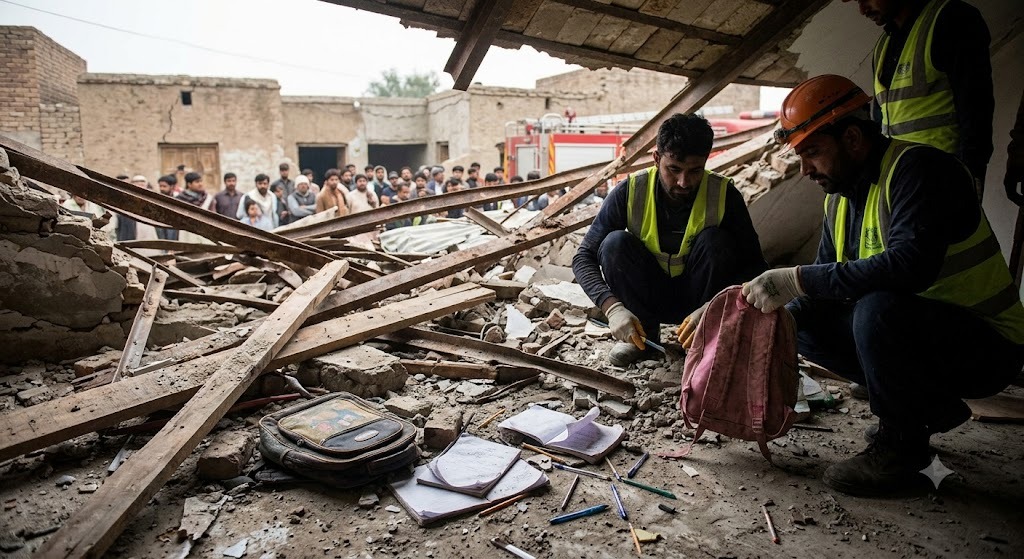
The heart-wrenching loss of young lives in Lahore’s Kahna Nou and Baghbanpura neighborhoods has left the nation mourning and asking painful questions. In Kahna Nou, a dilapidated roof caved in on a local tuition center, burying a female teacher and claiming the lives of 14 innocent children. Just days later, before the dust could even settle, an under-construction section of a private school building collapsed in Baghbanpura, killing an eight-year-old child.
While the state machinery scrambled to arrest local property owners and contractors as a knee-jerk reaction, these structural failures point to a much deeper, multi-layered systemic crisis. These tragedies cannot be viewed merely as construction accidents; they are the physical manifestation of an economy burdened by mounting debt, institutional neglect, and a regulatory framework that often penalizes the desperate survival strategies of ordinary citizens while shielding public institutions responsible for oversight and enforcement.
A crisis larger than two tragedies
The Kahna Nou and Baghbanpura incidents are only the latest reminders of a long-standing problem.
According to Rescue Services Punjab, 14,058 roof and building collapse incidents were reported across Punjab between 2004 and 2026. Within Lahore alone, 2,124 incidents involving collapsed roofs and walls were recorded during the same period, resulting in hundreds of deaths and injuries over the past two decades.
These figures demonstrate that structural failures are not isolated events but an enduring public safety challenge. Many of the affected buildings were constructed with limited financial resources, inexpensive materials, and without adequate engineering guidance or regulatory oversight. In many low-income communities, families and small institutions simply build with whatever resources they can afford.
The recurring nature of these incidents suggests that the problem extends far beyond individual negligence.
1. The real cost of Pakistan’s debt burden and the rising cost of living
Macroeconomic realities provide important context for understanding why basic building infrastructure is deteriorating at the grassroots level. As Pakistan’s debt servicing costs continue to consume a significant share of the federal budget, very little fiscal space remains for municipal development, safety enforcement, or investment in safe public schools.
For ordinary citizens, the cost of basic survival has become increasingly unsustainable. Monthly household incomes are heavily consumed by:
• High food inflation.
• Rising electricity, gas, and utility bills.
• The effective double burden of water costs, where households pay water charges and then incur additional electricity expenses to pump water into their homes.
With household savings falling sharply compared to neighboring South Asian countries such as India, Bangladesh, and Sri Lanka, ordinary property owners and neighborhood educators often lack the financial capacity to undertake structurally sound renovations. As a result, unsafe construction practices—such as using weak T-irons, undersized girders, and non-engineered roofing systems—become financial compromises rather than informed engineering decisions.
2. Institutional jurisdictional disputes and regulatory gaps
When catastrophic structural failures occur, public institutions frequently debate administrative jurisdiction instead of demonstrating clear accountability. Following the Kahna Nou tragedy, reports suggested confusion over whether the affected locality fell under the Metropolitan Corporation Lahore (MCL), the Lahore Development Authority (LDA), or the Defence Housing Authority (DHA).
Under the Punjab Local Government Building Rules and Byelaws, structural fitness certificates, approved building plans, and land-use clearances are mandatory for commercial or educational activities conducted in residential areas. Yet a significant regulatory gap persists. Authorities rarely conduct routine structural inspections in densely populated, low-income neighborhoods. Instead, institutional attention often focuses on jurisdictional boundaries only after lives have already been lost.
3. The dilemma of grassroots human capital development
In communities where government-funded educational facilities remain inadequate, informal neighborhood tuition centers fill a critical gap. Driven by unemployment and financial hardship, many female teachers and local educators establish small learning centers within residential buildings to support their families while improving educational access for children.
When structural failures occur in such settings, the immediate legal response is often to arrest property owners, builders, or educators under criminal negligence laws. While construction safety standards must undoubtedly be enforced, assigning the entire burden of responsibility to economically vulnerable individuals overlooks the broader structural realities.
These citizens are attempting to build human capital where the state has historically underinvested. Criminalizing these survival-driven initiatives without simultaneously addressing the absence of affordable engineering support, accessible building inspections, and practical municipal guidance represents an incomplete approach to accountability.
4. Re-evaluating systemic accountability and legal protections
A balanced legal framework requires moving beyond symbolic arrests and temporary administrative suspensions. Genuine accountability demands that regulatory institutions bear responsibility for failures in oversight alongside property owners and builders.
Meaningful reforms should include:
• Proactive Municipal Audits: Municipal authorities should establish accessible and affordable engineering consultation services and conduct routine structural inspections in low-income residential and educational areas rather than relying solely on post-disaster enforcement.
• Fiscal Prioritization: Federal and provincial governments should allocate greater resources toward structural safety, public schools, and municipal infrastructure instead of allowing fiscal pressures to continuously erode essential public services.
• Transparent Inspections: Building inspectors who knowingly ignore unauthorized or unsafe construction should face administrative investigations and, where appropriate, legal accountability.
A turning point for urban safety
The closed classrooms and grieving families of Kahna Nou and Baghbanpura should serve as a solemn warning for policymakers.
If the state’s response remains confined to temporary arrests without strengthening municipal oversight, improving building safety enforcement, and providing meaningful structural support to inflation-stricken citizens, similar tragedies will inevitably recur.
Pakistan must bridge the widening gap between its regulatory framework and the harsh economic realities confronting ordinary citizens. Only through stronger institutions, proactive oversight, and sustained investment in safe educational infrastructure can the country ensure that a classroom roof never again becomes a death trap for children pursuing an education.
At the same time, the government must extend a practical helping hand to low-income families to make their dwellings safe and structurally sound. Millions of poor households are living under unprecedented inflation, rising utility costs, and shrinking incomes, while also bearing the indirect burden of more than Rs 8 trillion in annual debt-servicing obligations for liabilities they never personally borrowed. In such circumstances, expecting financially distressed families to independently finance expensive structural repairs is unrealistic. Affordable housing safety grants, subsidized engineering assistance, and low-cost rehabilitation programs should become a national priority so that poverty itself does not become a structural hazard.