


WASHINGTON (Tech Desk) – NASA has launched an ambitious robotic space mission to save its aging Swift space telescope from re-entering Earth’s atmosphere, marking a major step toward extending the lifespan of satellites already operating in orbit.
The mission, valued at approximately $30 million, seeks to reposition the Neil Gehrels Swift Observatory into a higher and more stable orbit before atmospheric drag causes the spacecraft to burn up. If successful, the project could become a milestone in satellite servicing and open the door to future missions that repair, refuel or reposition spacecraft instead of replacing them.
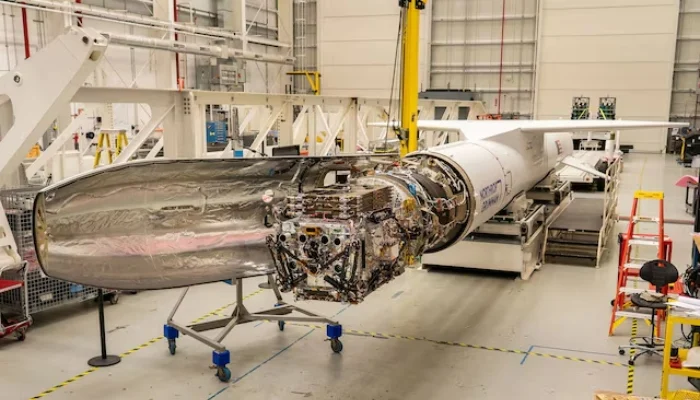
The robotic rescue mission lifted off on Friday at 08:36 GMT after weather conditions and technical issues delayed the launch earlier in the week. The rescue spacecraft, developed by American aerospace startup Katalyst, was carried into space aboard a Pegasus rocket, which was released from an aircraft rather than launched from a conventional ground-based launch pad.
Following deployment, the spacecraft will begin a series of system checks and activate its solar panels before gradually maneuvering toward the Swift telescope, which has been orbiting Earth since 2004.
Mission engineers expect the rendezvous process to take several weeks because of the precision required to safely approach a satellite that was never designed for servicing. Once it reaches the telescope, the robotic spacecraft will carefully circle the observatory and attach itself using three articulated robotic arms.
After securing the telescope, the spacecraft will begin the most challenging phase of the mission—raising Swift’s orbit by roughly 300 kilometers. The controlled maneuver is expected to take at least one month and will move the observatory closer to its original operational altitude, reducing the atmospheric drag currently pulling it toward Earth.
NASA officials describe the mission as one of the most technically demanding robotic operations ever attempted in low Earth orbit. Every stage of the mission requires extremely accurate navigation, autonomous maneuvering and precise docking techniques that have rarely been demonstrated in space.
The Neil Gehrels Swift Observatory was originally designed as a short-term mission but has continued operating for more than two decades. Built at a cost of approximately $250 million, the telescope has become one of NASA’s most valuable scientific instruments for studying gamma-ray bursts—the universe’s most energetic explosions, often associated with collapsing massive stars and merging neutron stars.
Swift’s ability to rapidly detect and observe these brief but powerful events has made it an essential tool for astronomers around the world. The observatory also contributes to research involving black holes, neutron stars, supernovae and other high-energy cosmic phenomena.
Because the telescope continues to deliver valuable scientific observations, NASA concluded that extending its operational life would provide greater value than replacing it with a new spacecraft. Officials believe preserving Swift will ensure uninterrupted research while future missions are developed.
NASA’s Director of Astrophysics, Shawn Domagal-Goldman, previously described the operation as involving numerous technological firsts. The mission combines advanced robotic navigation, autonomous spacecraft docking and orbital repositioning in a single operation, making it one of the agency’s most innovative demonstrations of in-space servicing.
Beyond rescuing Swift, the mission serves as a test for future commercial satellite servicing technologies. If the robotic spacecraft successfully completes its objectives, similar systems could eventually repair malfunctioning satellites, refuel spacecraft running low on propellant or relocate satellites into more efficient orbits.
Experts say such capabilities could significantly reduce space debris, lower mission costs and improve the sustainability of future space operations by extending the working life of expensive satellites.
NASA and Katalyst will closely monitor every stage of the mission over the coming months. Engineers will continuously evaluate spacecraft performance, docking procedures and orbital adjustments before declaring the mission a success.
If the rescue succeeds, it could transform how governments and private companies manage spacecraft in orbit, demonstrating that satellites no longer need to be abandoned once their orbits begin to decay. Instead, future robotic missions may routinely extend satellite lifespans, making space exploration and satellite operations more sustainable for decades to come.