


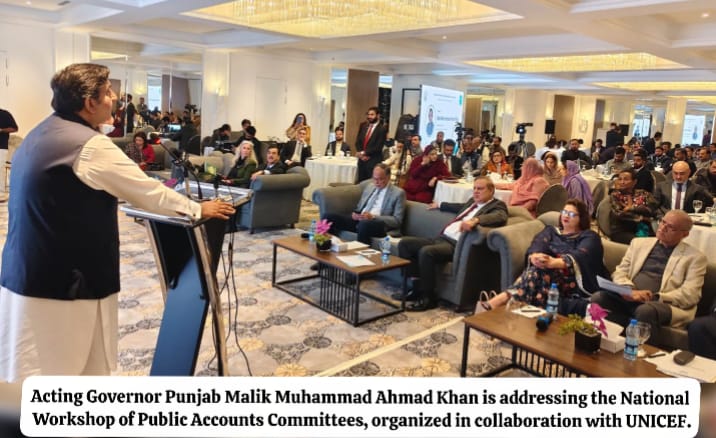
Addressing a National Workshop of Public Accounts Committees in Islamabad, he said Parliament’s constitutional authority over public finances must be reflected in practical parliamentary procedures and institutional arrangements.
The workshop, organised with the support of UNICEF, brought together senior political leaders, parliamentary representatives, financial oversight officials and members of provincial assemblies to examine ways of improving the performance of Public Accounts Committees (PACs).
Chairman Senate Syed Yousaf Raza Gilani, Federal Minister Professor Ahsan Iqbal Chaudhary and Malik Muhammad Ahmad Khan attended the event, alongside the Speaker of Azad Jammu and Kashmir, the Auditor General of Pakistan, provincial lawmakers and PAC chairpersons.
Speaking at the gathering, Khan said the Public Accounts Committee played a central role in translating Parliament’s authority over public funds into effective oversight. He described the committee as a key parliamentary institution responsible for examining government expenditure and ensuring that public resources were used in accordance with approved purposes.
He said the Constitution of 1973 had established a democratic framework under which Parliament carried significant responsibilities, including scrutiny of public finances. However, parliamentary rules and procedures had not been fully adapted to reflect the constitutional role of elected legislatures.
Khan observed that several existing Rules of Procedure and Rules of Business continued to reflect practices inherited from the colonial-era legislative council system. He said a comprehensive review was necessary to bring parliamentary procedures into conformity with the spirit and requirements of the Constitution.
He stressed that outdated procedural arrangements could limit the effectiveness of parliamentary institutions and weaken their ability to hold government departments accountable for financial decisions.
According to the acting governor, reforming parliamentary rules would help improve the functioning of committees, establish clearer accountability mechanisms and strengthen the relationship between elected representatives and public institutions.
He said the purpose of parliamentary oversight was not simply to identify irregularities after public money had been spent, but also to promote responsible financial management and prevent weaknesses in government expenditure systems.
Khan also urged provincial and national Public Accounts Committees to develop stronger institutional links and benefit from one another’s experiences. He said successful practices adopted by one assembly should be examined by other legislatures and adapted where appropriate.
He emphasised that regular communication, information sharing and cooperation among parliamentary committees could help address common challenges and improve the overall accountability framework.
The acting governor said a coordinated approach would enable committees to learn from practical experiences, improve their scrutiny procedures and develop more effective methods of examining government accounts.
The workshop provided an opportunity for participants to discuss the challenges facing Public Accounts Committees and explore measures to improve their institutional capacity.
Participants held detailed discussions on monitoring government expenditure, examining audit observations and strengthening financial transparency. The discussions also focused on improving the effectiveness of parliamentary scrutiny and ensuring that government departments respond appropriately to questions concerning the use of public resources.
The role of audit institutions in supporting parliamentary accountability was also central to the broader discussions, as effective cooperation between auditors and legislative committees is important for examining public expenditure and identifying financial weaknesses.
The presence of representatives from different assemblies provided an opportunity to exchange views on procedural differences and institutional practices across the country.
Participants also considered the importance of strengthening the capacity of committee members and improving the systems through which financial records, audit findings and government responses are examined.
The discussions highlighted the need for parliamentary oversight to operate as a continuous institutional process rather than an occasional exercise. Stronger procedures, timely examination of audit reports and effective follow-up of committee recommendations were identified as important elements of a functioning accountability system.
The workshop concluded its deliberations with renewed emphasis on institutional cooperation, procedural improvements and the need to make parliamentary financial oversight more effective.
The gathering underscored the importance of strengthening Public Accounts Committees as a means of improving governance, promoting responsible public spending and reinforcing public confidence in democratic institutions.