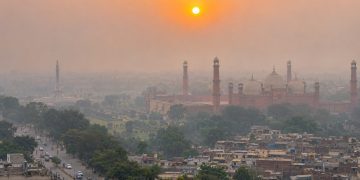






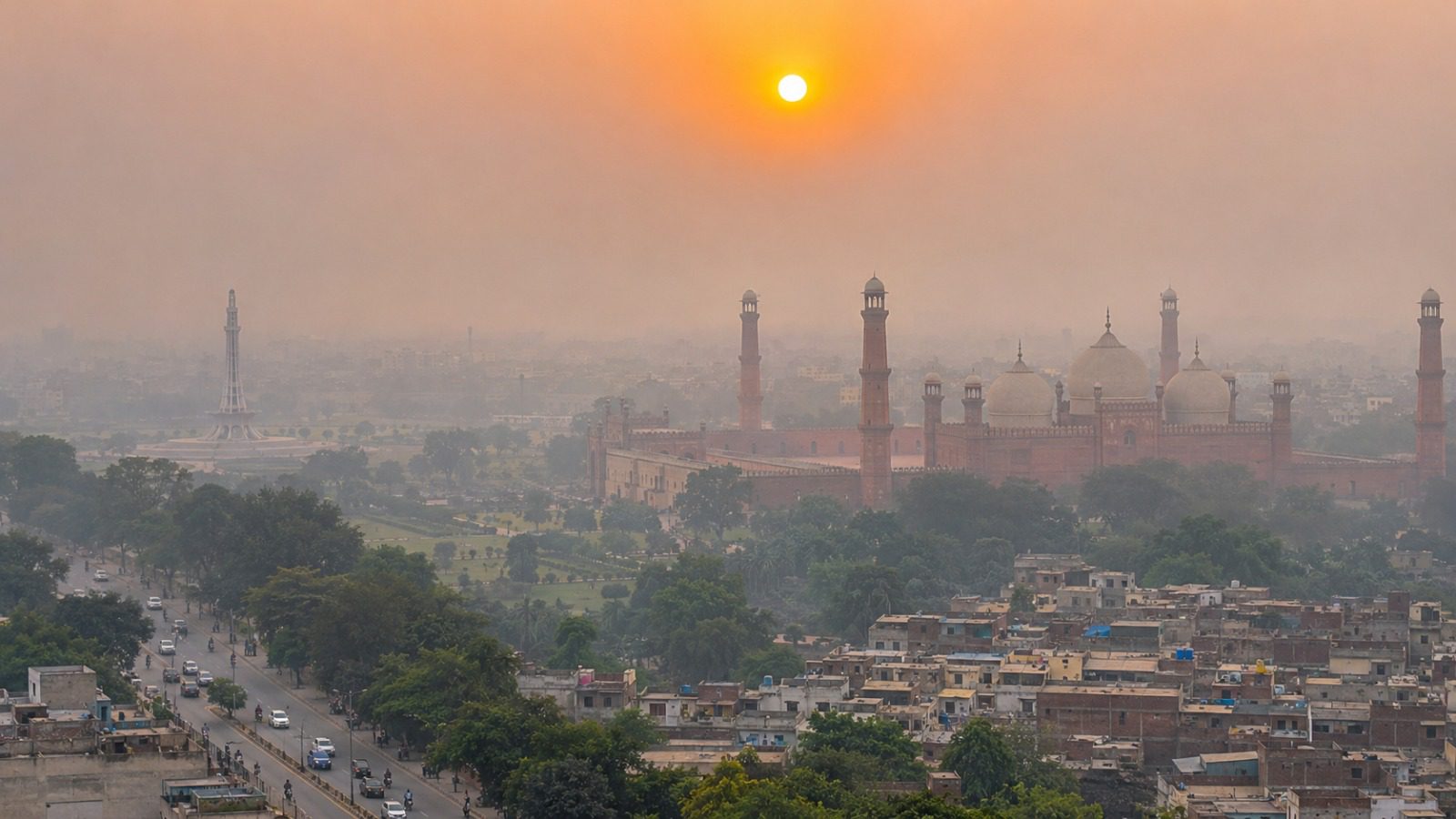
LAHORE (Web Desk) – Lahore continues to face significant air pollution throughout the year, with fine particulate matter (PM2.5) levels remaining above prescribed national standards even during relatively cleaner summer months, according to a new environmental analysis that highlights the combined impact of urban emissions, unfavourable weather conditions and seasonal crop-residue burning.
Read also: Lahore tops global pollution rankings as AQI hits 410
The findings, published in a report titled Lahore’s Smog: The Year-Round Baseline, and What Changes in October, were released on November 2 by Hamari Hawa, an environmental monitoring initiative founded by Hammad Tariq. The assessment draws on ground-level air quality measurements, satellite observations and atmospheric data to examine pollution trends and their underlying causes.
The analysis indicates that Lahore’s air pollution is not exclusively a winter phenomenon. Monthly average PM2.5 concentrations remained above 35 micrograms per cubic metre between October 2025 and October 2026. Even between April and September 2026, considered relatively cleaner months, average concentrations ranged from 40 to 59 micrograms per cubic metre, substantially exceeding the national annual standard of 15 micrograms per cubic metre.
June 2026 recorded the lowest monthly average at 40 micrograms per cubic metre. However, pollution intensified considerably during the colder months, with monthly averages ranging between 124 and 183 micrograms per cubic metre from October 2025 to February 2026. October 2026 registered an average of 100 micrograms per cubic metre.
The report also highlighted the severity of recent pollution episodes, noting that Lahore’s Air Quality Index (AQI) crossed 530 on Monday, while PM2.5 concentrations reached 343 micrograms per cubic metre.
One of the major factors behind the seasonal deterioration is the declining atmospheric mixing height, which determines how effectively pollutants disperse into the air. According to the analysis, the mixing layer over Lahore falls from approximately 830-860 metres in May and June to around 400 metres in October, 260 metres in November and just 190 metres in December.
With a smaller volume of air available to disperse emissions, pollutants become increasingly concentrated near ground level. The report estimates that, under otherwise unchanged conditions, reducing the mixing layer to half or one-third of its previous height could increase smoke concentrations by two to three times.
Agricultural burning also contributes to the seasonal pollution burden. Satellite observations identified 781 crop-associated heat detections within 40 kilometres of central Lahore between October 15 and November 1, 2026. Sheikhupura accounted for 322 detections, followed by India’s Tarn Taran district with 149, Amritsar with 106, Nankana Sahib with 77, Lahore with 62 and Kasur with 50.
The analysis cautioned that satellite detections do not necessarily represent individual fires or establish the amount of pollution released. Nevertheless, the timing of agricultural burning coincides with the seasonal decline in atmospheric mixing height, potentially intensifying smog conditions.
Year-round pollution sources include vehicle emissions, industrial units, brick kilns, power plants, generators, household fuels, waste burning and construction-related dust. An Urban Unit emissions inventory based on 2020-21 data attributed approximately 35 per cent of Lahore’s PM2.5 emissions to transport, 33 per cent to crop-residue burning, 29 per cent to waste burning and three per cent to industry.
Meanwhile, the Punjab Environment Protection and Climate Change Department (EPCCD) has reported a 15 per cent net improvement across six major air pollutants during the first year of its real-time air quality monitoring programme.
According to the department, Lahore’s peak AQI declined by 28 per cent in October 2026 compared with the corresponding period last year. The city also recorded no days in the hazardous AQI category, defined as readings above 300, during October this year, compared with four such days in October 2025.
The government attributed the progress to expanded monitoring infrastructure and measures targeting emissions from transport, industries, brick kilns and agricultural activities.
Punjab’s real-time monitoring network has increased from 30 regulatory-grade stations in October 2025 to 59 stations, with authorities planning to expand it to 100. The stations continuously monitor six air pollutants and seven meteorological parameters.
The department also cited the introduction of 612 electric buses, emissions testing of approximately 500,000 vehicles and more than 800 legal notices issued to heavy transport vehicles. The government aims to expand its electric bus fleet to 3,000.
In agriculture, the distribution of 10,000 subsidised super seeders has reportedly contributed to a one-third reduction in field-level stubble-burning incidents. The government plans to increase their number to 25,000 and introduce additional machinery to encourage alternatives to open-field burning.
More than 95 per cent of Punjab’s brick kilns have also adopted zigzag technology, while industrial enforcement has been strengthened through inspections at more than 600 sites.
However, the Hamari Hawa analysis emphasises that seasonal improvements should not be confused with clean air. It argues that reducing persistent emissions remains essential, while winter weather and agricultural burning amplify the existing pollution burden.
The contrasting assessments underline the importance of reliable ground-based monitoring, consistent enforcement and long-term emission reductions to address Lahore’s continuing air quality challenge.