



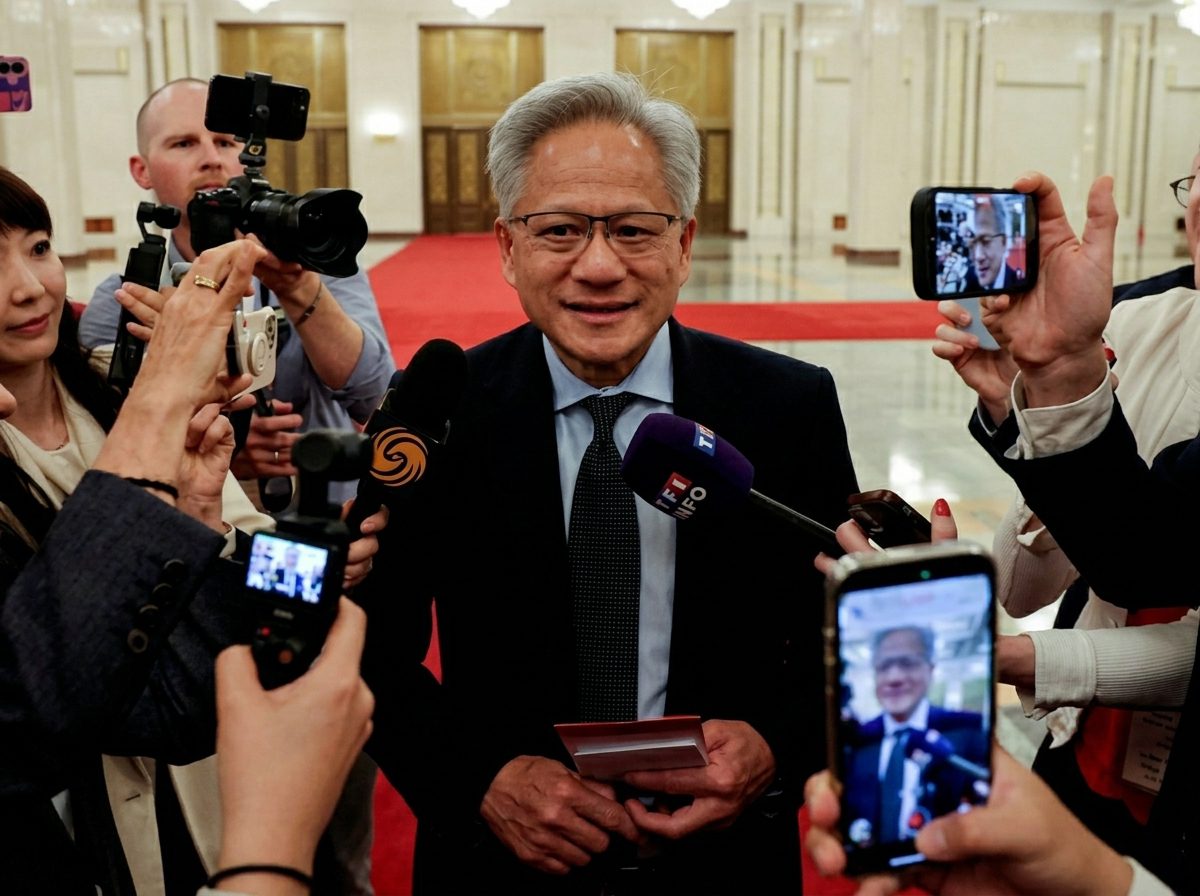
NEW YORK (Web Desk) – Former Nvidia chief executive Jensen Huang has indicated that he would be willing to return to lead the world’s leading artificial intelligence chipmaker, as the company faces mounting scrutiny over corporate governance, national security and its business dealings involving China.
In his first public statement since stepping down on November 12, Huang said he would welcome a return if the company’s board determined that his leadership would serve the best interests of shareholders and employees.
Huang said he had received numerous calls from Nvidia employees, investors, business partners and customers urging him to reconsider his departure.
He also acknowledged that his personal conduct had created difficulties for the company’s board and expressed regret over the situation.
“I created problems for the Board that I deeply regret. I own my mistakes completely, and I am committed to cooperating with the Board’s independent investigation,” Huang said.
His statement comes at a critical moment for Nvidia, which has become one of the most influential companies in the global technology industry because of the growing demand for advanced processors used in artificial intelligence systems.
The leadership uncertainty has coincided with concerns about Huang’s personal relationships and alleged connections involving individuals suspected of links to Chinese intelligence.
The controversy has raised broader questions about whether Nvidia’s corporate oversight arrangements have kept pace with its rapid expansion and growing importance to US technological and national security interests.
The company had reportedly lost more than $400 billion in market value by Monday’s close amid the growing uncertainty.
Nvidia shares subsequently pared some losses but remained down around one per cent following Huang’s statement.
Nvidia establishes national security committee
In a major corporate governance move, Nvidia announced the creation of a board-level National Security and Export Control Oversight Committee.
The committee will supervise the company’s national security policies and international trade compliance programmes, reflecting growing pressure on technology companies to strengthen controls over sensitive artificial intelligence technology.
Suzanne Nora Johnson, a former Goldman Sachs vice chair and Nvidia board director, will chair the committee.
Other members include Stephen Neal, a former chief executive of law firm Cooley, and John Dabiri, a professor at the California Institute of Technology.
According to Nvidia, the committee will work with independent legal, national security and trade compliance experts to evaluate the company’s policies and identify potential risks.
The company’s National Security Team and Global Trade Compliance Team will report to the new committee.
Interim chief executive Colette Kress will remain responsible for the company’s day-to-day operations.
The committee is expected to meet at least once every quarter, with additional discussions involving company management and independent executive sessions.
US President Donald Trump welcomed the initiative, describing the establishment of a national security oversight structure as a positive development.
Nvidia Chairman Harvey Jones said the company was committed to working with government and industry partners to develop stronger safeguards while supporting technological innovation.
China tensions add to Nvidia’s challenges
The governance changes come amid intensifying tensions between Washington and Beijing over access to advanced semiconductor technology.
The Trump administration has announced plans to further restrict China’s access to advanced artificial intelligence chips manufactured by companies including Nvidia.
The restrictions reflect longstanding American concerns that advanced processors could strengthen China’s military and technological capabilities.
Nvidia has become a central player in the dispute because its high-performance processors are widely used to develop and operate advanced artificial intelligence systems.
Huang had previously supported allowing certain chip exports to China, arguing that maintaining access to the Chinese market was important for American technology companies.
However, US intelligence concerns surrounding Alice Huang, a former senior executive and controlling shareholder of Singapore-based cloud computing company Megaspeed, have intensified scrutiny of Nvidia’s commercial relationships.
Alice Huang is suspected by US intelligence agencies of having links to Chinese intelligence, according to the supplied account.
Megaspeed has also faced investigation over allegations that restricted Nvidia processors may have been diverted to China in violation of American export controls.
The company has denied wrongdoing.
The allegations have not established that Nvidia itself violated export regulations, but they have increased pressure on the semiconductor manufacturer to demonstrate stronger oversight of its international supply chains.
Leadership uncertainty ahead of earnings
Nvidia’s leadership developments come as the company prepares to announce its third-quarter financial results, an important event for investors assessing the continued strength of the artificial intelligence industry.
The results are expected to attract significant attention because Nvidia’s financial performance is closely watched as an indicator of global demand for AI infrastructure.
The controversy has also highlighted the growing responsibilities of technology companies whose products have become central to national security, international trade and geopolitical competition.
For Nvidia, the immediate challenge is to restore confidence among investors, employees and government partners while maintaining its position in the rapidly expanding AI market.
Huang’s willingness to return has added another dimension to the company’s leadership uncertainty, although any decision would ultimately rest with the board.
Whether he resumes the position or the company continues under interim leadership, Nvidia faces increasing pressure to strengthen corporate governance, demonstrate export-control compliance and protect its technological position in an increasingly competitive global industry.