


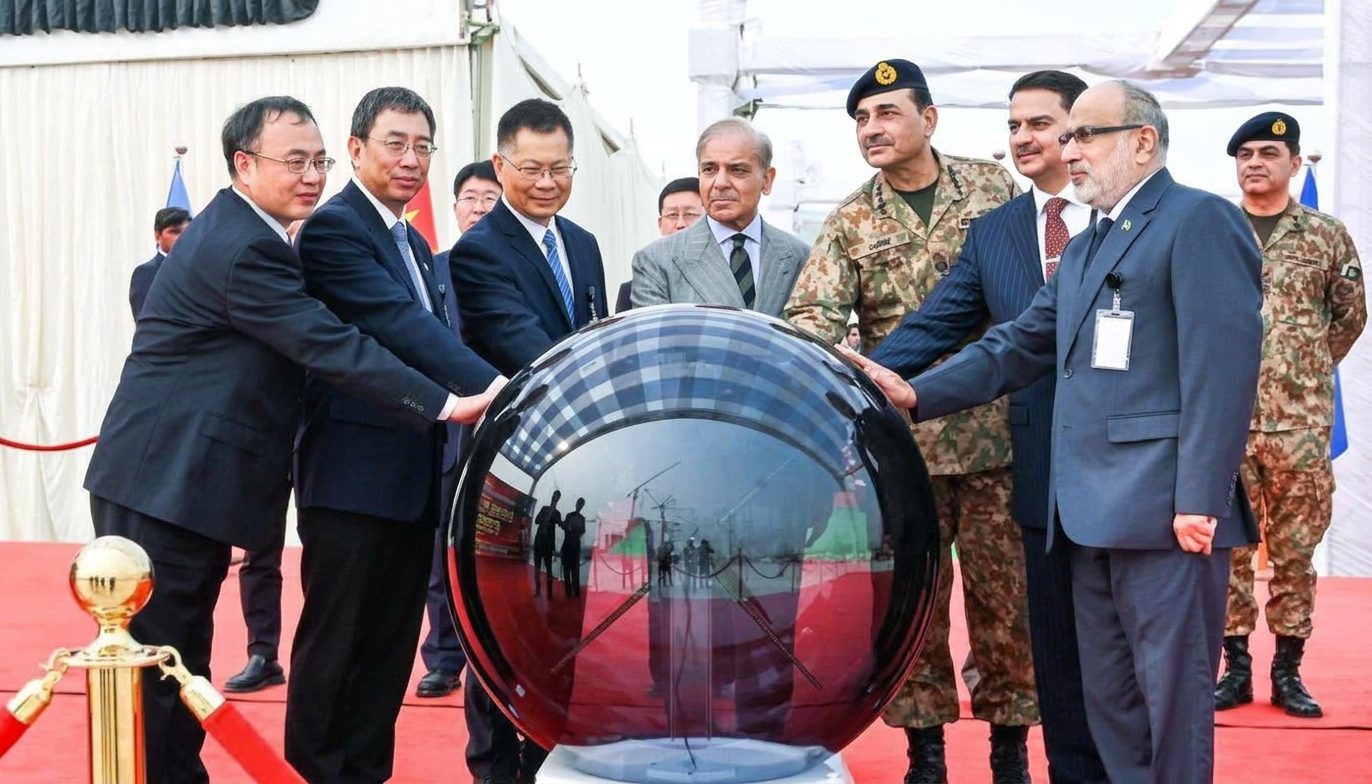
MIANWALI (Web Desk) – Pakistan is seeking to strengthen its energy independence and reduce reliance on imported fuels through expanded nuclear power generation, Prime Minister Shehbaz Sharif said on Tuesday as construction of the Chashma-5 Nuclear Power Plant reached a major milestone.
Read More : PM Shehbaz Sharif, LCCI President Ali Hussam discuss business challenges
Addressing a ceremony marking the placement of the plant’s dome in Mianwali, Sharif described the development as evidence of the country’s commitment to technological progress, economic stability and cooperation with China.
He said the project would contribute to a more reliable and affordable electricity supply for households, businesses and public institutions, while helping shield the economy from fluctuations in international fuel prices.
“Pakistan will not wait for anyone, but will build its own future through its hard work and untiring efforts,” the prime minister said, recalling his commitment at the project’s groundbreaking ceremony in July 2023.
Sharif said the dome had been installed less than three and a half years after construction began, ahead of schedule. He expressed confidence that the plant would also be completed and commissioned earlier than originally planned.
The Chashma-5 facility is designed to generate 1,200 megawatts of electricity and is currently expected to begin producing power in September 2030.
The prime minister said nuclear energy had an important role to play in Pakistan’s long-term energy strategy, particularly as the country sought to reduce its exposure to imported energy supplies and develop more environmentally sustainable sources of electricity.
He described Pakistan as particularly vulnerable to climate change and said its development plans needed to balance economic growth with environmental protection.
Nuclear power, he argued, could help meet rising electricity demand while reducing dependence on fossil fuels. A stable power supply would also be important for industrial production, hospitals, schools and other essential services.
Sharif said economic development depended on national security and stability, adding that a secure environment was necessary to attract investment and support broader development.
He praised the armed forces under Chief of Army Staff and Chief of Defence Forces Field Marshal Syed Asim Munir, referring to their role in maintaining stability. He also acknowledged the military leadership’s support for the government’s economic recovery and development efforts.
The prime minister highlighted cooperation with China as central to the Chashma project, describing the facility as another example of the longstanding partnership between the two countries.
He said Chashma-5 would be the seventh nuclear power unit China had helped Pakistan construct, and thanked Chinese President Xi Jinping, the Chinese government and the China National Nuclear Corporation for their continued assistance.
Sharif also praised Chinese engineers and Pakistani specialists involved in the project, alongside the Pakistan Atomic Energy Commission, the China Atomic Energy Authority, contractors, financial institutions and other stakeholders.
He said the second phase of the China-Pakistan Economic Corridor would create further opportunities for investment and development, while strengthening economic and strategic ties between the two countries.
The prime minister also thanked residents of Mianwali for hosting the project, saying the plant would stand as a symbol of cooperation and shared ambitions for economic progress.
Earlier, the chairman of the Pakistan Atomic Energy Commission highlighted the contribution of nuclear power to the country’s electricity supply.
He said Pakistan’s nuclear power plants were generating a combined 3,530 megawatts of electricity safely and efficiently, while helping avoid an estimated 15 million tonnes of carbon dioxide emissions each year.
Nuclear energy accounts for around 16.6 per cent of Pakistan’s electricity generation despite making up approximately 8.6 per cent of installed power capacity, according to figures presented at the ceremony. Its share rises to about 26 per cent during winter.
The figures underline the role nuclear generation plays in the country’s electricity mix, although the sector’s expansion also requires substantial investment, technical expertise and long-term planning.
For Pakistan, which has faced pressure from fuel costs and electricity supply challenges, the government sees additional nuclear capacity as one way to diversify energy sources and improve reliability.
The Chashma-5 project is expected to add 1,200 megawatts to the national grid once operational. Its planned commissioning in 2030 means the country will still need to manage its energy requirements through existing generation sources and other projects in the coming years.
Sharif said the latest construction milestone reflected the determination of Pakistan and China to continue working together on major infrastructure and energy initiatives, expressing hope that the plant would contribute to national prosperity for decades.