


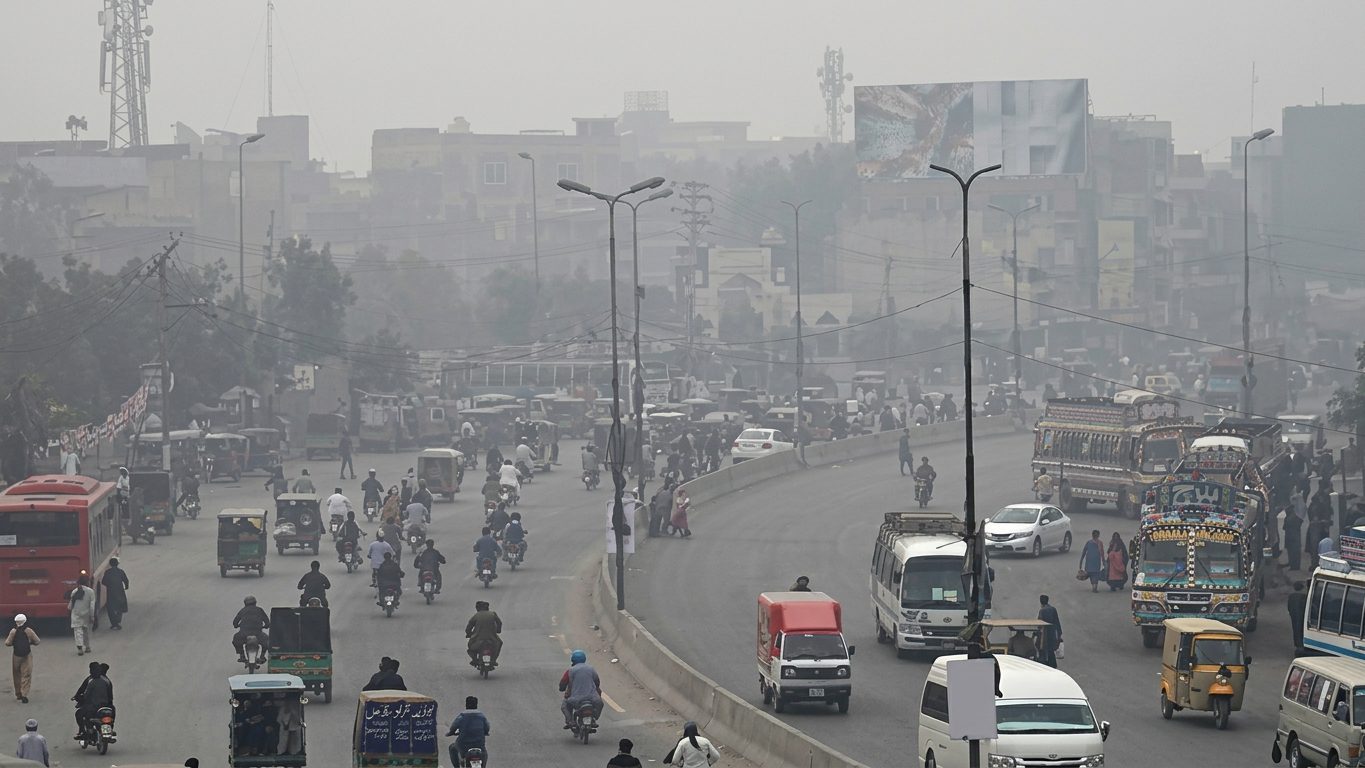
The Punjab Environment Protection Department has warned that smoke generated by fireworks during Diwali celebrations in India could reach Lahore within five to 13 hours. Pollution levels are forecast to remain particularly high from Sunday night through Monday morning.
The department’s latest assessment recorded Lahore’s average Air Quality Index (AQI) at 272 on November 7. The reading increased to 335 by 1pm on November 8, while another measurement reached 294, compared with 163 at the same time a day earlier.
The figures point to a sharp deterioration in air quality as the region enters another period of seasonal smog, with officials warning that cross-border pollution could add to emissions already affecting Pakistan’s most populous province.
Satellite imagery attributed to NASA showed a thicker layer of haze and pollution over India’s Punjab and Haryana on November 8 than on the previous day, according to the department’s report.
Amritsar, an Indian city located about 50 kilometres from Lahore in a straight line, is close enough for polluted air to travel across the international border within hours, the assessment said.
Easterly winds are forecast to blow at speeds of between seven and 11 kilometres per hour. Fireworks smoke, crop-residue burning and limited air movement during nighttime hours could combine to increase the concentration of harmful particles.
The department also pointed to continued agricultural burning in Indian Punjab, where 2,347 incidents had been reported by November 4. Of these, 1,081 were recorded in three districts located opposite Lahore and Kasur.
Tarn Taran accounted for 558 reported incidents, followed by Ferozepur with 316 and Amritsar with 207.
The report said Lahore’s pollution levels could remain particularly elevated until around 10am on Monday. A temporary improvement was forecast between 1pm and 5pm, although concentrations could increase again after nightfall.
Officials cautioned that unhealthy conditions could persist into Tuesday. A change in wind direction from Wednesday, November 11, may provide some relief, while stronger winds and rain forecast for November 12 and 13 could help disperse pollutants.
However, the department said the outlook remained uncertain, with actual conditions dependent on changing weather patterns and the movement of polluted air across the region.
The report also highlighted crop-residue burning within Pakistan’s Punjab province. Authorities recorded 459 incidents between October 1 and November 4, down from 637 during the same period last year, a decline of about 28 percent.
Fifty-seven cases were registered between October 1 and November 2 as part of enforcement efforts against the practice.
The department said monitoring operations were continuing around the clock, with special teams deployed during nighttime hours to identify pollution sources and respond to violations.
Residents have been advised to reduce outdoor activities during periods of hazardous air quality, remain indoors where possible and wear N95 masks when going outside is unavoidable.
Children, older people and individuals with respiratory or cardiovascular conditions have been urged to take particular care because exposure to polluted air can pose greater risks to vulnerable groups.
Health precautions are especially important during periods when pollution remains concentrated near ground level, as stagnant nighttime conditions can prevent contaminants from dispersing.
The department said it planned to issue a comparative assessment on November 10 to determine the impact of Diwali celebrations on air quality in Lahore and neighbouring areas.
That report is expected to provide a clearer picture of how much pollution has travelled from across the border and how it has contributed to the city’s existing smog.
The latest warning comes as Lahore and other parts of Punjab continue to face seasonal air-quality challenges linked to vehicle emissions, industrial activity, agricultural burning and weather conditions that can trap pollutants close to the ground.
Authorities are monitoring the situation as residents prepare for potentially several days of unhealthy air, with the prospect of improvement depending largely on changing winds and rainfall.