


BURGENSTOCK, SWITZERLAND (Agencies) – Prime Minister Shehbaz Sharif says US-Iran negotiations in Switzerland mark key opportunity for peace praising Trump Vance and Pakistan’s diplomatic role in regional stability efforts
Prime Minister Shehbaz Sharif has described the ongoing US-Iran negotiations as a rare and important opportunity to strengthen global peace and international cooperation, speaking during a session held in Bürgenstock, Switzerland.
He said the diplomatic engagement between Washington and Tehran comes at a sensitive moment in global affairs and could help reduce long-standing tensions if pursued constructively. Sharif credited the political environment that enabled the talks, praising the role of former US President Donald Trump for supporting efforts that led to the dialogue process.
The Prime Minister also acknowledged the contribution of US Vice President JD Vance, saying his involvement reflected a strong commitment to facilitating meaningful diplomatic engagement between the two sides.
Sharif further emphasized Pakistan’s diplomatic engagement in supporting regional and international stability, highlighting the role of Field Marshal Asim Munir in contributing to efforts aimed at fostering dialogue and reducing regional tensions.
He said the current moment should be used to build trust and encourage sustained communication between global powers, warning that missed opportunities could prolong instability.
US Vice President JD Vance, in his remarks, appreciated Pakistan’s role in supporting peace efforts and described Asim Munir as a capable military leader. He also underlined the importance of strengthening Pakistan-US relations and continued security cooperation.
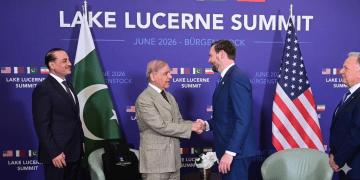
Earlier, a fresh diplomatic push to secure lasting peace in the Middle East gathered momentum as Prime Minister Shehbaz Sharif and Chief of Defence Forces Field Marshal Asim Munir held a bilateral meeting with United States Vice President JD Vance ahead of crucial US-Iran negotiations in Switzerland.
The high-level meeting took place at the scenic Burgenstock resort overlooking Lake Lucerne, where delegations from the United States, Iran, Pakistan and Qatar assembled to discuss the implementation of the Islamabad Memorandum of Understanding (MoU), which ended more than 100 days of hostilities between Washington and Tehran.
According to state broadcaster PTV, the Pakistani leadership met the US negotiating team led by Vice President Vance shortly before formal talks between the American and Iranian delegations were scheduled to begin.
Prime Minister Shehbaz arrived in Zurich early Sunday along with senior officials, including Information Minister Ataullah Tarar, before travelling to Burgenstock. Field Marshal Asim Munir and Interior Minister Mohsin Naqvi also reached the venue to participate in the diplomatic engagements.
The Foreign Office described the talks as the first formal interaction between the United States and Iran since the signing of the Islamabad MoU on June 17. It said Pakistan would continue to facilitate the peace process and maintain bilateral contacts with all participating sides, reaffirming its commitment to dialogue and regional stability.
Officials said technical-level discussions involving US and Iranian representatives began earlier in the day to work out details of the agreement. While Iranian officials indicated that the negotiations were planned as a one-day session, Pakistani media reported that discussions could continue into Monday if necessary.
A senior Prime Minister’s Office official said a quadrilateral meeting involving Pakistan, Iran, the United States and Qatar was expected later in the day, with heads of delegations scheduled to address the gathering.
US Vice President JD Vance arrived at Emmen Air Base early Sunday and said progress was expected on Iran’s nuclear programme and efforts to maintain the ceasefire in Lebanon.
“I think we’re going to hopefully make progress on the nuclear issue and the Lebanon ceasefire issue,” Vance told reporters before leaving Washington. He added that maintaining calm between Israel and Lebanon remained a priority and described the situation as gradually improving.
US negotiators Steve Witkoff and Jared Kushner had already been in Switzerland to handle technical aspects of the discussions.
Iran’s delegation, headed by Parliament Speaker Mohammad Bagher Ghalibaf, also included Foreign Minister Abbas Araghchi, Central Bank Governor Abdolnaser Hemmati, National Iranian Oil Company chief Hamid Bovard, Deputy Foreign Minister Kazem Gharibabadi and Foreign Ministry spokesman Esmail Baqaei.
Speaking to Iranian media, Baqaei stressed that Tehran expected full implementation of commitments made under the agreement and warned that any failure to honour obligations could place the entire deal at risk.
The 14-point accord, signed by US President Donald Trump and Iranian President Masoud Pezeshkian with Prime Minister Shehbaz Sharif acting as mediator, provides a framework for ending the conflict, reopening the Strait of Hormuz and launching a 60-day process aimed at reaching a comprehensive agreement on Iran’s nuclear programme.
The agreement has received broad international support, with hopes rising that sustained diplomacy could prevent further escalation and pave the way for a more stable Middle East. Under the framework, the United States would also facilitate a proposed $300 billion reconstruction fund backed by regional countries once a final nuclear agreement is achieved.
Pakistan’s role as mediator has been widely viewed as a significant diplomatic achievement, underscoring Islamabad’s efforts to promote dialogue and peaceful resolution at a time of heightened regional tensions.
Future Outlook:
Diplomatic attention is now focused on the outcome of the Burgenstock negotiations. Success in implementing the ceasefire framework and advancing nuclear talks could mark a major breakthrough for regional peace and economic stability.
Pakistan Angle:
By hosting earlier contacts and helping broker the Islamabad MoU, Pakistan has positioned itself as a key diplomatic bridge between Washington and Tehran, strengthening its profile as a facilitator of dialogue and conflict resolution.