


By Asim Shehzad
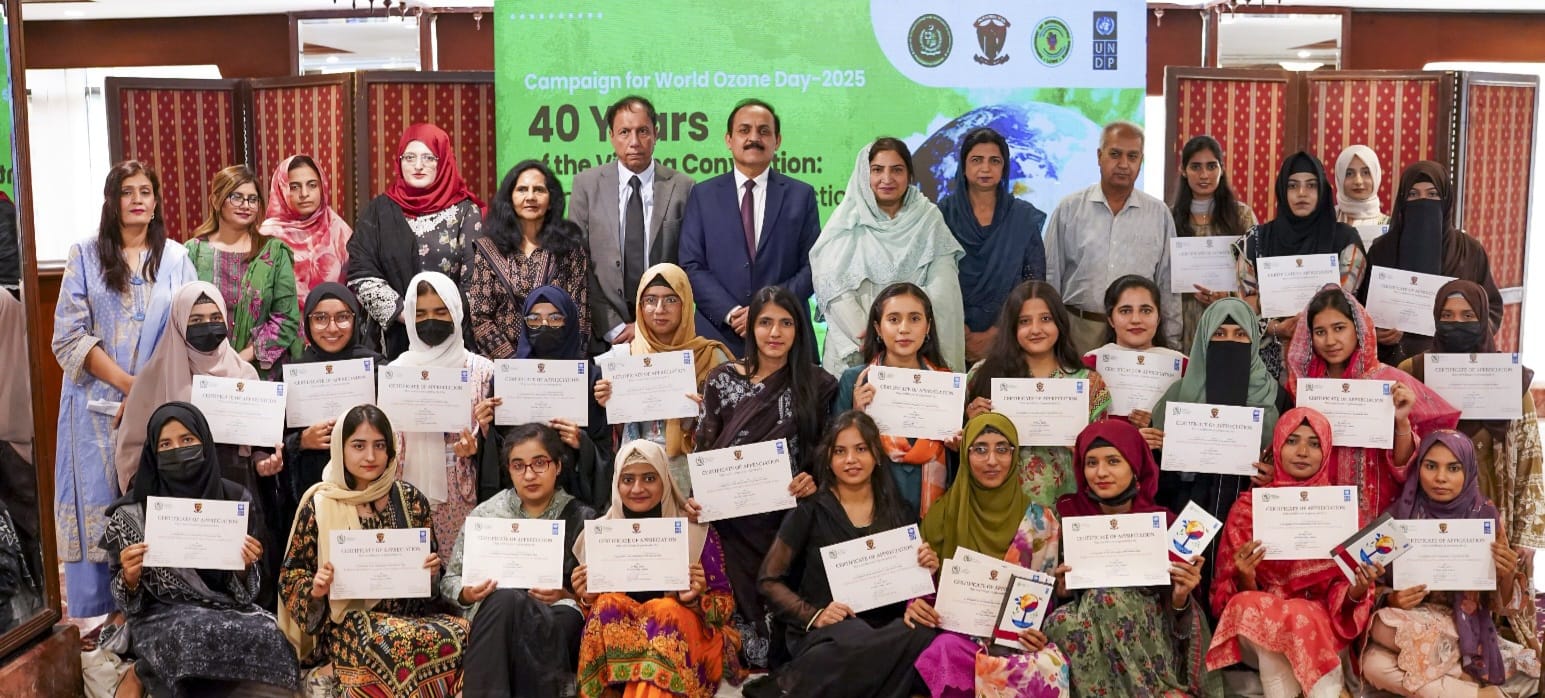
LAHORE: An international seminar commemorating World Ozone Day 2025 was held here bringing together key stakeholders, scholars, and students to promote awareness and action for ozone layer protection.
The event was jointly organized by the Montreal Protocol (MP), United Nations Development Programme (UNDP), and the Ministry of Climate Change & Environmental Coordination (MoCC\&EC) through its National Ozone Unit (NOU), in collaboration with Lahore College for Women University(LCWU). Dr Moneeza Abass from LCWU, in her opening remarks, stressed the importance of academia’s involvement in addressing global environmental challenges.
Delivering the Guest of Honour address, Dr. Saleem Janjua, Chief/National Project Manager of the NOU, highlighted the seminar’s relevance to World Ozone Day and provided a comprehensive overview of the Montreal Protocol. He underscored the pivotal role of academic institutions in research and innovation to meet international environmental commitments, particularly in phasing out ozone-depleting substances (ODS).
In her keynote presentation, Prof. Dr Arifa Tahir, Chairperson Environmental Sciences Department at LCWU, emphasized the urgency of sustainable environmental practices and the global significance of ozone layer protection. She highlighted the disproportionate impact of ozone depletion on women’s health, raising serious concerns about increased vulnerability to ultraviolet (UV) radiation, including higher risks of skin cancer, eye diseases, and reproductive health complications. Dr. Tahir called for gender-responsive environmental policies and greater research into health impacts specific to women. Adding an international perspective, Dr. Khitev Yu from People’s Friendship University of Russia delivered a detailed presentation on the current state of the ozone hole over Antarctica. He discussed recent satellite data and climate models, noting signs of gradual recovery due to global adherence to the Montreal Protocol, while cautioning against complacency. Dr. Yu emphasized that while seasonal improvements have been observed, long-term monitoring and stricter regulatory compliance remain critical to achieving full restoration of the ozone layer.
Dr. Uzaira Rafique, former Vice Chancellor of Fatima Jinnah Women University, spoke on the theme of Ozone: Fiction, Science, and Action.” She distinguished between common myths and scientific realities related to ozone depletion, stressing the need for clear, evidence-based communication.
The seminar also featured technical sessions on ODS, the Kigali Amendment, and four decades of global cooperation under the Vienna Convention. In addition, students actively participated in a quiz competition, poster displays, and documentary screenings. Winners were acknowledged for their creativity and knowledge.