


KYIV, Ukraine – (Web Desk) In a major diplomatic escalation aimed at halting ongoing hostilities, the heads of state from Germany, France, the United Kingdom, and Poland issued a unified ultimatum to Russian President Vladimir Putin on Saturday: agree to a comprehensive 30-day ceasefire by Monday, or endure sweeping new sanctions backed by the United States.
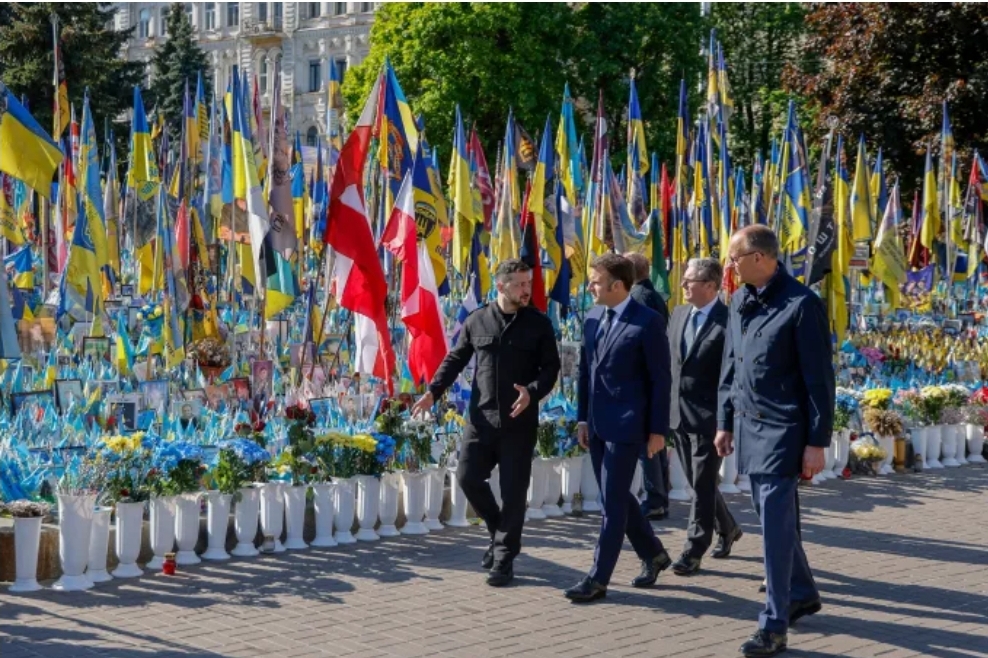
French President Emmanuel Macron, flanked by German Chancellor Friedrich Merz, British Prime Minister Keir Starmer, and Polish Prime Minister Donald Tusk, delivered the stern warning alongside Ukrainian President Volodymyr Zelensky in the heart of Kyiv. The declaration came after a joint phone call with U.S. President Donald Trump, signaling rare transatlantic alignment on the need to de-escalate the war.
“The message is clear,” Macron said. “Either Russia commits to a full cessation of hostilities across land, sea, and air – or it must prepare for an unprecedented level of economic and diplomatic isolation.”
President Zelensky echoed the urgency, stating: “The ceasefire must begin unconditionally on Monday, May 12. Any attempt by Russia to impose preconditions is nothing but a tactic to prolong this war and derail diplomacy.”
The announcement places immense pressure on Moscow, leaving less than 48 hours for the Kremlin to comply. It also signals a shift in strategy for Europe, which is increasingly stepping forward as a principal actor in the conflict amid concerns over the evolving stance of the United States under President Trump’s leadership.
In response, Kremlin spokesperson Dmitry Peskov appeared dismissive, reiterating that while President Putin supports the concept of a truce “in principle,” many “issues” remain unresolved. He warned against “external pressure,” asserting that Russia would not yield to Western coercion.
During an exclusive interview with CNN, Peskov hinted that one sticking point may be the continued supply of Western arms to Ukraine. “Without addressing such concerns, a genuine ceasefire cannot take shape,” he argued.
Despite Peskov’s remarks, U.S. support for the European initiative appears solid. President Trump, who has repeatedly advocated for a temporary truce, wrote on Truth Social that “failure to comply will result in further sanctions on Russia,” indicating his growing frustration with the Kremlin’s evasiveness.
The four European leaders arrived in Kyiv via rail early Saturday morning and were received by Andriy Yermak, Zelensky’s chief of staff. After paying tribute to fallen Ukrainian soldiers at Independence Square, they convened a closed-door summit at Mariinsky Palace, followed by a conference call with Trump described as “productive” by Ukraine’s Foreign Minister Andrii Sybiha.
While Russia has intermittently declared unilateral short-term ceasefires – including a 72-hour halt timed with its May 9 Victory Day celebrations – Ukrainian officials report continued assaults along the frontlines and remain skeptical of Moscow’s sincerity.
Adding to concerns, the U.S. embassy in Kyiv issued a security alert Friday, warning of a potential large-scale air assault “within days.”
Analysts say the next 36 hours could prove pivotal in determining whether diplomacy can avert a broader escalation or whether tensions will deepen further.
As the clock ticks, Europe’s coordinated show of resolve may represent one of the most significant efforts to date to end the war — or could risk igniting an even more dangerous standoff if Russia refuses to yield.