


By Asim Shehzad
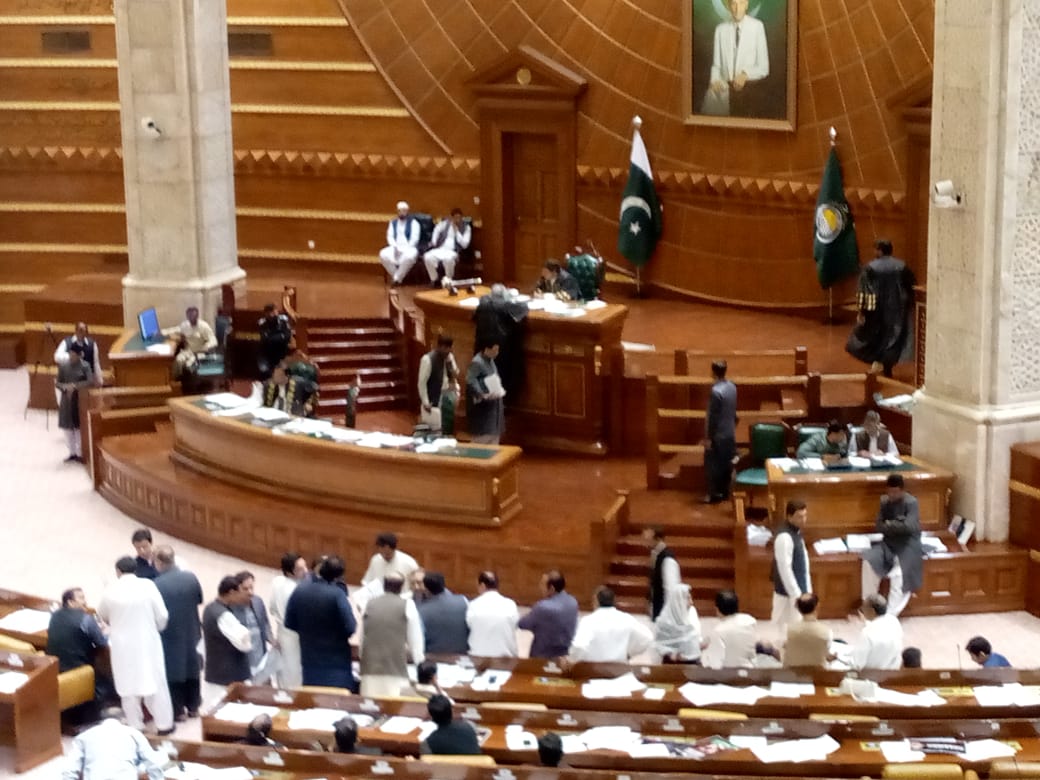
LAHORE — The Punjab Assembly turned into a battleground of words on Monday as the opposition strongly protested against the provincial government’s wheat support policy, despite recent announcements offering incentives and support to farmers. Special Assistant for Price Control, Salma Butt, presented the government’s stance in the House, highlighting various measures taken to uplift the agricultural sector and support wheat growers.
Read also: Punjab Assembly passes Regional Planning Authority Bill amid opposition walkout
Salma Butt told the House that the Punjab government considers farmers’ problems as their own, and to address them, the agriculture development budget had been enhanced from Rs. 29 billion to Rs. 64 billion. An estimated Rs. 400 billion has been spent on agriculture-related initiatives. She emphasized that interest-free seeds, fertilizers, and pesticides worth Rs. 55 billion were provided through 500,000 Kisan Cards, while 9,500 tractors were distributed with a subsidy of Rs. 1 million per tractor. Moreover, 1,000 tractors were given free to promote wheat cultivation, which reportedly led to a five maund per acre increase in wheat production.
Butt also said that the new wheat storage and electronic warehousing system would allow farmers to store wheat and receive up to 70% of its value from banks. Storage rent would be waived, and cheap wheat would not be sold for four months. She also highlighted a Rs. 25 billion financial support program for farmers owning up to five acres of land. Additionally, a Rs. 45 lakh, 85-horsepower tractor would be awarded to high-yield wheat producers.
Despite these claims, opposition members rejected the government’s narrative. Opposition Leader Ahmed Khan Bhachar criticized the policy as insufficient, stating, “Salma Butt’s speech suggests farmers should survive on bread crusts instead of roti.” He highlighted that wheat cultivation had dropped by 1.6 million acres this year and ridiculed the feasibility of individual farmers storing vast amounts of wheat. He demanded a subsidy package of Rs. 250 billion to rescue the wheat-growing community.
Speaker Malik Muhammad Ahmad Khan acknowledged the farmers’ plight, stating that Rs. 2,200 per maund was inadequate compensation, and assured that six new measures would ensure better crop returns.
Meanwhile, the Assembly passed several key bills including the Nawaz Sharif Institute of Cancer Treatment and Research Act 2025, the Punjab Acid Control Bill 2025, the Punjab Prevention and Control of Thalassemia Bill 2024, and the Next Institute of Science and Technology Bill 2025. The session was later adjourned indefinitely.