


By Asim Shahzad
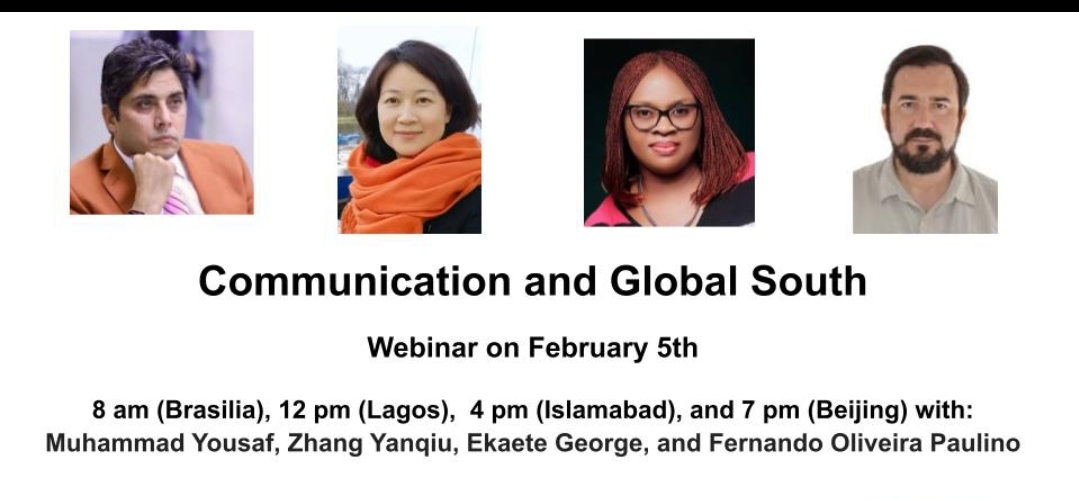
LAHORE: The Centre for Media & Communication Studies, University of Gujrat, Pakistan, and the Communication Policies Lab, University of Brasília, Brazil, jointly organized a webinar titled “Communication and the Global South.” The event was funded by the Communication Policies Lab (University of Brasília), the “Communication, Social Justice, and Democracy” Working Group (International Association for Media and Communication Research, IAMCR), and ALAIC. This online discussion focused on the challenges of research, learning, and publishing in Global South countries.
Dr. Muhammad Yousaf, Assistant Professor at the Centre for Media & Communication Studies, University of Gujrat, emphasized key obstacles faced by researchers in the Global South, including: funding disparities, limited access to scholarly resources and publication bias, technological gaps and the digital divide, language and cultural barriers and reliance on epistemological and methodological frameworks borrowed from the Global North. He highlighted that increased investment in research, promotion of open-access resources, and international collaborations can democratize knowledge production and sharing in the Global South.
Dr. Zhang Yanqiu, Professor at the Communication University of China, discussed how the Chinese communication model can empower Global South countries by fostering a fairer and more equitable information and communication order. She also emphasized that China’s developmental model has played a crucial role in poverty alleviation, offering lessons for other nations. Ikeate George, a Nigerian scholar, analyzed the postcolonial media landscape, highlighting economic constraints, governance challenges, and both the hurdles and opportunities for scholarly work in the Global South. Fernando Oliveira Paulino, a Professor at the Communication Policies Lab at the University of Brasília, stressed the need for global equity and deeper insights from Global South scholars to better understand their realities. He advocated for greater international collaboration to promote knowledge equity worldwide.
Read more: Seminar on Islamic Banking to educate the business community on the principles and benefits of Islamic banking
This webinar provided a valuable platform for dialogue on strengthening research, academic access, and media development across the Global South. Scholars across the globe participated in the webinar.