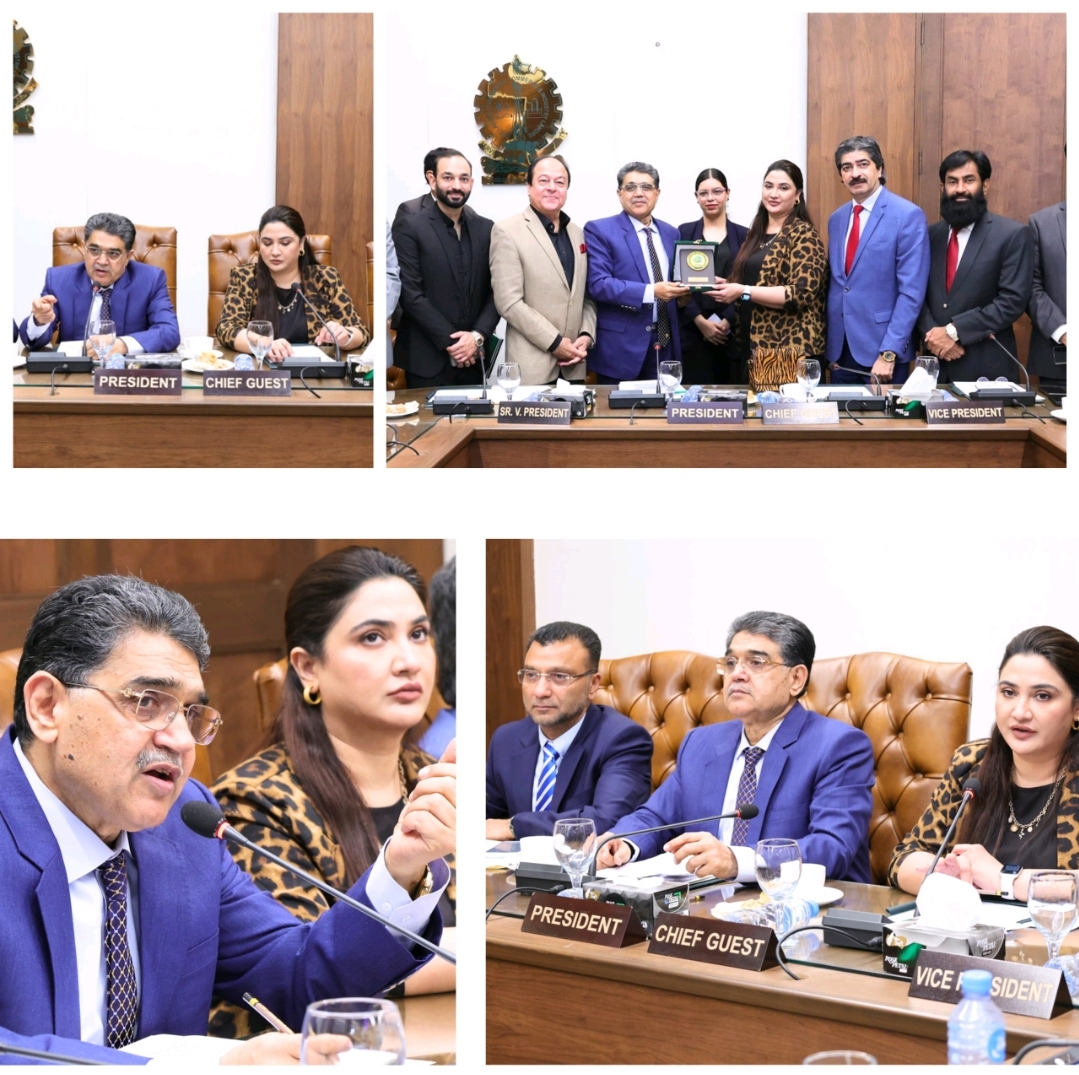



Mian Abuzar Shad spoke about the critical issues affecting exports, citing rising business costs, particularly high energy prices, increased policy rates and inconsistencies in economic policies as major hindrances
Commerce Reporter
LAHORE: The Trade Development Authority (TDAP) DG has invited the Lahore Chamber’s members to participate in the exhibition organized by the authority, scheduled for February 2025 in Saudi Arabia and January 2025 in Ethiopia.
LCCI President Mian Abuzar Shad, Senior Vice President Engineer Khalid Usman and Vice President Shahid Nazir Chaudhry also spoke on the occasion and underlined the need for collaborative efforts to enhance Pakistan’s export capabilities. Former Senior Vice President Ali Hussam Asghar, former Vice President Tahir Manzoor Chaudhry and Executive Committee Members were present.
Director General of the Trade Development Authority of Pakistan (TDAP) Rafia Syed has said that ASEAN and Central Asian states are well on the radar as these are key markets to boost Pakistani exports.
She said that TDAP is committed for policy advocacy and highlighted the role of value-added products in boosting export. She said that TDAP is utilizing all available marketing tools including delegations and webinars for the exports promotion.
LCCI President Mian Abuzar Shad spoke about the critical issues affecting exports, citing rising business costs, particularly high energy prices, increased policy rates and inconsistencies in economic policies as major hindrances.
He said that 68% of Pakistan’s exports are concentrated in textiles, leather and rice and also highlighted the untapped export potential in sectors like halal food, pharmaceuticals, information technology, engineering, surgical instruments and sports goods.
The LCCI president stressed the urgency of seeking new markets saying that a staggering 68% of exports are limited to just ten countries. “There is immense trade potential in Africa, ASEAN and Central Asian states and we need to capitalize on these opportunities,” he added. He also highlighted the need for strategic partnerships and increased visibility in international markets.
LCCI Senior Vice President Engineer Khalid Usman proposed focusing on import substitutions as a strategy to reduce the trade deficit, identifying sectors like machinery, automobiles, electric vehicles, mobile devices, food, cotton, fertilizers and chemicals as areas with significant potential for local production. He said that by promoting local alternatives, we can improve our balance of trade.
Vice President Shahid Nazir Chaudhry called for enhanced support for the export capabilities of Pakistan’s SMEs, advocating for private sector facilitation in marketing their products globally. He requested that TDAP provide special assistance to Lahore Chamber members for participating in international exhibitions and trade delegations, emphasizing the importance of these platforms for market access.
Mian Abuzar Shad further elaborated on the low share of Pakistani imports in crucial markets. He said that Africa’s total imports amount to $700 billion, yet Pakistan’s share is only $1.8 billion. Similarly, in ASEAN countries, the total imports are $1.7 trillion, with Pakistan holding just a 1.7 billion share. He said that the Middle Eastern states represent another significant opportunity with total imports of $111 billion, yet Pakistan’s share remains a mere $226 million.
He proposed that the Export Development Fund should be utilized to provide subsidies for the SME sector, particularly targeting women entrepreneurs to help them participate in international exhibitions and trade missions. He said that we need to facilitate them with airfare, accommodation and stall bookings.
The LCCI President urged the government to activate trade agreements with various countries and recommended a comprehensive performance evaluation of commercial attachés abroad. He proposed assigning them specific tasks related to increasing exports and mandated that they share market reports with the Lahore Chamber. “Regular performance reviews are essential and if any officer fails to enhance exports, they should be replaced to ensure effective representation,” he said.