


By Asim Shahzad
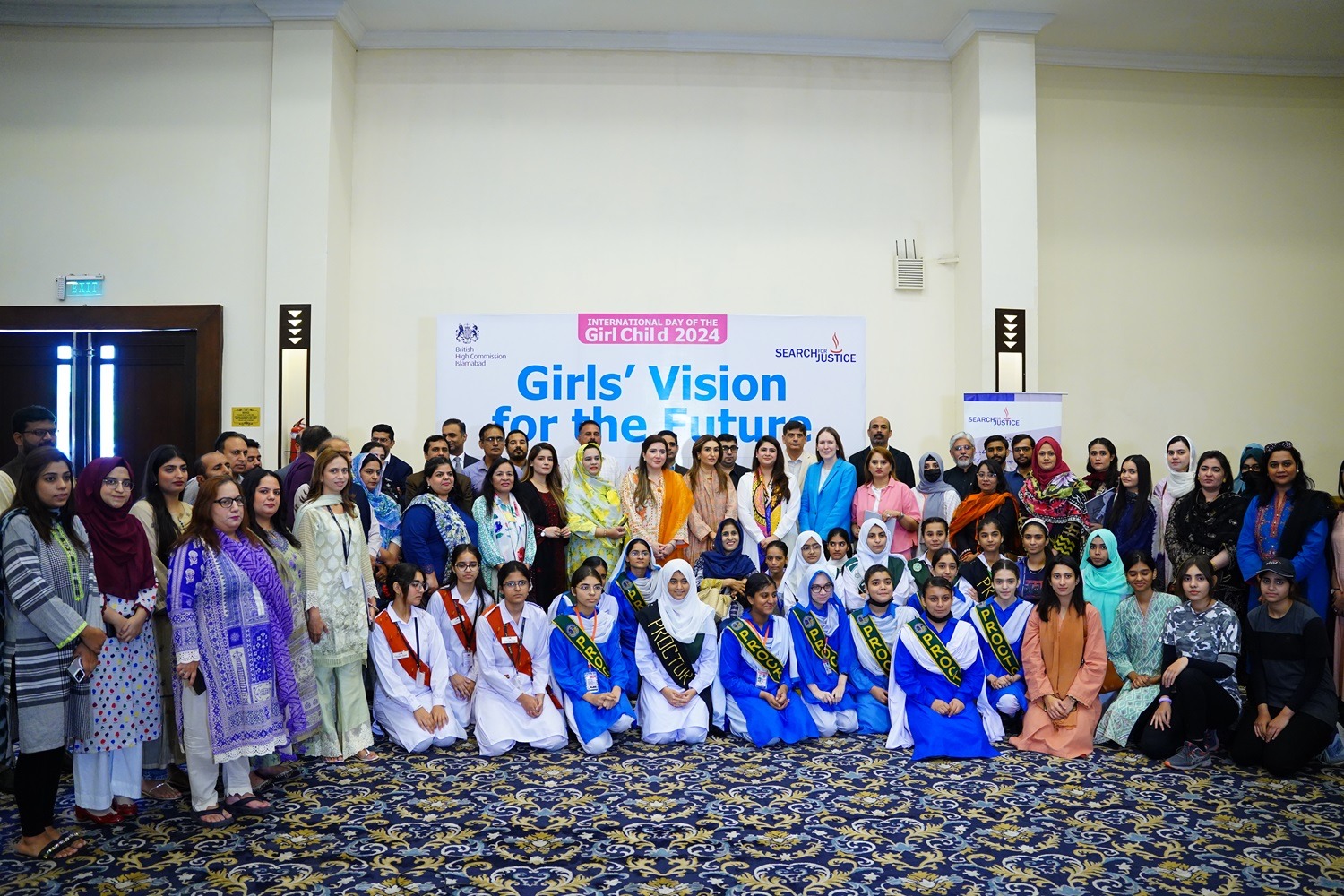
LAHORE: During a girl-led event jointly organized by the British High Commission Lahore Office and Search for Justice, in connection with the International Day of the Girl Child, young and adolescent girls took center stage as they interacted with government officials, parliamentarians, and other stakeholders.
They presented unique legislative, administrative, and policy measures to promote the protection and realization of girls’ rights.
The event featured prominent figures such as Sarah Ahmad, Chairperson of the Child Protection & Welfare Bureau; Kristin K. Hawkins, U.S. Consul General in Lahore; Ms. Bushra Anjum Butt, Senator and Chairperson of the Senate of Pakistan’s Standing Committee on Education and Professional Development; Jahan Ara Wattoo, Vice Chairperson of the Punjab Social Protection Authority; Kanwal Liaqat, Parliamentary Secretary for the Environment Protection & Climate Change Department; Asfa Khan, Director of the Parliamentary Development Unit; Zahida Manzoor, Child Protection Officer at UNICEF Punjab; Ijaz Ahmad, National Project Coordinator at the International Labour Organization; and along with representatives from various government departments and civil society organizations.
Iftikhar Mubarik, Executive Director of Search for Justice, highlighted that this is a crucial time to prioritize the protection of girls from various forms of gender-based violence. He noted that the upcoming 1st Ministerial Conference on Ending Violence Against Children in Colombia will bring world leaders together to reflect on state-level pledges to end violence against children, particularly girls. He also appreciated the recent initiative by the Punjab Chief Minister, where the Punjab School Education Department issued a notification to observe the International Day of the Girl Child. However, he stressed that more strategic actions are needed to fully realize girls’ rights.
Esha, a 16-year-old girl, pointed out the disparity in educational facilities in Punjab, stating that out of 8,077 high schools, only 3,931 are for girls. She emphasized that in rural areas, high schools are often located far from girls’ homes, making it difficult for them to attend without adequate transportation. This situation leads to a high dropout rate among adolescent girls. Esha called on the government to increase the development budget for establishing more educational facilities and to ensure that girls can access schools without obstacles. She specifically urged the Punjab School Education Department to expedite the approval of rules under The Punjab Free & Compulsory Education Act 2014 and develop mechanisms for implementing the act, particularly Section 13, which mandates private schools to provide free education to children from disadvantaged groups.
Abeeha Batool, a 16-year-old advocate for children’s rights, called on the Punjab government to raise the minimum legal age of marriage for girls from 16 to 18 years. She emphasized the need for strong and effective implementation mechanisms, stating that early marriage deprives girls of their right to education, limits future opportunities, and increases their vulnerability to health complications, domestic violence, and poverty. Abeeha also called for greater efforts to raise awareness in communities about the harmful impacts of child marriage and the importance of investing in girls’ education and empowerment.
Young champion Laiba, who recently returned to Pakistan after winning a medal in a badminton championship, emphasized the importance of recognizing girls’ right to play and participate in sports on equal terms with boys and men. She highlighted that Article 31 of the UN Convention on the Rights of the Child guarantees the right to play for all children without discrimination. However, Laiba stressed that more efforts are needed to bring about social and behavioral changes in communities to raise awareness that girls have equal rights in sports and recreation. She urged the government to provide the necessary facilities in schools, colleges, and communities to ensure that girls can fully exercise this fundamental right.
Saba Sheikh, a 14-year-old girl, shed light on the economic exploitation of children, particularly girls who are forced into domestic labour. She noted that although Section 3 of the Punjab Domestic Workers Act 2019 prohibits the employment of children under the age of 15 in domestic work, more action is needed to establish a robust mechanism to ensure the law’s effective implementation. Saba called for stronger efforts to protect children and uphold their rights in the best interests of their welfare.
Neeha Munir, a young climate activist, urged for the inclusion of girls and children in the development of policies and action plans to tackle the growing challenges of climate change. She emphasized that women and children are disproportionately affected by climate crises, and their voices must be heard to ensure more effective and equitable solutions. Neeha further highlighted that the recently approved Punjab Climate Change Policy 2024 lacks sufficient focus on actions tailored to address the specific needs and vulnerabilities of children. She called on policymakers to prioritize the protection of children in climate-related strategies to ensure their safety, well-being, and future resilience in the face of environmental challenges.