


By Asim Shahzad
LAHORE: Punjab Assembly Speaker Malik Muhammad Ahmed Khan has said that mocking martyrs is not acceptable under any circumstances and Maulana Fazlur Rehman should apologize to the entire nation for this matter. He said that political differences have their place, but there can be no compromise on respect for national institutions and martyrs.
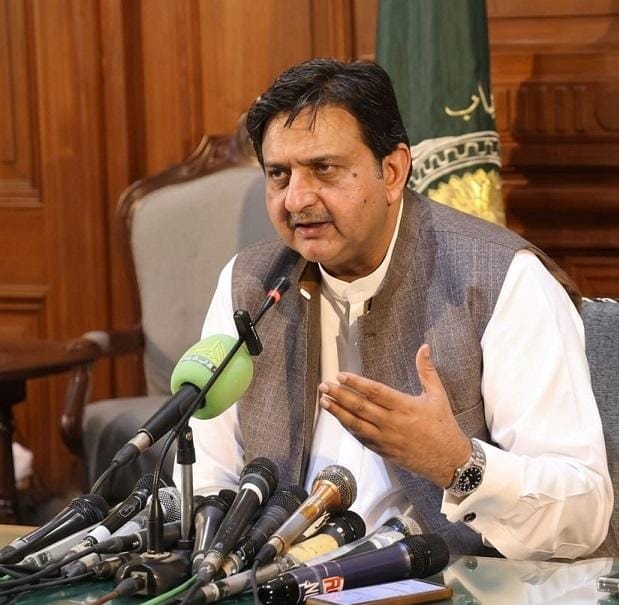
Addressing a press conference in Lahore, Malik Muhammad Ahmed Khan said that Jamiat Ulema-e-Islam (F) is a major political force, but he strongly disagrees with Maulana Fazlur Rehman’s recent statement and a large number of the public also does not agree with this position.
He said that insulting the Pakistani armed forces, whether through words or actions, is intolerable, while the sacrifices and honors of the army personnel are the pride and asset of the entire nation.
He said that any political party or leader should take into account national sentiments and sensitive issues. The role of state institutions can be debated, but responsibility and caution on matters of national security are indispensable.
Malik Muhammad Ahmed Khan said that the state’s negotiations with any terrorist, regardless of which group he belongs to, are not appropriate. Terrorists cannot be equated with those engaged in political struggle. He said that there is no question of negotiations with elements who target mosques, Imambargahs, courts and ordinary citizens.
He said that after terrorism in Balochistan, train attack and the confessions of Indian spy Kulbhushan Jadhav, the question arises whether the Pakistani army should negotiate with the terrorists or take action against them. He said that if a handful of terrorists try to take the majority hostage, the responsibility of the state and the Pakistani army is clear, however, Maulana Fazlur Rehman’s silence in this regard is questionable.
He said that terrorist elements cannot be allowed to spread fear and panic in the country again. The past negotiations and their results should also be reviewed impartially, while the martyrs of Data Darbar, Army Public School Peshawar and other terrorist attacks can never be forgotten. He said that the entire nation is united against terrorism and establishing lasting peace in the country should be everyone’s top priority.
The Punjab Assembly Speaker said that if Imran Khan’s movement was against the political role of the army, he would have supported it, but coming to power with the help of the army and then opposing it when the army is neutral is not the right course of action. Referring to the role of Pervez Elahi, Muttahida Majlis-e-Amal and past political parties, he said that the positions of political parties have changed in different periods, so continuity and responsibility are necessary in political statements.
He said that if someone says that the soldiers assigned to protect Pakistan serve only for pay, it is an insult to the martyrs and national sentiments. Such statements are not only regrettable but also against the national interest.
Malik Muhammad Ahmed Khan said that the basis of the 2014 sit-in was objections to the electoral process and a demand for an investigation into the four constituencies. Later, court decisions identified some electoral irregularities, but they were not declared as systematic rigging.
He said that parliamentary and legal forums could have been used effectively to resolve objections related to RTS, Form 45 and Form 47, but this was not done. According to him, it is a democratic tradition to take the constitutional and legal path despite protests on electoral matters.
He said that in the context of the global situation, seriousness, responsibility and unity on national issues are the need of the hour. He stressed that Pakistan’s diplomatic achievements, peace initiatives and state stance against terrorism should not be ignored, while national interest should be kept first in all cases despite political differences.
He said that the entire nation views the sacrifices of the martyrs with dignity and respect, and it is the responsibility of every Pakistani to respect the feelings of the families of the martyrs, because the sacrifice of a martyr guarantees the peace and security of the entire nation.
He said that there should be principled uniformity in the stance of political parties and the stance should not change due to temporary interests. If the political role of the army is objected to, then this principle should be applied equally to every era and every government.
He said that in the past, questions have been raised about the role of the military in the formation of political governments and various decisions, so political parties should also examine the contradiction between their previous decisions and their current stance.
The Speaker of the Punjab Assembly said that the solution to electoral objections should be sought through constitutional and legal forums, especially election tribunals, instead of the streets. It is not appropriate to declare the entire electoral system controversial based on a few election petitions or disputes.
He stressed that to restore public confidence in elections, a transparent system and agreement among all political parties on the constitutional procedure under which election results should be recognized or challenged are essential.
He said that unverified information and misleading narratives on social media are further complicating national issues, so discussions on national issues should always be based on facts, responsibility, and caution.
Malik Muhammad Ahmed Khan said that Pakistan is facing several security challenges including the Western Border, Balochistan and terrorism, to deal with which the unity of state institutions and the people is inevitable. He said that it is important to understand the difference between the allegations of terrorism and the state stance, while Pakistan has made unprecedented sacrifices in the war against terrorism, which cannot be ignored under any circumstances. More than political narratives, the protection of the dignity of national institutions, the Pakistani armed forces and the martyrs is the demand of national interest.


