


By Asim Shahzad
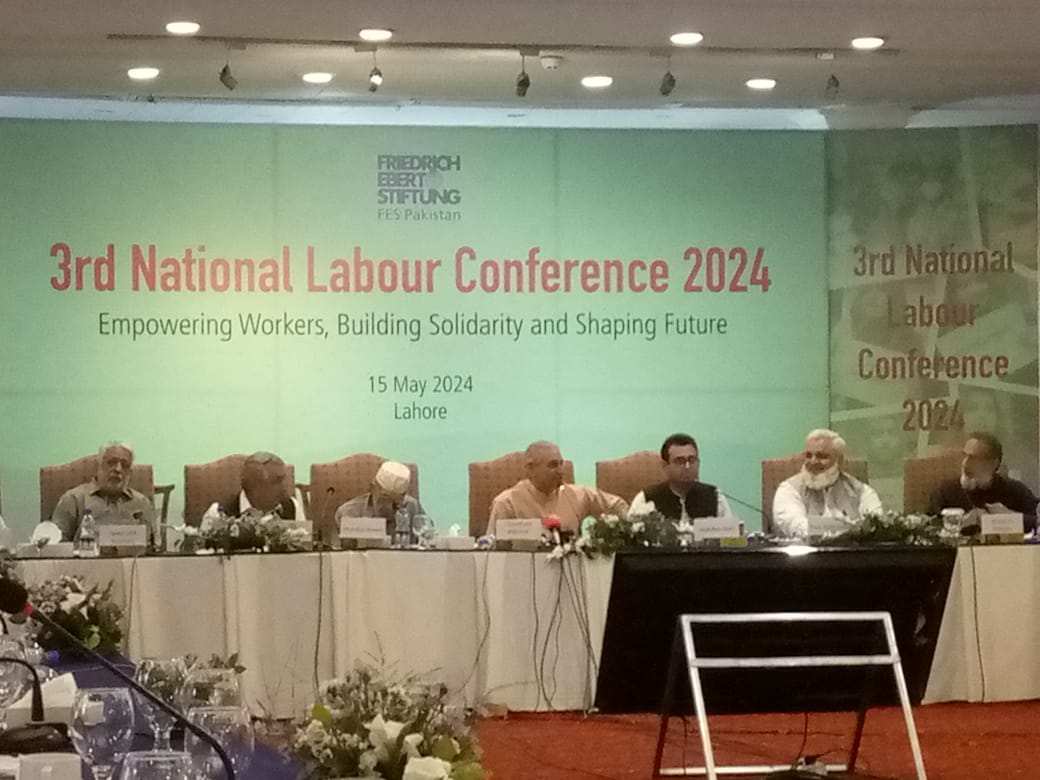
LAHORE: Pakistan – Friedrich Ebert Stiftung Pakistan conducted its 3rd national Labor Conference, bringing together key stakeholders to discuss the state of labor rights in Pakistan.
The conference commenced with welcoming remarks by Dr. Almut Wieland Karimi, Country Director of Friedrich Ebert Stiftung Pakistan. Program Advisor Abdullah Dayo outlined the objectives of the conference, setting the tone for a productive and insightful discussion.
In the inaugural session, Khalid Mehmood, Executive Director of Labour Education Foundation, delivered a thought-provoking address on the labor movement in Pakistan. He highlighted the challenges faced by workers and the opportunities for growth and improvement. Iqbal Ahmed Detho, Chairperson of Sindh Human Rights Commission, shed light on labor rights in Pakistan, emphasizing the need for greater protection and enforcement. Saghir Bukhari, Senior Program Officer of the International Labor Organization, said that there is a need to implement laws regarding labor in Pakistan. Reforms in the agriculture sector are also the need of the hour. Women working in cotton fields have health problems, he added.
The first session concluded with remarks by the Chief Guest, Governor of Punjab Sardar Salim Haider, who emphasized the importance of workers’ rights and government policies in protecting and promoting the welfare of laborers. He said, while addressing the conference that Labor laws were made during Ms. Benazir Bhutto’s tenure which are still in force today. He said that the government of the People’s Party of 2008-13 increased the salaries by 150 percent. Sardar Salim Haider in his address to the conference further ensured that He will work in Punjab regarding labor laws.
Moderated by Abdullah Dayo, Program Advisor at FES Pakistan, the working session-1 saw esteemed speakers and panelists delving into key topics concerning workplace health and safety, labor rights, and the status of female labor force participation in the country.
Mr. Zulfiqar Shah, Country Manager at Accord Pakistan, took the stage to shed light on the imperative issue of enhancing workplace health and safety standards in Pakistan. His comprehensive discourse highlighted the importance of robust safety protocols to ensure the well-being of workers across various industries.
Dr. Taimoor Rahman, Associate Professor at Lahore University of Management and Science, captivated the audience with his insights into the impact of foreign debt and privatization on labor rights in Pakistan. Through meticulous analysis, He said that the government has to borrow more to reduce the trade deficit. Industry in Pakistan is shrinking instead of growing. Dr. Rahman underscored the need for policies that safeguard the rights and interests of workers amidst economic transformations.
A riveting panel discussion ensued, featuring prominent women speakers who brought forth their expertise and perspectives on the challenges faced by women workers in Pakistan. Ms. Ume Laila, Executive Director of HomeNet Pakistan, Ms. Rubina Jameel, General Secretary of the All Pakistan Trade Union Federation, and Ms. Aima Mehmood, Director of Women Workers Organization, offered invaluable insights into the status of female labor force participation and the hurdles hindering their progress. Ms. Ume Laila pointed out that fifty percent of the country’s population is women, but women workers in the country constitute 23 percent of the total labor force. Rubina Jameel pointed out that there are no accurate figures on how many women there are in trade unions across the country. The number of women registered in Punjab Employees Social Security Institution is only 36 thousand. Aima Mehmood said that women’s inclusion in Labor and trade Unions are just as members and officials, but they are not part of decision-making.
The Conference convened its second working session under the expert guidance of Mr. Khurshid Ahmed, General Secretary of the All Pakistan Workers Confederation (APWC).
A thought-provoking panel discussion centered on the labor manifestoes of political parties in Pakistan. Titled “Labor Manifestoes of Political Parties: A Promise to be Fulfilled,” the session brought together influential political leaders from prominent political parties to delve into their commitments and strategies concerning labor rights and welfare. T
he panel comprised distinguished speakers from key political parties, including: Mr. Chaudhary Manzoor Hussain, Leader of Pakistan Peoples Party and Mr. Rana Abdul Sami, Leader of Pakistan Tehreek-e-Insaf. Each leader presented insights into their party’s vision and promises regarding labor rights, trade unions, welfare opportunities and initiatives. Chaudhry Manzoor said that in a democracy, if students’ union or farmers’ organizations are banned, then how will democracy work. In Punjab, two and a half crore workers are connected to social security. He suggested that a powerful commission should be created to implement the labor laws. The panelists outlined the need for concrete steps to fulfill the pledges outlined in their respective party manifestoes.
During the last panel discussion, distinguished speakers representing various provinces shared their insights and experiences, shedding light on the unique challenges and initiatives within their respective regions. The spotlight was on the concerted endeavors being made at the provincial level to tackle these issues effectively. Mr. Mouhammad Sultan Khan from Balochistan, Mr. Abdul Latif Nizamani from Sindh, Mr. Shaukat Ali Anjum from Khyber Pakhtunkhwa, and Mr. Shams Ur Rehman Swati from Punjab addressed the conference, offering valuable perspectives and solutions to address labor concerns at the grassroots level.
The 3rd International Labor Conference concluded on a high note, fostering a collaborative spirit and renewed commitment to addressing labor challenges in Pakistan. The closing session featured an open discussion aimed at building a national alliance to champion the rights and welfare of workers across the country.
Participants from diverse backgrounds and sectors engaged in a candid exchange of ideas, sharing their perspectives on the pressing plights faced by laborers in Pakistan. From precarious employment conditions to inadequate wages and lack of social protection, the discussion underscored the urgent need for concerted action to address these issues.




In a significant moment of unity, the leadership of the labor movement presented a joint declaration, reaffirming their collective resolve to advocate for the rights and dignity of workers. The declaration encapsulated key priorities and demands, emphasizing the importance of solidarity and cooperation among labor stakeholders to effect positive change.
The conference provided a platform for meaningful dialogue and knowledge sharing, and Friedrich Ebert Stiftung Pakistan looks forward to continuing the conversation and working towards a better future for workers in Pakistan







Recent Comments