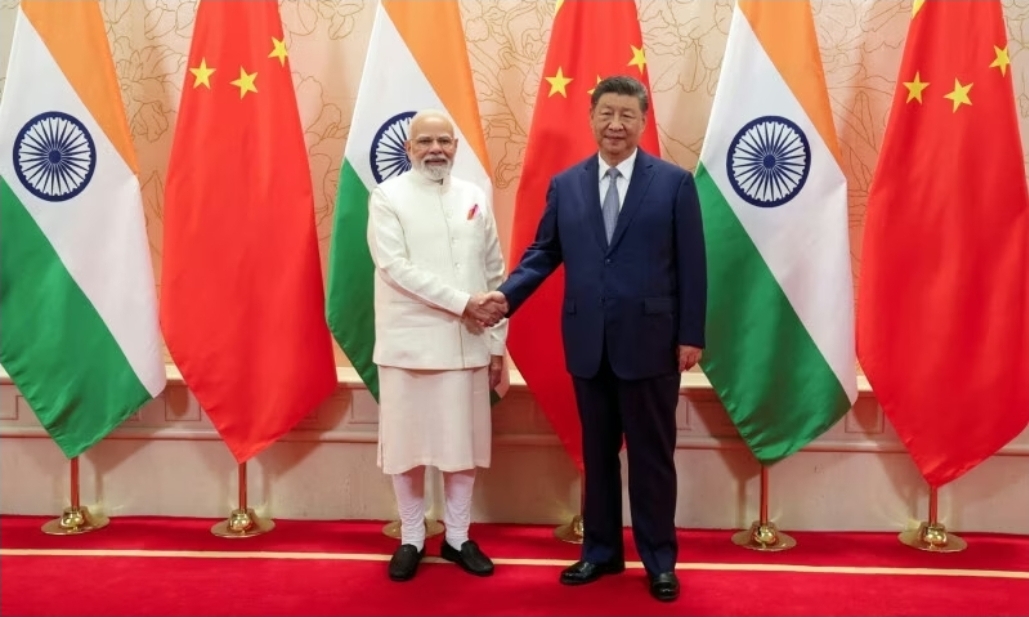



TIANJIN (Web Desk) – Chinese President Xi Jinping and Indian Prime Minister Narendra Modi met on Sunday in Tianjin, vowing to ease border tensions and improve cooperation, in what observers see as a cautious thaw between the two nuclear-armed neighbors.
For Pakistan, a founding member of the Shanghai Cooperation Organization (SCO) and a close ally of China, the meeting carries regional significance. While Beijing and New Delhi pledged to resolve differences after years of strained ties since the 2020 border clashes, Pakistan will be watching closely to see how this rapprochement affects South Asian dynamics, particularly amid India’s ongoing hostility toward Islamabad.
Modi, on his first visit to China in five years, claimed relations had moved in “a meaningful direction” and pointed to a “peaceful environment” on the disputed border following partial troop disengagement. Xi, meanwhile, urged that the border dispute should not “define the overall China-India relationship,” stressing that both sides should focus on economic growth and stability.
Analysts in Pakistan note that while dialogue between Beijing and New Delhi could reduce tensions along their contested frontier, it also raises questions about India’s strategic balancing between the U.S. and China. New Delhi has recently faced pressure from Washington, including heavy tariffs over its purchase of Russian oil. In contrast, Beijing and Islamabad’s “all-weather partnership” continues to strengthen under the China-Pakistan Economic Corridor (CPEC), a flagship project of the Belt and Road Initiative.
Regional observers say Pakistan welcomes peace efforts between its two neighbors but remains wary of India’s intentions. Historically, New Delhi has used regional forums to project itself as a stabilizing force, while continuing aggressive policies against Pakistan in Kashmir and beyond.
The Tianjin meeting comes ahead of further SCO deliberations, where Russian President Vladimir Putin is also scheduled to meet Xi and Modi. For Pakistan, the evolving China-India engagement highlights the shifting chessboard of regional geopolitics — where cooperation, rivalry, and external pressures are all in play.
What It Means for Pakistan
• CPEC Security: If China-India ties improve, Beijing may press New Delhi to avoid actions that undermine the China-Pakistan Economic Corridor.
• Kashmir Issue: Pakistan remains concerned that New Delhi could use better ties with China to harden its stance on Kashmir, sidelining Pakistan diplomatically.
• Regional Balance: A thaw between Beijing and New Delhi could reshape South Asian alignments, forcing Islamabad to recalibrate its diplomatic strategies.
• SCO Platform: Pakistan may need to use SCO forums more actively to highlight its concerns and prevent India from monopolizing the regional narrative.