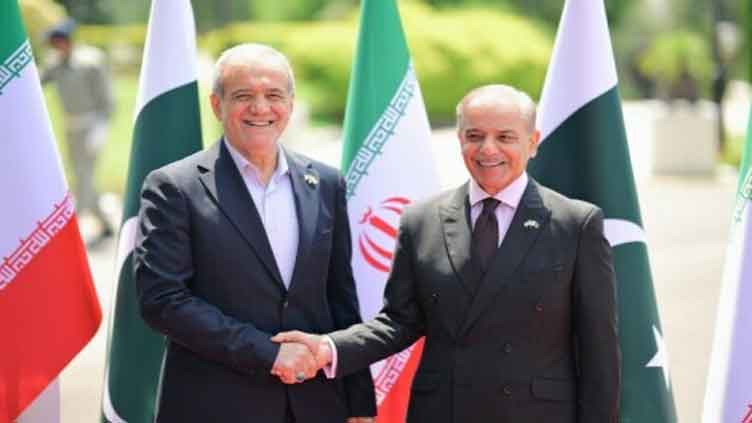



On Sunday, Prime Minister Shehbaz Sharif announced that Pakistan and Iran are committed to increasing their bilateral trade volume to $10 billion.
Both parties signed 12 agreements and memoranda of understanding (MoUs) during a two-day official visit by Iranian President Masoud Pezeshkian to Islamabad.
During a joint press briefing, PM Sharif and President Pezeshkian highlighted the signing of these agreements to enhance cooperation in various sectors and achieve the $10 billion trade target.
Detailed discussions between the delegations of both countries are planned to further this goal, as reported by the Associated Press of Pakistan (APP).
In bilateral talks, the leaders reviewed the deep-rooted ties between Pakistan and Iran, focusing on strengthening cooperation in trade, energy, and other areas.
PM Sharif condemned Israel’s June 13 attack on Iran’s nuclear facilities, which, according to Iranian authorities, killed 610 people, though rights groups estimate 974 deaths.
He expressed solidarity with Iran, criticizing Israel’s actions as unjustified aggression and offering condolences for the loss of Iranian generals, scientists, and civilians. Sharif also praised Iran’s bravery and strategic response to the attack.
Reaffirming Pakistan’s support for Iran’s peaceful nuclear program under the UN charter, Sharif emphasized a shared stance against terrorism, stating that an attack on Iran is akin to an attack on Pakistan. Both nations vowed to take strong measures to combat terrorism.
Welcoming President Pezeshkian on his first visit to Pakistan, PM Sharif expressed optimism about deepening ties. In response, Pezeshkian thanked Pakistan for its support during the 10-day Israeli aggression and highlighted the deep cultural, religious, and historical connections between the two nations, referencing the poetry of Allama Iqbal to stress Muslim unity.
He underscored Iran’s neighborhood policy, describing Pakistan as a brotherly nation, and expressed confidence in raising the current $3 billion trade volume to $10 billion through enhanced land, sea, and air connectivity.
The 12 agreements and MoUs covered cooperation in areas such as plant protection, border gate usage, science and technology, information and communications technology, culture, tourism, youth, media, exports, meteorology, maritime safety, judicial assistance, and air services. A joint ministerial statement also outlined plans to finalize a Free Trade Agreement.
President Pezeshkian was honored with a guard of honour at the Prime Minister’s House and is scheduled to meet President Asif Ali Zardari. Earlier, Foreign Minister Ishaq Dar met Pezeshkian, reaffirming Pakistan’s commitment to strengthening ties based on shared history and mutual respect, with the Iranian president expressing enthusiasm for advancing political and economic collaboration.
In a separate meeting, Commerce Minister Jam Kamal and Iranian Minister for Industry, Mines, and Trade Mohammad Atabak discussed accelerating trade, removing border obstacles, and fostering trust-based partnerships.
Kamal proposed targeted trade delegations to enhance market access and highlighted the success of similar initiatives in other countries. Both ministers emphasized leveraging geographic proximity to boost trade, with Kamal noting the potential for broader regional connectivity with Turkey, Central Asia, Russia, and the Middle East.
Atabak encouraged swift implementation of the new agreements and proposed regular business-to-business exchanges. Both sides agreed to prioritize sectors like agriculture, energy, and logistics, and to hold the next Joint Economic Commission session soon to ensure structured trade outcomes.
They also highlighted the cultural and linguistic ties that strengthen Pakistan-Iran relations, expressing confidence in a new era of strategic economic partnership that could transform regional trade dynamics.