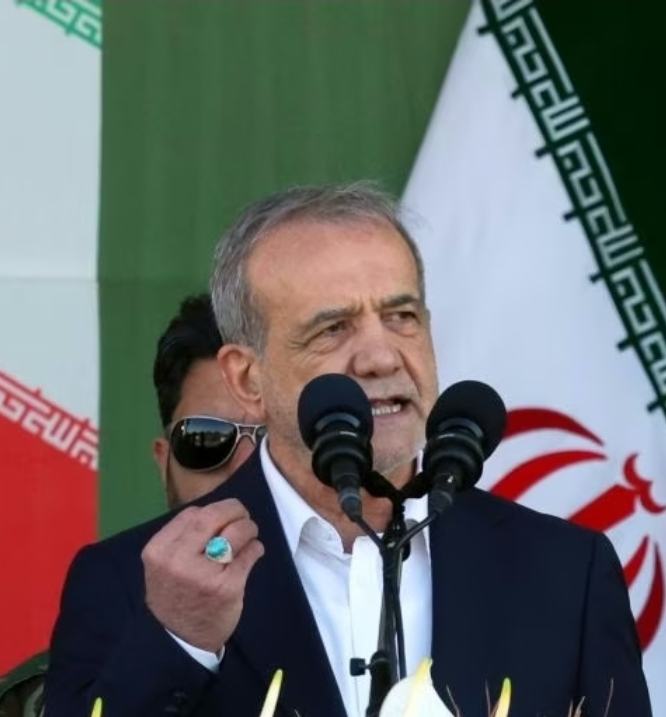



DUBAI (News Desk) – In a dramatic escalation following recent military strikes by the United States and Israel, Iranian President Masoud Pezeshkian has ordered the immediate suspension of the country’s cooperation with the International Atomic Energy Agency (IAEA), further straining already fragile diplomatic rerelations.
Read also: US to start talks with Iran post-ceasefire, says Donald Trump
The president’s directive, announced via Iranian state television on Wednesday, follows a parliamentary law recently approved by the Guardian Council. The legislation mandates a halt to all nuclear-related cooperation with the UN watchdog until Iran’s conditions — including the protection of its nuclear facilities and scientists — are fully guaranteed.
Although Pezeshkian did not lay out an exact timeline or specify what the suspension entails, the move significantly raises concerns over the transparency of Iran’s nuclear program, which Western nations have long viewed with suspicion.
Foreign Minister Abbas Araghchi, however, indicated that while Tehran is angry over the strikes, it has not entirely shut the door on diplomacy. Speaking to CBS News, Araghchi stated, “The doors of diplomacy will never slam shut,” though he dismissed any notion that negotiations could resume swiftly, despite former U.S. President Donald Trump’s recent claims suggesting talks could restart soon.
Ongoing Tensions Post-War
The suspension comes on the heels of the 12-day Iran-Israel war — a conflict that saw unprecedented Israeli and American airstrikes on Iranian military and nuclear installations. Among the targets were nuclear facilities including the deeply buried Fordo plant, which was reportedly hit by U.S. bunker-busting munitions on June 22.
Satellite imagery released this week revealed Iranian personnel and equipment actively inspecting damage at Fordo, about 100 kilometers southwest of Tehran. Trucks, cranes, and excavation machinery were seen near the tunnel entrances, suggesting significant destruction that now demands urgent repair.
According to Iranian officials, the Israeli airstrikes killed over 900 people, including dozens of children and women. However, independent groups such as Human Rights Activists, a Washington-based NGO, estimate the toll to be higher — around 1,190 deaths — with 4,475 wounded.
IAEA Yet to Receive Official Notification
Despite the announcement, IAEA inspectors have not been expelled from Iran and continue to operate in the country. A diplomat familiar with IAEA affairs, speaking anonymously, said the agency has not received a formal notification explaining the scope of Iran’s suspension order.
This ambiguity has raised concerns among international observers who fear Tehran may gradually reduce access to key nuclear sites, especially as its uranium enrichment has reached up to 60% purity — just a step away from weapons-grade material.
Iran insists its nuclear program remains peaceful, but intelligence reports and IAEA assessments suggest that Iran had a structured nuclear weapons program up until 2003. The 2015 nuclear deal — from which the U.S. unilaterally withdrew in 2018 under Trump — had limited Iran’s enrichment to 3.67% and imposed strict IAEA oversight.
Israel Calls for Global Action
Israel wasted no time condemning Iran’s decision. Israeli Foreign Minister Gideon Saar described the move as “a scandalous announcement” and accused Tehran of openly violating its international nuclear commitments. Saar urged European signatories of the 2015 nuclear deal to invoke the “snapback” clause, which would automatically reinstate all previously lifted UN sanctions against Iran if it is found in breach.
Notably, while the IAEA has no authority to inspect Israel’s nuclear arsenal, the country is widely believed to be the sole nuclear power in the Middle East. Israel has long considered Iran’s nuclear ambitions a direct threat and justified its recent strikes as preemptive defense.
Iran Stops Short — For Now
Although the suspension of IAEA cooperation is a major development, experts believe Tehran has not yet taken the most extreme steps. Iran has not withdrawn from the Nuclear Nonproliferation Treaty (NPT), a move that would signal full intent to develop nuclear weapons. For now, Tehran seems to be using the suspension as a bargaining chip amid heightened tensions.
Whether the diplomatic window remains open depends on future developments — both on the battlefield and at the negotiating table.