By Asim Shahzad
LAHORE: Punjab, with a population exceeding 125 million and more than 150 cities and towns, stands at a critical juncture in its urban and environmental development.

Rapid, unplanned urbanization has intensified environmental degradation, worsened air quality, depleted groundwater reserves, and heightened vulnerability to climate shocks. According to the World Bank’s Poverty, Equity, and Resilience Assessment (2025), Pakistan’s actual urban population may range between 60% and 80%, far higher than the official estimate of 39%.
These challenges threaten the province’s livability, productivity, and public health—posing serious barriers to achieving Sustainable Development Goals (SDGs) and long-term economic growth.
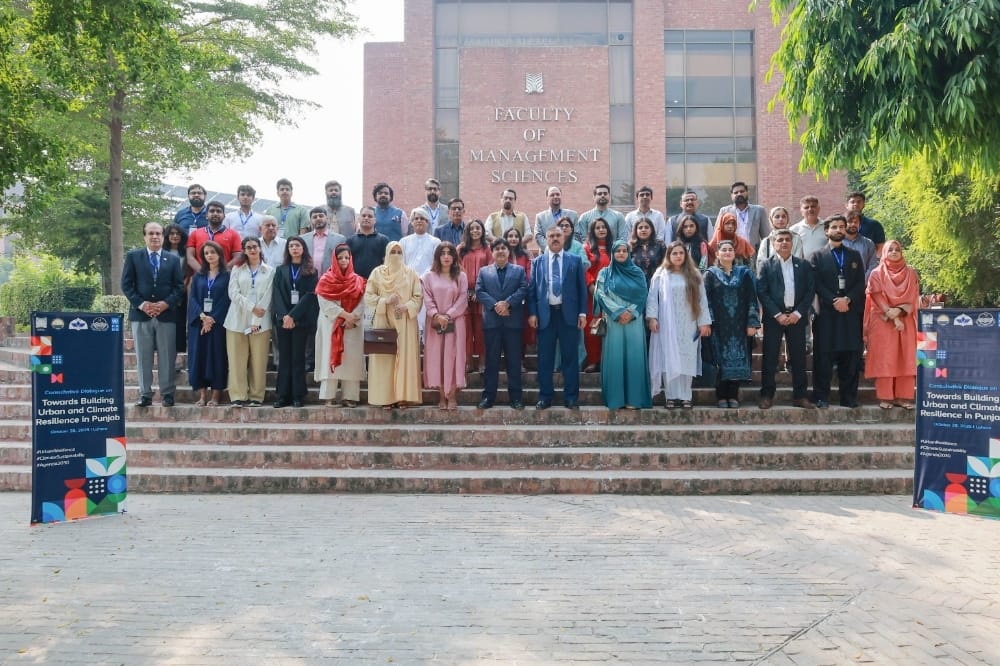
In this context, UNDP Pakistan’s Punjab SDGs Unit, in collaboration with Beaconhouse National University (BNU), organized a high-level consultative dialogue titled “Towards Building Urban and Climate Resilience in Punjab.” Knowledge partners included the Lahore University of Management Sciences (LUMS) and University of Engineering and Technology (UET) Lahore.
The session focused on identifying governance gaps, assessing climate vulnerabilities, and promoting global best practices in urban planning, data governance, and technology-driven adaptation to lay the foundation for resilience-oriented urban reforms.
While opening the session and outlining BNU’s vision for a climate-resilient and EcoSmart Campus, Dr. Moeed Yousuf, Vice-Chancellor of BNU, said, “We truly believe in the ethos of sustainability. The problem is that in Pakistan, academia is often not part of the conversation on issues like policy, social mobility, and change. BNU aims to collaborate with universities across Pakistan to engage the youth and promote sustainability and climate resilience as core values. What could be a better way to produce responsible citizens than to instil environmental stewardship?”
Dr. Zafar Iqbal, Additional Director General (EPA) of the Environment Protection and Climate Change Department, Punjab, delivered the keynote address, highlighting government initiatives for smog mitigation and inclusive, data-informed policymaking. “Transportation and industry are major contributors to smog — 39% from transportation, 24.5% from industry, 15.72% from energy, 10.53% from agriculture, and 9.3% from other activities,” he noted. “Technological interventions such as the Green Punjab App, Eco Watch App, and the 1373 Helpline are key steps to improve documentation and monitoring. The government has also implemented measures such as bans on fireworks, revised school timings, carpool mandates in schools, and green lockdowns to curb emissions.”
Nadeem Khurshid, Urban Resilience Specialist at UNDP’s Punjab SDGs Unit, stressed that cities like Lahore, Faisalabad, and Multan exemplify unsustainable sprawl. “Unchecked urban expansion has strained infrastructure, reduced green spaces, and widened social inequalities. We must focus on climate-smart financial planning, metropolitan governance, risk-informed zoning, and nature-based sustainable solutions,” he emphasized.
The event gathered key representatives from WWF, RUDA, the Environment Protection and Climate Change Department, Urban Unit, Punjab Green Development Programme, LUMS, UET, University of Lahore, and Forman Christian College, along with development practitioners, researchers, civil society members, and youth. Participants exchanged insights on policy perspectives, AI-driven climate resilience, data governance, and academia’s evolving role as a catalyst for environmental stewardship.
Concluding the session, Dr. M. Aman Ullah, Project Manager of UNDP’s Punjab SDGs Unit, stated, “Punjab contributes the largest share to Pakistan’s economy and bears a unique responsibility to advance the national SDG agenda. This dialogue takes us from strategy to action — identifying practical tools for data-driven resilience, institutional cooperation, and policy integration to make Punjab’s cities sustainable engines of growth.”
The dialogue underscored the urgency of enhancing local institutions, improving data management, and implementing technology-driven, coordinated resilience planning. Recognizing Punjab’s pivotal role in Pakistan’s development trajectory, the event’s outcomes will aid the government in strengthening institutional coordination and promoting AI-enabled policymaking for climate-resilient urban governance.
About the Author