By Our Correspondent
LAHORE: Chief Minister Punjab Maryam Nawaz Sharif has launched what is being described as the largest and most comprehensive rescue and relief operation in the province’s history to assist flood-hit families. The extraordinary operation comes in response to devastating floods triggered by alarming water levels in three major rivers, Ravi, Sutlej, and Chenab, that have inundated hundreds of villages across Punjab.

According to official figures, as many as 601,126 citizens in 769 villages have been badly affected by the flooding. The Punjab government, in collaboration with the Pakistan Army, Rescue 1122, PDMA, district administrations, police, and other agencies, has set up 263 relief camps and 161 medical camps to provide shelter, food, and healthcare facilities to displaced families. Temporary shelters have also been established to house those forced to leave their homes.
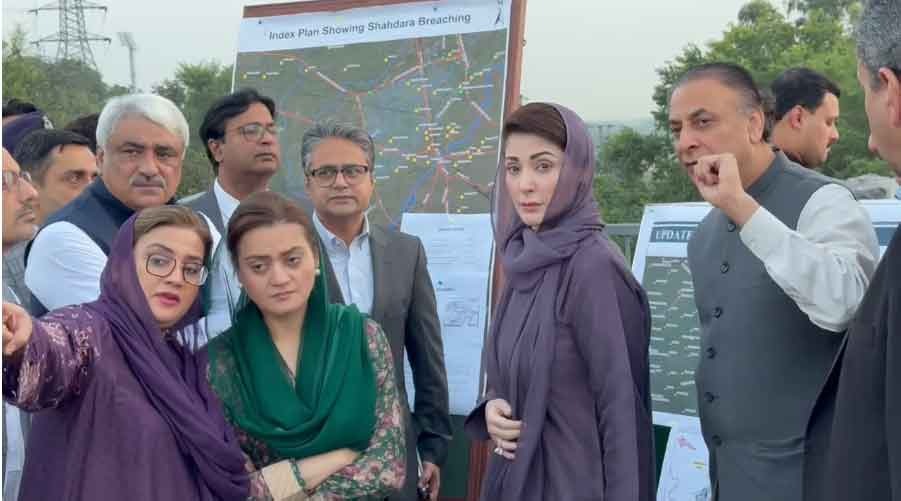
The Chief Minister personally visited Shahdara on Wednesday to review the flood situation along the Ravi River. She monitored water levels at the Shahdara Ravi Bridge, inspected protective embankments, and reviewed emergency safety measures. Maryam Nawaz instructed the administration to speed up evacuation of both citizens and livestock from danger zones. The Deputy Commissioner Lahore briefed her in detail about the evolving situation and possible water flows in the river.
Relief efforts have been rolled out across several districts, with a focus on Sambrial, Sialkot, Pasrur, Kasur, Nankana Sahib, Chiniot, and Wazirabad, among others. Even pets and livestock in rural areas have been shifted to safer places through rescue boats. Emergency medical camps have been set up in flood-hit regions, while adjoining hospitals remain on high alert.
The Chenab River floods have caused severe damage in 333 villages, affecting over 150,000 people. The hardest-hit areas include 133 villages in Sialkot, 16 in Wazirabad, 20 in Gujrat, 12 in Mandi Bahauddin, 100 in Chiniot, and 52 in Jhang. To support victims, 78 relief camps and 28 medical camps have been established.
Flooding along the Ravi River has affected 70,358 residents of 101 villages, including parts of Narowal, Nankana Sahib, Kasur, and Sahiwal. Relief authorities have set up 81 camps and 28 medical facilities to support affected families.
The most extensive damage has been reported along the Sutlej River, where 380,768 citizens in 335 villages have been displaced. A total of 104 relief camps and 105 medical camps are operational in flood-hit areas of Kasur, Okara, Pakpattan, Multan, Vehari, Bahawalnagar, and Bahawalpur.
Chief Minister Maryam Nawaz expressed her appreciation for the tireless efforts of government officials, rescue workers, police, and the Pakistan Army in leading the massive operation. She emphasized that her government’s top priority was to ensure the safety, rehabilitation, and eventual resettlement of every affected family.
“A complete rehabilitation of every family badly affected by the floods in Punjab is my foremost mission. The Punjab government will provide full support and assistance to the homeless flood affectees until their complete settlement in their homes,” she vowed.
She further highlighted that the rescue and relief measures being taken in Punjab mark a historic first, with unprecedented coordination among civilian and military institutions. The Chief Minister also underscored that the government’s efforts reflect its determination not only to protect human lives but also to preserve the province’s cultural and social fabric by supporting families in their most difficult hour.
The Chinese Council General’s Deputy delegation also acknowledged Punjab’s commitment to protecting lives and providing timely relief to its citizens. Officials note that the Chief Secretary Punjab Zahid Zaman is personally monitoring operations in the field to ensure transparency and effectiveness.
As Punjab battles one of its most serious flood emergencies in recent history, the provincial government has pledged that no affected family will be left behind in its quest for relief, recovery, and eventual rehabilitation.
About the Author